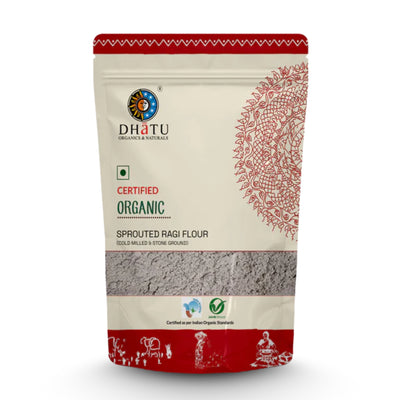
Ragi (Eleusine coracana), also called finger millet or Nachni, is one of the most nutritionally complete ancient grains cultivated in India for around 4,000 years. Walk into any Indian health food store today and you will find at least five different Ragi products — and the labels can be bewildering. Is sprouted better than popped? Does roasting change the nutrition? Is a porridge mix the same as a malt? And what exactly is Nachani Satva?
This guide settles every question with science, side-by-side comparisons, and practical guidance on which form suits your kitchen and goals best.
Table of Contents
- Quick Visual: How Each Form is Made (Interactive Animation)
- Sprouted Ragi Flour — The Nutritional Powerhouse & Traditional Infant Food
- Sprouted Ragi Malt — The Enzyme-Rich Drink Base
- Popped Ragi Flour (Huri Hittu) — The Instant Superfood
- Roasted Sprouted Ragi Porridge Mix — The Warming Single-Ingredient Blend
- Side-by-Side Comparison Table
- Which Should You Choose?
- Scientific References
Quick Visual: How Each Form is Made
Press Play to see the 5-step animated journey through each Ragi product form.
1. Sprouted Ragi Flour — The Nutritional Powerhouse & Traditional South Indian Infant Food
Sprouted Ragi Flour is made from whole ragi grains that are germinated before milling. Sprouting activates phytase enzymes that break down phytic acid, improving mineral bioavailability significantly.
- Full nutrition: fibre, protein, fat, and all micronutrients retained
- Calcium ~344 mg/100g — among the highest of any grain
- Glycaemic Index ~65–68 (medium)
- No roasting — low-temperature dried to preserve heat-sensitive vitamins and enzymes
- Requires cooking (5–10 min): use for rotis, dosas, cookies, ladoos, porridge
- Traditional South Indian first food for babies: Thin ragi porridge (ragi ganji / ragi ambli) made from sprouted ragi flour has been fed to infants for generations across Karnataka, Tamil Nadu, and Andhra Pradesh. Its exceptional calcium content supports bone development during the critical growth phase
- Best for: infants (as thin porridge), growing children, pregnant and lactating women, general family cooking
2. Sprouted Ragi Malt — The Enzyme-Rich Drink Base
Ragi Malt follows the same sprouting process but the sprouted grain is gently toasted at low temperature (55–70°C) before grinding. Low-heat toasting partially gelatinises starch without destroying amylase enzymes, so the malt disperses instantly in warm water and the enzymes help pre-digest starch in the gut.
- Same nutrient base as sprouted flour but with enhanced enzyme activity
- Glycaemic Index ~60–64 (lower than plain flour due to amylase action)
- No separate cooking required — mixes instantly in warm liquid
- Roasting level: low (55–70°C) — gentle enough to preserve amylase enzymes
- Best for: morning drinks, older children as a warm drink, adults seeking a drinkable meal
3. Popped Ragi Flour (Huri Hittu) — The Instant Superfood
Huri = popped, hittu = flour (Kannada). Raw ragi is dry-roasted at high heat causing internal moisture to superheat and expand the grain. The result is fully pre-cooked starch — no further cooking required.
- 100% pre-cooked; mix with cold milk, curd, or water — ready in 30 seconds
- Calcium ~310–330 mg/100g; Fibre ~3.3 g/100g
- Higher GI ~72–76 (starch fully accessible post-popping)
- Roasting level: very high (180–220°C) — high-heat pop destroys heat-sensitive vitamins but fully gelatinises starch for instant use
- Some heat-sensitive vitamins reduced vs. sprouted versions
- Best for: athletes, travellers, hikers, quick snacks, elderly with low appetite
4. Roasted Sprouted Ragi Porridge Mix — The Warming Single-Ingredient Base
Dhatu’s Ragi Sprouted Porridge Mix is a single-ingredient product: roasted sprouted ragi flour, and nothing else. The sprouted grain is gently roasted before stone-grinding, which develops a warm, nutty flavour that plain sprouted flour does not have, and makes the flour dissolve more smoothly in hot water or milk without lumping. No added oats, millets, sugar, or spices — just pure roasted sprouted ragi.
How to prepare: Stir 3–4 tbsp of the flour into a cup of water or milk, heat on medium flame while stirring continuously for 5–7 minutes until thick. Sweeten and flavour as you like.
Suggested additions (all your choice — the base needs nothing):
- A spoon of jaggery or honey for natural sweetness
- Chopped cashews, almonds, or walnuts for protein and crunch
- Chopped dates, raisins, or figs for iron and natural sugar
- A pinch of cardamom or dry ginger for warmth
- A banana mashed in for potassium and creaminess
- A spoon of ghee for healthy fats and fat-soluble vitamin absorption
- ~168 kcal per 40g serving (before additions); Calcium ~320 mg/100g; Fibre ~3.5 g/100g
- Glycaemic Index ~58–65 (roasting + sprouting combination keeps GI moderate)
- Roasting level: gentle — higher than malt toast but lower than popping; flavour-developing, not starch-destroying
- Best for: busy mornings, children’s breakfast, elderly nutrition, post-illness recovery
Side-by-Side Comparison Table
| Parameter | Sprouted Flour | Sprouted Malt | Popped (Huri Hittu) | Roasted Sprouted Porridge Mix |
|---|---|---|---|---|
| Process | Soak → Sprout → Low-temp dry → Grind | Soak → Sprout → Low-toast → Grind | Dry-Pop at high heat → Grind | Soak → Sprout → Gentle Roast → Grind |
| Roasting step? | No roasting | Low-heat toast (55–70°C) | High-heat pop (180–220°C) | Gentle roast (between malt and pop) |
| Cooking needed | Yes (5–10 min) | No (instant) | No (instant) | Yes (5–7 min stir) |
| Calcium (mg/100g) | ~344 | ~330 | ~310 | ~320 |
| Fibre (g/100g) | ~3.6 | ~3.5 | ~3.3 | ~3.5 |
| Protein (g/100g) | ~7.5 | ~7.3 | ~7.2 | ~7.3 |
| Glycaemic Index (indicative) | ~65–68 | ~60–64 | ~72–76 | ~58–65 |
| Phytic acid | Low (sprouted) | Low (sprouted) | Moderate | Low (sprouted) |
| Flavour | Earthy, mild | Warm malt / caramel | Crispy, nutty | Warm, toasty, smooth |
| Multi-ingredient? | Single ingredient | Single ingredient | Single ingredient | Single ingredient (add-ins your choice) |
| Best use | Rotis, dosas, baking, infant porridge | Drinks, malt milk | Instant drink, trail mix | Morning porridge + your choice of add-ins |
| Ideal for | Infants (thin porridge), family cooking | Drink lovers, older children | Athletes, travellers | Busy adults, children |
GI figures are indicative estimates by processing method, not lab-tested values for these products. A 2021 meta-analysis of 65 studies classed finger millet overall as intermediate GI (55–69), lower than milled rice and refined wheat [4].
Which Should You Choose?
Everyday Cooking
Sprouted Ragi FlourMost versatile — replaces any ragi flour with better nutrition. Makes rotis, dosas, cookies, ladoos, or thin infant porridge. The original South Indian baby food.
Morning Drink
Ragi MaltStir 2–3 tbsp into warm milk, add jaggery and cardamom. Enzyme-rich and deeply nourishing in 60 seconds. No cooking needed.
Instant Energy
Huri HittuZero cooking, maximum convenience. Mix with cold milk or water for an instant meal anywhere, anytime. Athletes’ and travellers’ choice.
Warming Porridge
Roasted Sprouted Porridge MixPure roasted sprouted ragi flour — just add hot water or milk and stir 5–7 minutes. Add jaggery, dry fruits, nuts, or banana to make it your own.
Explore Dhatu Ragi Products
- Sprouted ragi flour (nachni satva) — 500g to 5kg packs, for porridge, mudde, rotti and dosa
- Organic Ragi Flour 500g — stone-milled whole grain
- Popped Ragi Flour (Huri Hittu) 300g — fully pre-cooked instant flour
- Ragi Sprouted Porridge Mix 250g — roasted sprouted ragi, pure and simple
- Organic Ragi Whole 500g — for home-milling and malting
- Ragi Laddu 150g — traditional sweet, no refined sugar
- All Ragi Products at Dhatu Organics →
Scientific References
- Hemalatha S, Platel K, Srinivasan K (2007). Influence of germination and fermentation on bioaccessibility of zinc and iron from food grains. Eur J Clin Nutr 61(3):342–348. PubMed 16969377
- Mbithi-Mwikya S, Van Camp J, Yiru Y, Huyghebaert A (2000). Nutrient and antinutrient changes in finger millet (Eleusine coracana) during sprouting. LWT – Food Science and Technology 33(1):9–14. doi:10.1006/fstl.1999.0605
- Nirmala M, Subba Rao MVSST, Muralikrishna G (2000). Carbohydrates and their degrading enzymes from native and malted finger millet (Ragi, Eleusine coracana, Indaf-15). Food Chemistry 69(2):175–180. doi:10.1016/S0308-8146(99)00250-2
- Anitha S, Kane-Potaka J, Tsusaka TW, et al. (2021). A systematic review and meta-analysis of the potential of millets for managing and reducing the risk of developing diabetes mellitus. Front Nutr 8:687428. PubMed 34395493
- Kumar A, Metwal M, Kaur S, et al. (2016). Nutraceutical value of finger millet [Eleusine coracana (L.) Gaertn.], and their improvement using omics approaches. Front Plant Sci 7:934. doi:10.3389/fpls.2016.00934
- Ragaee S, et al. (2006). Antioxidant activity and nutrient composition of selected cereals for food use. Food Chemistry 98(1):32–38. doi:10.1016/j.foodchem.2005.04.039