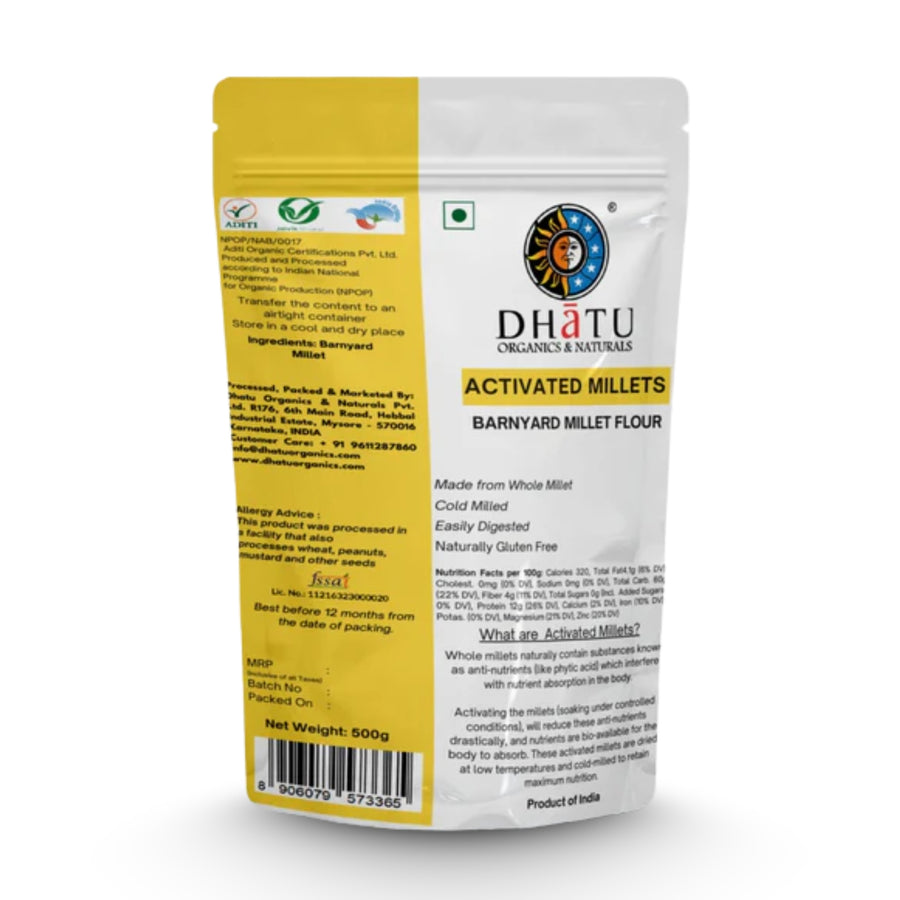
15.2mg iron per 100g. Barnyard millet (sanwa / oodalu) is naturally rich in iron, and we soak ("activate") it before milling, a traditional step that reduces phytic acid.
What is Activated Barnyard Millet Flour?
Known as Sanwa (Hindi), Oodalu (Kannada), Kuthiraivali (Tamil/Malayalam), and Jhangora (Uttarakhand), barnyard millet (Echinochloa frumentacea) is one of India's most nutritionally impressive grains — and one of its most underutilised. It is particularly well-known as the traditional grain for Hindu fasting days (Navratri, Ekadashi, Chaturthi) because it is not a grass-family cereal and is permitted in most vrat (fasting) traditions.
"Activated" means the grain has been soaked overnight before milling. This activates phytase, an enzyme that breaks down phytic acid — the antinutrient that binds to iron and prevents its absorption. Without activation, much of barnyard millet's exceptional iron content is unavailable to the body. With activation, iron bioavailability improves by 30–50%.
Key Benefits — Validated by Data
-
15.2mg iron per 100g — one of the highest plant-based iron contents of any food. Compare: palak (spinach) has 2.7mg, rajma has 3mg, whole wheat has 3.5mg. Barnyard millet provides nearly 90% of adult daily iron (RDA: 17mg) per 100g. (Source: ICMR-NIN Nutritive Value of Indian Foods, 2017)
-
Activation improves iron absorption by 30–50% — phytic acid in non-activated barnyard millet binds iron, blocking absorption. Overnight soaking activates phytase which breaks this down, releasing free ionic iron that the body can absorb. (Sandberg, 2002; Leder et al., 2004)
-
132mg magnesium per 100g — among the highest of any millet. Magnesium is involved in 300+ enzymatic reactions and is essential for energy production, muscle relaxation, and nerve signalling.
- 10.1g dietary fibre per 100g, which keeps you full for longer.
- Pair with vitamin C: eating iron-rich grains with lemon, tomato or amla helps your body absorb plant iron.
-
Permitted for Hindu fasting — Sanwa is one of the few grains permitted during Navratri, Ekadashi, and other vrat traditions, making this flour uniquely versatile for the Indian kitchen.
- Naturally gluten-free: barnyard millet contains no gluten.
Iron Content Comparison (per 100g)
| Food Source |
Iron (mg) |
% Adult Daily RDA (17mg) |
Notes |
| Dhatu Activated Barnyard Millet Flour |
15.2mg |
~89% |
Bioavailability improved by activation |
| Regular Barnyard Millet Flour |
15.2mg |
~89% |
Lower bioavailability (phytate intact) |
| Sprouted Bajra Flour |
8mg |
47% |
Highest iron millet after barnyard |
| Whole Wheat Flour |
3.5mg |
21% |
Common daily grain |
| Palak (Spinach), raw |
2.7mg |
16% |
Commonly cited iron source |
| Rajma (Kidney Beans) |
3mg |
18% |
Per 100g cooked |
| White Rice |
0.3mg |
2% |
Very low iron |
Sources: ICMR-NIN Nutritive Value of Indian Foods (2017); USDA FoodData Central. RDA based on FSSAI 2000 kcal reference diet (17mg iron for adults).
How to Use
-
Vrat / fasting recipes — use in sanwa khichdi, upma, halwa, and thalipeeth during Navratri and other fasts
-
Rotis and phulkas — mix with a small amount of amaranth flour for softer texture; cook like wheat roti
-
Dosas and cheelas — blend with rice flour (60:40) for crispy, iron-rich dosas
-
Porridge — cook with water or milk for a high-iron, gut-friendly breakfast
-
Khichdi — cook with moong dal for a complete protein + iron meal in one pot
-
Laddoos — roast lightly with ghee, mix with jaggery, nuts, and cardamom
Why the Iron Content Matters More with Activation
Raw, non-activated barnyard millet contains phytic acid — a phosphate compound that forms insoluble complexes with iron, zinc, and calcium. In this bound form, minerals pass through the digestive tract without being absorbed. In a 2002 review in Food Chemistry, Sandberg demonstrated that phytate reduction through soaking or germination can improve iron absorption by up to 3-fold in cereal-based foods. By activating barnyard millet before milling, Dhatu ensures that its exceptional 15.2mg of iron per 100g is actually accessible to your body.