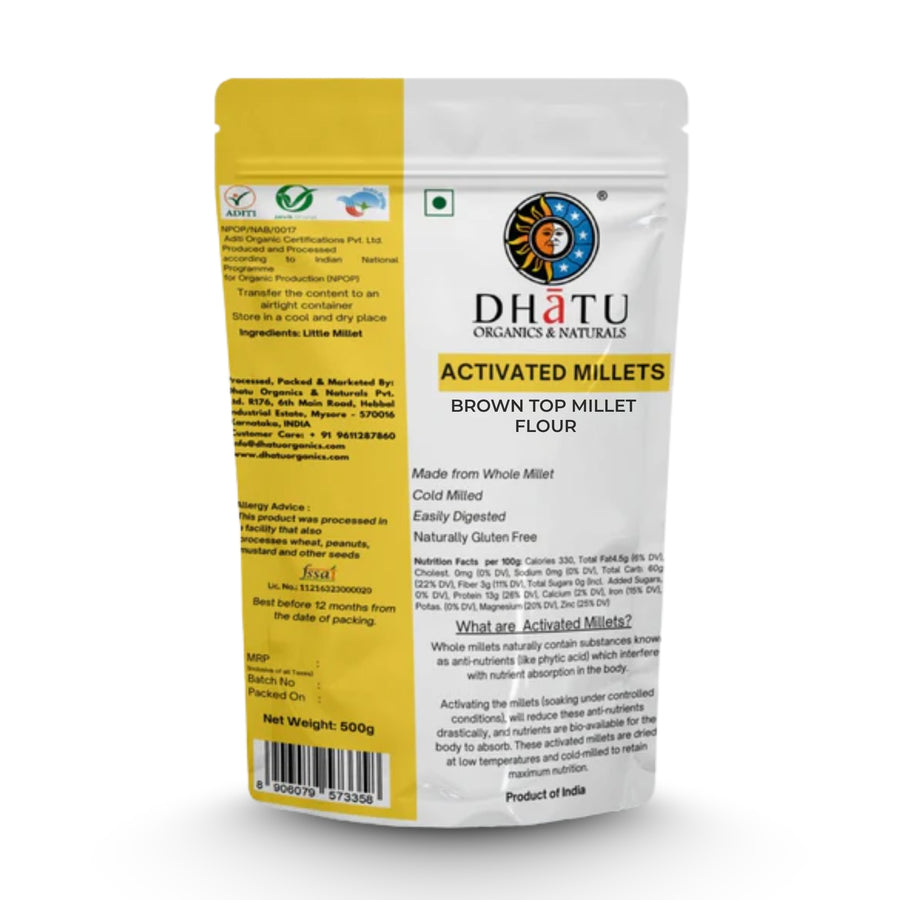
12.5g dietary fibre per 100g — the highest fibre content of any Indian millet. Brown top millet (Andu Korralu/Korale) is also one of the rarest commercially available millets in India.
What is Activated Brown Top Millet Flour?
Known as Andu Korralu (Telugu), Korale (Kannada), and Korle in some regions, brown top millet (Brachiaria ramosa, reclassified as Urochloa ramosa) is a forgotten ancient grain that is beginning to attract scientific attention for its exceptional nutritional properties. It is rarely found in mainstream markets — Dhatu is among a small number of Indian producers offering it in flour form.
Like all Dhatu activated flours, the grain is soaked overnight before milling. This bioactivation process breaks down phytic acid, activates beneficial enzymes, and improves the digestibility and mineral bioavailability of the grain. The activated millet is then sun-dried and stone cold-milled into a fine flour.
Key Benefits — Validated by Data
-
12.5g dietary fibre per 100g — the highest fibre content of all Indian millets. Compare: whole wheat has 2.7g, barnyard millet 10.1g, foxtail 8g. Brown top millet provides 50% of the daily fibre requirement (25g RDA) in 100g alone. (Source: ICMR-NIN; Dayakar Rao et al., 2017)
- Rich in fibre: about 12.5g of dietary fibre per 100g.
-
11.5g protein per 100g — comparable to whole wheat, with a better amino acid profile for a cereal grain.
-
Certified organic and rare — brown top millet is not widely cultivated commercially. Dhatu sources directly from certified organic small farmers to preserve this heritage crop.
-
Gluten-free — naturally gluten-free. If you have coeliac disease, please contact us about how it is packed before ordering.
Fibre Content Comparison (per 100g)
| Food |
Dietary Fibre |
% Daily RDA (25g) |
Category |
| Dhatu Activated Brown Top Millet |
12.5g |
50% |
Highest-fibre millet |
| Barnyard Millet |
10.1g |
40% |
High fibre millet |
| Ragi (Finger Millet) |
11g |
44% |
High fibre millet |
| Foxtail Millet |
8g |
32% |
Good fibre |
| Bajra (Pearl Millet) |
8g |
32% |
Good fibre |
| Whole Wheat Flour |
2.7g |
11% |
Low fibre |
| White Rice Flour |
0.4g |
2% |
Very low fibre |
| Oats |
10.6g |
42% |
High fibre (imported) |
Sources: ICMR-NIN Nutritive Value of Indian Foods (2017); Dayakar Rao et al. (2017) Nutritional and Health Benefits of Millets. USDA FoodData Central.
How to Use
-
Rotis and bhakri — use alone or blended 50:50 with wheat flour; has a slightly earthy, nutty flavour and denser texture
-
Dosas and uttapams — blend with rice flour (60:40) for crispy dosas with maximum fibre
-
Porridge — cook with water or milk for a thick, high-fibre breakfast that keeps you full all morning
-
Energy bars and laddoos — roast lightly, combine with jaggery, dried fruit, and seeds
-
Muffins and cookies — replace 30–50% of wheat flour with brown top millet flour in baking
-
Soups and stews — use as a thickener; adds fibre without changing the flavour significantly
-
Multigrain flour blend — combine with ragi, jowar, and little millet for a wholesome everyday flour
Why Brown Top Millet is Rare — and Why That Matters
Brown top millet (Brachiaria ramosa) is not a commercially dominant crop. Unlike bajra, jowar, and ragi — which have received significant government and industry support — brown top millet has remained largely unknown outside specific tribal and agrarian communities in Andhra Pradesh and Karnataka. This is actually a nutritional advantage: the grain has not been hybridised or commercially optimised and retains its original nutritional integrity. Dhatu sources this grain directly from traditional farmers, supporting the preservation of agrobiodiversity while making this exceptional food accessible.