

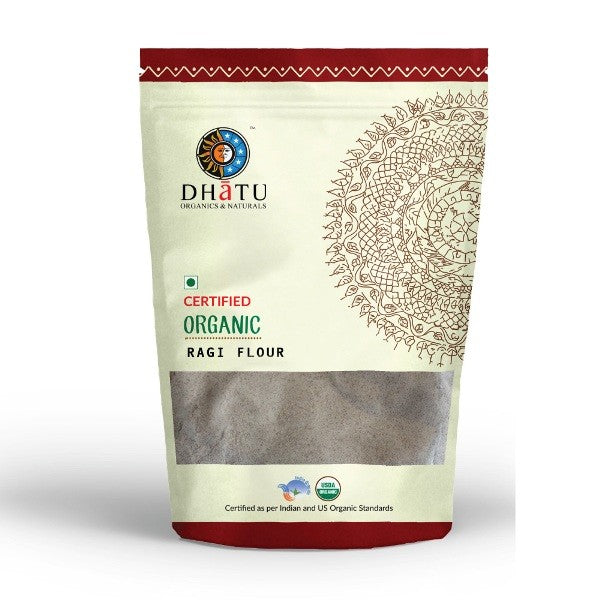
Organic Ragi Flour 500g
₹ 90.00
Finger millet (ragi) delivers more calcium per 100g than milk — 364mg versus cow's milk's 113mg — making it one of the most important plant-based calcium sources for vegetarian... Read more ↓
100% Organic
No Additives
Free Delivery ₹749+
100% Organic Finger Millet (Ragi / Nachni / Kezhvaragu). Vegan. Naturally gluten-free. No preservatives, no additives, no artificial flavours or colours.
Nutrition FactsServing: 30g (3 tbsp)
| Nutrient | Per serving | Per 100g | % RDA* |
|---|---|---|---|
| Energy | 101 kcal | 336 kcal | 5.1% |
| Protein | 2.2g | 7.3g | 4.4% |
| Carbohydrates | 21.6g | 72g | 6.6% |
| Of which Sugars | 0.4g | 1.2g | <1% |
| Total Fat | 0.6g | 1.9g | <1% |
| Of which Saturated Fat | <0.1g | 0.3g | <1% |
| Dietary Fibre | 3.5g | 11.5g | 13.8% |
| Sodium | 3mg | 11mg | <1% |
| Calcium | 109mg | 364mg | 10.9% |
| Iron | 1.2mg | 3.9mg | 7.1% |
| Magnesium | 41mg | 137mg | 12.1% |
* % RDA based on a 2000 kcal reference diet (FSSAI). Values are approximate and may vary by batch.
We deliver across India within 3–5 business days via trusted logistics partners.
- Free delivery on orders above ₹749.
- Orders dispatched within 1 business day of payment confirmation.
- Perishable goods cannot be returned once dispatched. Non-perishable items may be returned within 7 days in original, unopened condition.
- For damaged or incorrect items, contact info@dhatuorganics.com within 48 hours of delivery.
Choose Your Pack
Finger millet (ragi) delivers more calcium per 100g than milk — 364mg versus cow's milk's 113mg — making it one of the most important plant-based calcium sources for vegetarians, vegans and lactose-intolerant individuals. Our stone cold-milled organic ragi flour preserves every milligram.
What is Ragi Flour?
Ragi (Eleusine coracana), also called finger millet, nachni (Maharashtra), kezhvaragu (Tamil Nadu) and mandua (North India), is an ancient cereal cultivated in India for over 5,000 years. It is the only cereal grain with calcium content comparable to dairy, making it uniquely valuable in plant-based diets. Our ragi flour is stone cold-milled from certified organic finger millet, retaining the bran, germ and all naturally present minerals in the whole grain.
Key Nutritional Benefits
- Exceptional calcium — 364mg per 100g (10.9% RDA per 30g serving), naturally present in the grain's seed coat and germ
- High dietary fibre: 11.5g per 100g, which keeps you full for longer
- Iron and magnesium — 3.9mg Fe and 137mg Mg per 100g support haemoglobin and bone mineralisation
- Naturally gluten-free: ragi contains no gluten
- Complete milling — stone cold-milled at low temperature to preserve heat-sensitive vitamins and natural oils
Ragi vs Common Calcium Sources (per 100g)
| Source | Calcium (mg) | Key Note |
|---|---|---|
| Dhatu Organic Ragi Flour | 364 | Plant-based, whole grain |
| Cow's Milk (whole) | 113 | Animal-based |
| Paneer | 208 | Animal-based, high fat |
| Whole Wheat Atta | 53 | Low calcium grain |
| Jowar Flour | 25 | Low calcium grain |
Source: ICMR-NIN Nutritive Value of Indian Foods, 2017. Ragi calcium: 364mg/100g (Table 1, p.14).
How to Use Ragi Flour
- Ragi roti — Knead with hot water; use warm tawa for best results
- Ragi dosa — Fermented batter with urad dal; lacy, crisp texture
- Ragi porridge (ambali) — Traditional breakfast; mix with warm water, jaggery and milk
- Ragi mudde — Steamed balls eaten with sambar or meat curry in Karnataka
- Ragi ladoo — Roasted ragi flour with jaggery and ghee; festive sweet
- Ragi baking — Replace 30–50% wheat flour in muffins, cookies and banana bread
Frequently Asked Questions
Finger millet (ragi) has about 364mg calcium per 100g (ICMR-NIN 2017), far more than rice or wheat. The calcium sits in the outer seed coat and germ, which are kept in our stone cold-milled whole ragi flour.
Yes. Finger millet is a naturally gluten-free grain, and our ragi flour contains only ragi. If you have coeliac disease, please contact us about how it is packed before ordering.
For ragi rotis, use warm water to bind the dough (ragi lacks gluten, so warm water helps). Mix 1 cup ragi flour with hot water gradually until a soft, pliable dough forms. You can add 10–20% whole wheat flour if you prefer a softer roti. Cook on a medium-high tawa for 1–2 minutes per side.
Ragi is a whole grain with plenty of fibre, but it is still a carbohydrate food. Please ask your doctor or dietitian how it fits into your meal plan.
Yes. Our stone-ground ragi flour works for traditional preparations including ragi mudde (steamed balls), ragi ambali (porridge), ragi dosa and ragi ladoo. The fine grind and whole-grain character give the authentic taste and texture of traditional stone-milled ragi.