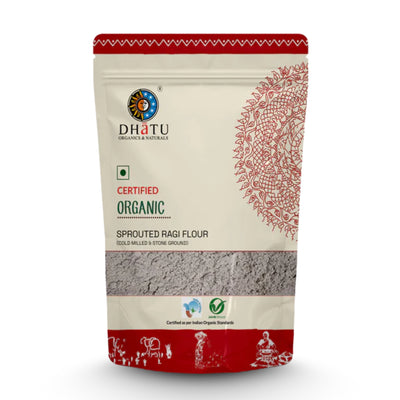
Benefits of sprouted ragi flour go far beyond basic nutrition. Finger millet, known locally as ragi, is a traditional Indian crop ranked sixth among major grains. It is highly nutritious, easy to digest, and suitable for those with gluten intolerance, including celiac disease. In southern India, sprouted ragi flour is widely used as a weaning food for infants, thanks to its digestibility and health-promoting properties.
The grain is unique because it has a multilayered seed coat, which contributes to its high dietary fiber and phenolic content. Ragi contains antioxidants and is rich in protein, iron, calcium, phosphorus, and vitamins. It is traditionally used in porridge, mixed with other cereals, and in beer substitutes. It is considered a good food for children, pregnant women, the elderly, and patients. Nutrition of Ragi / Finger Millet Ragi possesses an equivalent measure of protein akin to rice (approximately 6-8%) and an approximately equivalent measure of fat (about 1-2%), yet it boasts a heightened concentration of minerals and micronutrients surpassing those found in rice and wheat. In terms of its nutritional worth, it exhibits an elevated concentration of calcium (344 mg per 100 g), dietary fiber (15-20%), and phenolic compounds (0.3-3%). These indispensable amino acids, including isoleucine, leucine, methionine, and phenyl alanine, are scarcely present in starchy sustenance1. Much of the research interest in finger millet focuses on its dietary fibre and polyphenols.Polyphenols in Finger Millet2
Finger millet polyphenols show antioxidant and antimicrobial activity in laboratory studies, and researchers are studying how they behave during digestion. Most of this research is at an early, laboratory or animal stage. Finger millet polyphenols have been found to increase antioxidant activity in the colon, which is attributed to the role of gut microbiota . Overall, finger millet is a nutritious whole grain, and its polyphenols are an active area of food-science research.Benefits of Sprouted Ragi Flour
The benefits of Sprouting ragi are numerous in terms of nutrition and ease of cooking. During the sprouting process, enzyme activity increases, leading to enhanced nutrient availability and improved digestibility. Sprouting breaks down anti-nutrients like tannin present in the ragi, unlocking minerals and making them more absorbable. Additionally, the levels of certain vitamins, such as B vitamins and antioxidants, increase. Sprouted ragi is also easier to digest, reducing the likelihood of digestive discomfort and thus increasing the bioavailability of the nutrition for the body to absorb. Additionally, Germination of finger millet enhances its functional properties, such as water absorption capacity, solubility, and oil absorption capacity. Germination also improves the sensory aspects of finger millet porridge, making it suitable for infants, pregnant mothers, and breastfeeding mothers. Sprouting of finger millet grains reduces the tannin content and increases the phytase activity and antioxidant activity. Sprouting also improves the digestibility of nutrients and enhances the physico-functional properties of millet flours, such as water absorption capacity, water solubility index, paste clarity, and foam capacity. A study 3 on millet sprouting found the following: Soaking and germination processes improved the nutritional quality of millets by reducing anti-nutritional factors and increasing antioxidant activity. Sprouting was particularly effective, with 24h soaking and 24h germination being the best treatment for enhancing millet nutrition. Tannin content decreased significantly after germination, especially in finger millet. Overall, sprouted ragi flour is a nutritious and beneficial food option with improved functional properties and enhanced bioavailability of nutrients.How to use Sprouted Ragi Flour?
Baking
Use sprouted ragi flour as a healthier alternative in baking. Incorporate it into recipes for bread, muffins, pancakes, or cookies to add a nutrient boost and a unique flavor.Smoothies and Shakes
Blend sprouted ragi flour into your smoothies or shakes for a nutritious kick. It adds a mild, nutty flavor and provides essential nutrients, including fiber, protein, and minerals.Porridge and Cereal
Prepare a wholesome breakfast by using sprouted ragi flour to make porridge or cereal. Cook it with milk or plant-based alternatives and sweeten with fruits or natural sweeteners for a nutritious start to your day. Want a beginner-friendly size? Check out our Sprouted Ragi Flour 500 g pack here.Rotis and Flatbreads
Mix sprouted ragi flour with other flours like wheat or chickpea (besan, about 21.6 g protein per 100 g) to create a nutritious dough for rotis or flatbreads. This adds a distinctive taste and boosts the nutritional content of your staple foods.Healthy Snacks
Create healthy snacks by incorporating sprouted ragi flour into recipes for crackers, energy bars, or homemade granola. These snacks can be convenient, portable, and provide a sustained energy release. Ishwar, Patel., Komal, Patel., Suneeta, Pinto., Sunil, M., Patel. Ragi: A Powerhouse of Nutrients. Journal of Dairy Science and Technology, (2018). doi: 10.37591/RRJODST.V5I3.461 ↩︎ Pranita, P., Patil., Surya, Pratap, Singh., Pankti, S, Patel. Functional properties and health benefits of finger millet (Eleusine coracana L.): A review. The journal of phytopharmacology, (2023). doi: 10.31254/phyto.2023.12308 ↩︎ G., Bhuvaneshwari., A., Nirmalakumari., S., Kalaiselvi. Impact of soaking, sprouting on antioxidant and anti-nutritional factors in millet grains. The Journal of Phytology, (2020).62-66. doi: 10.25081/JP.2020.V12.6384 ↩︎From the Dhatu pantry
- Organic sprouted ragi flour – our most-loved flour
- Ragi sprouted porridge mix – for little ones and breakfast
- The complete ragi range – malt, huri hittu and more
- Sprouted ragi flour vs ragi flour vs malt – which form to use when
- Sprouted flour vs regular flour – what sprouting changes in ragi, wheat and jowar