- Whole grains contain antinutrients — primarily phytic acid — that bind iron, zinc, calcium and magnesium, significantly reducing how much your body absorbs.
- Sprouting triggers the grain's own phytase enzyme, which degrades phytic acid by 20–90% depending on the grain and duration, releasing those minerals into bioavailable form.
- Sprouting also increases GABA (gamma-aminobutyric acid) levels, improves protein digestibility, lowers glycemic index, and reduces enzyme inhibitors — making activated grains functionally superior to their dormant counterparts.
For most of the 20th century, nutrition advice about grains went like this: whole is better than refined, brown is better than white, more fibre is more virtuous. That framing wasn't wrong — but it was dangerously incomplete. A quietly building body of research over the past three decades has revealed a more complicated picture: the very properties that make whole grains nutritionally rich also make them structurally resistant to absorption. And the resolution, it turns out, has been sitting in traditional kitchens for four thousand years.
It is called sprouting, or activation. And science is finally catching up to what your grandmother already knew.
The Antinutrient Problem: What's Really Inside a Whole Grain
Pick up any unsprouted whole grain — buckwheat, ragi, foxtail millet, emmer wheat — and you are holding a dormant seed that has evolved, over millions of years, to protect its genetic payload at all costs. Seeds are not neutral food parcels. They are survival machines. And their primary defence mechanism against being digested before they can germinate is a class of compounds collectively called antinutrients.
The principal offenders, in the context of grains and legumes, are:
- Phytic acid (phytate) — the dominant antinutrient in grains. It binds iron, zinc, calcium, magnesium and manganese in insoluble complexes in the digestive tract. You eat the mineral; your body never sees it.
- Enzyme inhibitors — particularly trypsin inhibitors, which suppress the proteases your gut uses to digest protein.
- Tannins — polyphenolic compounds that bind proteins and digestive enzymes and reduce protein digestibility.
- Oxalates — bind calcium and to a lesser extent iron, forming insoluble crystals that pass through the gut unabsorbed.
Of these, phytic acid deserves the closest attention, because it operates at a scale that many nutrition professionals have been slow to acknowledge. In a landmark 2009 review in Molecular Nutrition and Food Research, Schlemmer and colleagues quantified the chelating power of phytic acid across food systems, concluding that in populations relying heavily on cereals and legumes as staples — which is most of the world — phytic acid is a primary driver of micronutrient deficiency, even in diets technically rich in minerals on paper [1].
This is not a fringe finding. The World Health Organization has classified iron deficiency as the world's most prevalent nutritional disorder. Zinc deficiency affects an estimated two billion people globally. A significant fraction of both is attributable not to inadequate mineral intake, but to inadequate mineral absorption — driven by phytic acid in grain-heavy diets [2].
Phytic Acid: How It Works and Why It Matters
Phytic acid (inositol hexakisphosphate, or IP6) is the seed's way of storing phosphorus for use during germination. In its bound form, it carries a strong negative charge — a chemical property that makes it powerfully attracted to the positively charged mineral ions in your digestive tract.
The chemistry is straightforward: phytic acid grabs onto iron, zinc, calcium, and magnesium in your gut and forms phytate-mineral complexes that are too large and insoluble to pass through the intestinal wall. They exit your body unabsorbed. You have eaten the mineral. You have not benefited from it.
The percentage reduction in mineral absorption from phytic acid is not trivial. A comprehensive review in the American Journal of Clinical Nutrition found that the presence of phytic acid in a meal reduces iron absorption by up to 82% and zinc absorption by 47–78%, depending on the phytic acid load [3]. These are not marginal effects. For vegetarians, vegans, and populations in South Asia where grains are dietary staples, these numbers have profound implications.
How Sprouting Breaks the Lock: The Biochemistry
Now for the elegant part. Seeds contain the solution to their own antinutrient problem. The enzyme phytase — present in dormant form inside every grain — is specifically designed to degrade phytic acid during germination. When a seed encounters moisture and warmth, it interprets this as a signal that conditions for growth are right. It activates phytase. Phytase begins dismantling phytic acid, releasing both phosphorus (for the seedling's use) and the previously bound minerals.
When we sprout grains before milling or eating, we are simply triggering this endogenous process. The grain does the work. We provide the water and time.
The measurable effect on phytic acid levels is significant. A 2015 study in the Journal of Food Science and Technology by Gupta and colleagues, examining sprouting effects across a range of Indian cereals and legumes, found phytic acid reductions ranging from 23% to 90% depending on grain type and sprouting duration, with simultaneous improvements in the in-vitro bioavailability of iron, zinc and calcium [4]. For ragi (finger millet), a staple grain in Karnataka and much of South India, sprouting reduced phytic acid by approximately 36% in 24 hours and up to 53% in 48 hours — with corresponding improvements in mineral extractability.
A separate study in Food Chemistry, focusing specifically on soaking and germination effects on zinc in brown rice, found that 24 hours of germination reduced phytate content by 27% and more than doubled the proportion of soluble zinc [5].
What happens to the phytate phosphorus? It is hydrolysed into inositol and free phosphate — both of which are metabolically useful and do not interfere with mineral absorption. The system is elegant: activation converts a mineral-binding lock into usable nutrients for both the seedling and the person who eats it.
Beyond Minerals: The Full Nutritional Upgrade
Phytic acid reduction is the headline story, but sprouting's nutritional benefits extend further.
Protein Digestibility
Enzyme inhibitors — particularly trypsin inhibitors — are degraded during sprouting. With trypsin inhibitors reduced, the protein in the grain becomes more accessible to digestive proteases. Research in Plant Foods for Human Nutrition found that sprouting increased protein digestibility in millet and legumes by 8–20% across multiple grain varieties [6]. In a food system where protein quality is often as important as quantity, this matters.
GABA Elevation
Germination significantly increases gamma-aminobutyric acid (GABA), the primary inhibitory neurotransmitter in the central nervous system. Sprouted brown rice has been studied for its elevated GABA content and associated effects on anxiety, blood pressure regulation, and sleep quality. The mechanism: sprouting activates glutamate decarboxylase, which converts glutamate into GABA. Levels can increase 4–10x compared to unsprouted grain, depending on germination conditions.
Glycemic Index
Sprouting partially breaks down starch through enzymatic action, modifying the grain's glycemic response. Multiple studies have found lower postprandial blood glucose rises from sprouted grain products compared to their non-sprouted equivalents — relevant for diabetics, pre-diabetics, and anyone managing metabolic health.
Vitamin C and B Vitamins
Germination triggers the synthesis of vitamin C (absent in dormant grains) and increases levels of B vitamins including thiamine, riboflavin, niacin, and folate. These are water-soluble vitamins that many grain-reliant populations fall short on.
The Cold-Milling Question: Preserving What Sprouting Creates
Here is where production method matters as much as the sprouting itself. Heat destroys phytase — the same enzyme that reduced phytic acid during sprouting. Conventional industrial milling generates significant heat through friction. If a grain is sprouted and then heat-milled, the nutritional gains of sprouting are partially or fully lost.
Cold-milling — grinding at low temperatures that keep the grain below the threshold at which heat-sensitive enzymes and nutrients degrade — is essential for preserving the work sprouting has done. This is not a marketing claim; it is food chemistry. The milling temperature determines how much of the sprouted grain's nutritional profile survives into the flour.
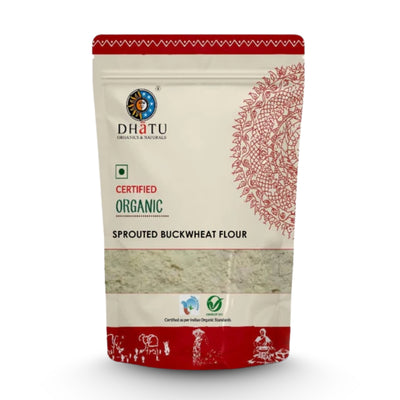
Dhatu's sprouted ragi flour and sprouted buckwheat flour are both sprouted-then-cold-milled — the sequence that the research supports. Their activated flaxseeds use a similar principle: soaking triggers phytase in the flax, reducing phytic acid before the seeds are consumed. These are not premium positioning decisions. They reflect the biochemistry.
Frequently Asked Questions
Does cooking after sprouting destroy the nutritional benefits?
Partially. Cooking reduces some of the heat-sensitive benefits (GABA, certain B vitamins, vitamin C) but the mineral bioavailability gains are largely preserved, because the phytic acid has already been physically degraded during sprouting — it cannot reform. The structural change to the phytate-mineral bond is largely irreversible once phytase has acted.Is soaking the same as sprouting?
Soaking initiates the activation process and provides meaningful phytic acid reduction (typically 10–30% in 8–12 hours), but sprouting — where the grain is allowed to germinate and a shoot emerges — achieves significantly greater phytase activity and phytic acid reduction, typically 40–70% or more depending on the grain and duration. Both help; sprouting does more.Which grains benefit most from sprouting?
All grains and legumes contain phytic acid, but the relative benefit of sprouting varies. Legumes (lentils, chickpeas, mung beans) typically show the largest absolute reductions. Among cereals, ragi (finger millet), buckwheat, and millet show strong phytase activity when sprouted. Wheat and oats also respond well. Rice responds less dramatically than other cereals.Are sprouted grain products suitable for everyone?
Yes, for the vast majority of people. Those with specific grain intolerances (such as coeliac disease with gluten-containing grains) are not helped by sprouting — the proteins responsible for intolerance are different from the antinutrients sprouting addresses. Sprouted versions of gluten-free grains (ragi, buckwheat, millet, amaranth) remain appropriate for most gluten-sensitive individuals, though celiacs should verify cross-contamination protocols.The next frontier in this space is personalised phytate management — understanding that individual phytase expression varies with gut microbiome composition. Emerging research suggests that certain gut bacteria (particularly Bifidobacterium) produce phytase of their own, meaning that a person with a diverse, fermentation-fed microbiome may absorb significantly more minerals from the same grain than someone on an antibiotic-depleted diet. The implication for Dhatu: a sprouted grain + lacto-fermented food combination product — such as a sprouted millet porridge base paired with fermented pickle — may achieve synergistic mineral bioavailability that neither product achieves alone. This is a product space no one in the Indian organic sector has explored explicitly. It should be the next conversation.
References
- Schlemmer U, Frølich W, Prieto RM, Grases F. Phytate in foods and significance for humans. Mol Nutr Food Res. 2009;53 Suppl 2:S330-75. PubMed 19774556
- Hambidge KM, Krebs NF. Zinc deficiency: a special challenge. J Nutr. 2007;137(4):1101-5. PubMed 17374687
- Hurrell R, Egli I. Iron bioavailability and dietary reference values. Am J Clin Nutr. 2010;91(5):1461S-1467S. PubMed 20200263
- Gupta RK, Gangoliya SS, Singh NK. Reduction of phytic acid and enhancement of bioavailable micronutrients in food grains. J Food Sci Technol. 2015;52(2):676-84. PubMed 26345228
- Liang J, Han BZ, Nout MJR, Hamer RJ. Effects of soaking, germination and fermentation on phytic acid, total and in vitro soluble zinc in brown rice. Food Chem. 2008;110(4):821-828. PubMed / ScienceDirect
- Vijayakumari K, Pugalenthi M, Vadivel V. Effect of soaking and hydrothermal processing methods on the levels of antinutrients and in vitro protein digestibility of Bauhinia purpurea L. seeds. Food Chem. 2007;103(3):968-975.