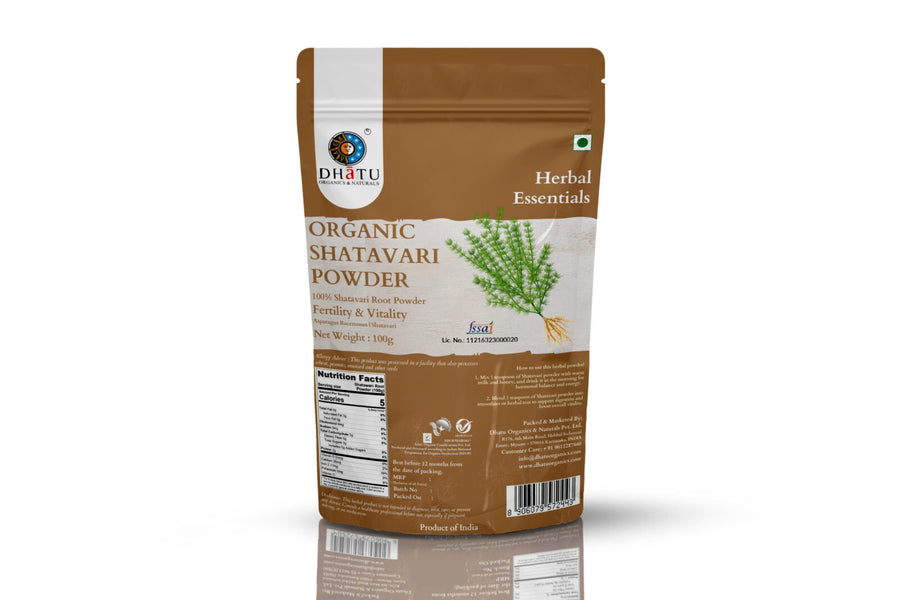
Organic Shatavari Powder 100g
Dhatu Organics Organic Shatavari Root Powder is made from the tuberous roots of Asparagus racemosus — revered as the “Queen of Herbs” in Ayurveda and the primary Rasayana (re... Read more ↓
Organic Shatavari Root Powder (Asparagus racemosus)
| Nutrient | Per serving | Per 100g | % RDA* |
|---|---|---|---|
| Energy | 10.7 kcal | 358 kcal | <1% |
| Protein | 0.08 g | 2.7 g | <1% |
| Carbohydrates | 2.4 g | 80.0 g | <1% |
| Dietary Fibre | 0.11 g | 3.6 g | <1% |
| Total Fat | 0.015 g | 0.5 g | <1% |
| Iron | 0.04 mg | 1.4 mg | <1% |
| Zinc | 0.04 mg | 1.2 mg | <1% |
| Saponins (Shatavarin I–IV) | 120–240 mg | 4–8 g |
* % RDA based on a 2000 kcal reference diet (FSSAI). Values are approximate and may vary by batch.
We deliver across India within 3–5 business days via trusted logistics partners.
- Free delivery on orders above ₹499.
- Orders dispatched within 1 business day of payment confirmation.
- Perishable goods cannot be returned once dispatched. Non-perishable items may be returned within 7 days in original, unopened condition.
- For damaged or incorrect items, contact info@dhatuorganics.com within 48 hours of delivery.
Dhatu Organics Organic Shatavari Root Powder is made from the tuberous roots of Asparagus racemosus — revered as the “Queen of Herbs” in Ayurveda and the primary Rasayana (rejuvenating tonic) for women’s health. Our Shatavari is organically grown in the Western Ghats, slow-dried to preserve its steroidal saponin content (shatavarins I–IV), and fine-milled into a smooth powder that dissolves easily in warm milk or water.
Ingredients
Organic Shatavari Root Powder (Asparagus racemosus)
100% root. No leaf or stem filler. No preservatives. Slow-dried to preserve saponins.
Nutrition Facts
Per 100g / Per 3g serving
| Nutrient | Per 100g | Per 3g |
|---|---|---|
| Energy | ~358 kcal | 10.7 kcal |
| Protein | 2.7 g | 0.08 g |
| Carbohydrates | 80.0 g | 2.4 g |
| Total Fat | 0.5 g | 0.015 g |
| Dietary Fibre | 3.6 g | 0.11 g |
| Saponins (Shatavarin) | 4–8 g | 120–240 mg |
Values approximate. Source: published literature on A. racemosus.
Key Benefits
- Hormonal Balance: Shatavari’s phytoestrogenic saponins modulate oestrogen receptor activity — helpful for PMS, PCOS, perimenopause, and menopausal symptoms.[1]
- Breast Milk Production: A double-blind RCT found a 33% increase in serum prolactin after 30 days of supplementation.[2]
- Adaptogen and Stress Support: Shatavari reduces cortisol and modulates the HPA axis, providing calm without sedation.[3]
- Fertility Support: Supports normalising FSH/LH ratios and uterine lining quality.[1]
- Digestive Soothing: Mucilaginous compounds coat the gut lining, reducing acid discomfort and symptoms of IBS.[4]
- Immune Modulation: Shatavarins stimulate macrophages and NK cell function; improved antibody response to vaccination documented in RCT.[3]
Research at a Glance
| Benefit | Finding | Reference |
|---|---|---|
| Hormonal balance | Modulates FSH/LH; reduces menopausal symptoms | Pandey et al., 2005 |
| Breast milk | 33% increase in prolactin (double-blind RCT) | Sharma et al., 1996 |
| Stress and immunity | Reduced cortisol; improved vaccine antibody response | Rege et al., 1999 |
| Gut health | Protective effect on gastric mucosa | Alok et al., 2013 |
How to Use
- Shatavari Milk: Boil 1 tsp in 300 ml milk for 15 minutes. Add honey or jaggery. Drink warm at bedtime.
- Decoction: Simmer 3–4g in 300 ml water for 15 minutes, strain, sweeten.
- Smoothie: Blend ½ tsp with banana, almond milk, and cardamom.
- Postpartum Ladoo: Combine with ghee, jaggery, and cardamom for traditional nursing ladoos.
Suggested daily use: 3–5g (½–1 tsp) twice daily with warm milk or water.
Frequently Asked Questions
Is Shatavari only for women?
No. While Shatavari is most celebrated for women’s wellness, it is an adaptogen used for both men and women in Ayurveda. In men, it supports adrenal health, digestive soothing, immunity, and stress resilience.
Can I take it if I have oestrogen-sensitive conditions?
Shatavari’s phytoestrogens behave as selective oestrogen receptor modulators (SERMs). Women with oestrogen-receptor-positive conditions should consult their gynaecologist or oncologist before supplementing.
How long before it shows benefits?
Prolactin and milk production effects: 2–4 weeks. Hormonal cycle regularisation and stress reduction: 6–12 weeks. Shatavari is a long-term Rasayana tonic.
Is it safe during pregnancy?
Shatavari is traditionally used as a uterine tonic in the second and third trimester and for postpartum recovery. Consult your obstetrician before supplementing during pregnancy.
Explore More from Dhatu Organics
- Shatavari Root — whole dried root for traditional decoctions
- Sprouted Fenugreek Powder — complementary galactagogue
- Ashwagandha Powder — complementary adaptogen
- All Health Supplements
Scientific References
- Pandey AK, et al. Asparagus racemosus: a phytopharmacological review. Int J Pharm Sci Res. 2005. PubMed:19044353
- Sharma S, et al. Galactogogue property of Shatavari in the postnatal period. Ancient Science of Life. 1996;16(2):136–9.
- Rege NN, et al. Adaptogenic properties of six rasayana herbs. Phytother Res. 1999;13(4):275–91. doi:10.1002/ptr.510
- Alok S, et al. Plant profile, phytochemistry and pharmacology of Shatavari. Asian Pac J Trop Dis. 2013;3(3):242–51. doi:10.1016/S2222-1808(13)60049-3