

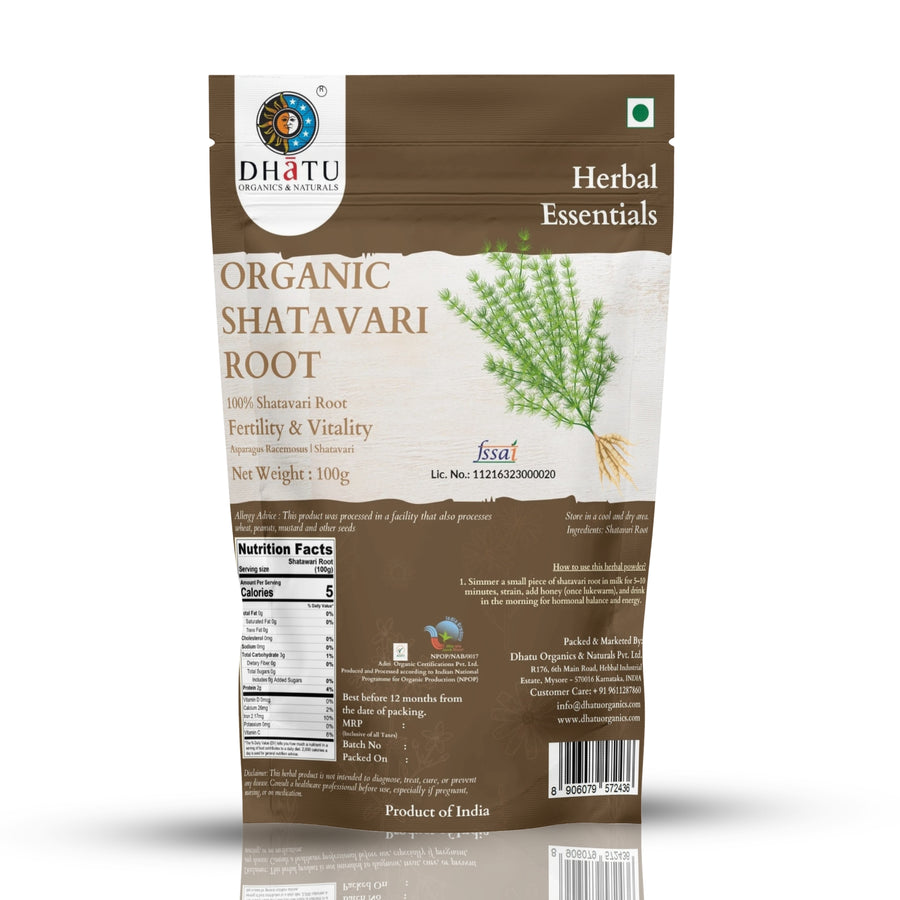
Organic Shatavari Root 100g
₹ 350.00
Dhatu Organics Organic Shatavari Root is the whole, dried tuberous root of Asparagus racemosus — the traditional form in which Shatavari has been used for thousands of years ... Read more ↓
100% Organic
No Additives
Free Delivery ₹499+
Organic Shatavari Root (Asparagus racemosus) — whole, dried tuberous roots, cut into 3–5 cm sections
Nutrition Facts
| Nutrient | Per serving | Per 100g | % RDA* |
|---|---|---|---|
| Energy | 14.4 kcal | 360 kcal | <1% |
| Protein | 0.10 g | 2.5 g | <1% |
| Carbohydrates | 3.3 g | 82.0 g | 1.1% |
| Dietary Fibre | 0.14 g | 3.6 g | <1% |
| Total Fat | ~0 g | 0.4 g | <1% |
| Saponins (Shatavarin I–IV) | 160–320 mg | 4–8 g | |
| Asparagamine A | ~20 mg | ~0.5% |
* % RDA based on a 2000 kcal reference diet (FSSAI). Values are approximate and may vary by batch.
We deliver across India within 3–5 business days via trusted logistics partners.
- Free delivery on orders above ₹499.
- Orders dispatched within 1 business day of payment confirmation.
- Perishable goods cannot be returned once dispatched. Non-perishable items may be returned within 7 days in original, unopened condition.
- For damaged or incorrect items, contact info@dhatuorganics.com within 48 hours of delivery.
Choose Your Pack
Dhatu Organics Organic Shatavari Root is the whole, dried tuberous root of Asparagus racemosus — the traditional form in which Shatavari has been used for thousands of years in Ayurvedic medicine. While our Shatavari Powder is convenient for daily supplementation, whole roots offer a distinctly different experience: they can be used to make potent, traditional decoctions (kadha) by boiling in water or milk, which practitioners of classical Ayurveda often prefer for deeper, slower-releasing absorption of saponins and mucilaginous compounds.
Whole Root vs. Powder: Whole dried roots are the classical form of Shatavari used in Ayurvedic Rasa shastra preparations. Boiling the root in milk for 15–20 minutes creates a decoction that extracts the fat-soluble saponins (shatavarins) into the fat matrix of milk — the traditional delivery vehicle for these steroidal compounds. This is the form prescribed in Charaka Samhita, the oldest compendium of Ayurvedic medicine (2nd century BCE).
🌿 What You Receive
Organic Shatavari Root (Asparagus racemosus) — whole, dried tuberous roots
Roots are cut into 3–5 cm sections for easy use. Slow-dried to preserve saponin content. Organically grown without synthetic pesticides or fertilisers.
Certified Organic
Non-GMO
Gluten-Free
Vegan
📊 Nutrition Facts
Per 100g dried root · Per 3–4g decoction dose
| Nutrient | Per 100g | Per 4g |
|---|---|---|
| Energy | ~360 kcal | 14.4 kcal |
| Carbohydrates | 82.0 g | 3.3 g |
| Protein | 2.5 g | 0.1 g |
| Total Fat | 0.4 g | ~0 g |
| Dietary Fibre | 3.6 g | 0.14 g |
| Saponins (Shatavarin I–IV) | 4–8 g | 160–320 mg |
| Asparagamine A | ~0.5% | ~20 mg |
Values approximate. The decoction extracts roughly 40–60% of total saponins. Source: published literature on A. racemosus.
Key Benefits
- Women's Hormonal Wellness: Shatavari root's steroidal saponins (shatavarins I–IV) act as phytoestrogens, gently modulating oestrogen receptor activity. Used for PMS relief, PCOS hormonal balance, fertility support, and menopausal comfort including hot flashes and mood changes.[1]
- Breast Milk Production (Galactagogue): Shatavari root decoction has been used for centuries to increase breast milk supply. Double-blind clinical studies confirm significant increases in serum prolactin and milk output within 2–4 weeks.[2]
- Gut and Digestive Soothing: Shatavari root has pronounced mucilaginous properties — when boiled in water or milk, it releases complex polysaccharides that coat the oesophagus, stomach, and intestinal lining, reducing acid irritation, gastric inflammation, and symptoms of IBS.[3]
- Adaptogenic Stress Support: Shatavari modulates the HPA axis, reducing cortisol and supporting a calm, balanced nervous system. Particularly effective when stress is expressing as hormonal disruption, digestive upset, or insomnia.[4]
- Immune System Modulation: Shatavari polysaccharides directly stimulate macrophage activity and NK cell function. A double-blind trial found significantly improved antibody response in Shatavari-supplemented subjects.[4]
- Anti-Ulcer and Gastric Protection: Shatavari root extract has been shown to significantly reduce gastric ulcer index and protect gastric mucosa from NSAID and stress-induced damage.[3]
Research at a Glance
| Benefit | Study Finding | Reference |
|---|---|---|
| Hormonal balance | Phytoestrogenic saponins modulate FSH/LH; reduces menopausal symptoms | Pandey et al., 2005[1] |
| Breast milk production | Increased prolactin and milk output; double-blind RCT | Sharma et al., 1996[2] |
| Gastric protection | Significant anti-ulcer activity; mucilage coats gastric lining | Alok et al., 2013[3] |
| Immunity | Enhanced antibody response; increased NK cell activity | Rege et al., 1999[4] |
How to Prepare Traditional Shatavari Decoctions
Method 1 — Milk Decoction (Ksheer Paka — most traditional)
- Add 3–4g Shatavari root pieces (1–3 small sticks) to 300 ml full-fat cow's milk or coconut milk.
- Bring to a gentle boil, then simmer on low heat for 15–20 minutes, stirring occasionally.
- Strain through a fine strainer or muslin cloth.
- Sweeten with honey or jaggery. Optionally add a pinch of cardamom or saffron.
- Drink warm, ideally before bed or in the morning on a light stomach.
Method 2 — Water Decoction (Kashaya)
- Add 3–4g root pieces to 400 ml water.
- Bring to a boil and simmer until reduced to approximately 200 ml.
- Strain and drink warm with sweetener. Can be consumed throughout the day.
Suggested dose: 3–5g root per preparation (1–3 small sticks), once or twice daily. For nursing mothers: up to 6g twice daily under guidance.
Frequently Asked Questions
What is the difference between Shatavari Root and Shatavari Powder?
Both are made from Asparagus racemosus roots. The powder is more convenient for daily supplementation — it can be stirred into warm milk or water without boiling. The whole root is preferred for traditional decoctions (kadha/ksheer paka) where boiling in milk extracts fat-soluble saponins into the fat matrix for superior absorption. Experienced Ayurvedic practitioners often prefer the whole root for deeper, longer-acting therapeutic effects.
How long should I boil the roots?
For a mild preparation, 10–12 minutes is sufficient. For a therapeutic-strength decoction, 15–20 minutes extracts the maximum saponin content. Longer boiling (beyond 25 minutes) can cause bitterness without additional benefit. The liquid should take on a mild creamy-white colour and a slight sweet, earthy aroma when ready.
Can I reuse the roots for a second decoction?
Yes — the same roots can typically be used for 2–3 decoctions before their saponin content is sufficiently depleted. The second decoction will be milder and is suitable for a maintenance or lighter dose.
How long do the dried roots keep?
Properly stored in an airtight container, away from moisture, heat, and direct sunlight, dried Shatavari root keeps for 12–18 months without significant loss of potency. Do not refrigerate as condensation can introduce moisture and promote mould.
Explore More from Dhatu Organics
- Shatavari Powder — the convenient powdered form for daily use
- Sprouted Fenugreek Powder — a complementary galactagogue and women's wellness herb
- All Health Supplements
Scientific References
- Pandey AK, et al. Asparagus racemosus: a phytopharmacological review. Int J Pharm Sci Res. 2005. PubMed review
- Sharma S, et al. Galactogogue property of Shatavari in the postnatal period. Ancient Science of Life. 1996;16(2):136–9.
- Alok S, et al. Plant profile, phytochemistry and pharmacology of Asparagus racemosus (Shatavari). Asian Pac J Trop Dis. 2013;3(3):242–51. doi:10.1016/S2222-1808(13)60049-3
- Rege NN, et al. Adaptogenic properties of six rasayana herbs used in Ayurvedic medicine. Phytother Res. 1999;13(4):275–91. doi:10.1002/ptr.510