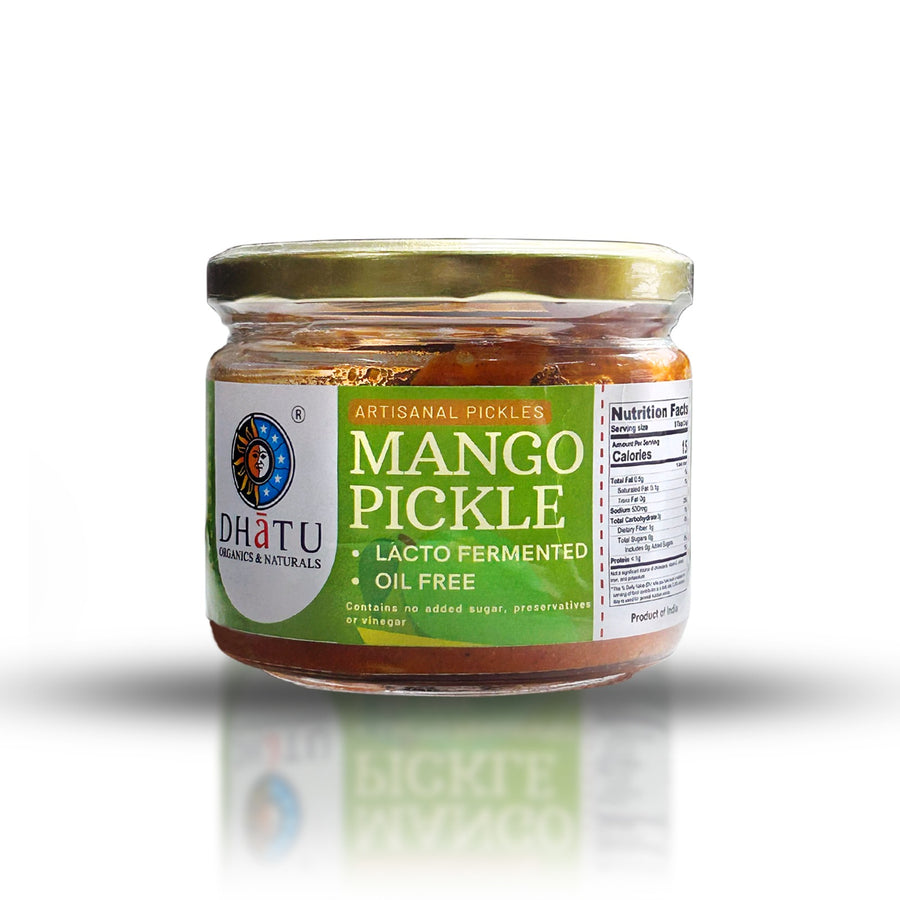
Oil Free Mango Pickle 250g

Oil Free Mango Pickle 250g

New Arrival — Write a review
₹ 250.00

Dhatu Organics Oil-Free Mango Pickle is made from raw, unripe green mango (Mangifera indica) — the most beloved pickle base in Indian culinary tradition. Unlike the oil-laden... Read more ↓

Key Benefits

Mangiferin
Mangiferin — the Standout Polyphenol:
Vitamin C — Higher Than Ripe Mango:
Digestive Acid Stimulation:

This variant is currently unavailable.

Earn 0 points on this purchase.

Learn more
100% Organic
No Additives
Free Delivery ₹499+

Raw Green Mango (Mangifera indica), Sea Salt, Organic Turmeric Powder, Red Chilli Powder, Fenugreek Seeds (Trigonella foenum-graecum), Mustard Seeds (Brassica nigra)

Nutrition Facts
Nutrient Per serving Per 100g % RDA*
Energy 16 kcal 80 kcal/100g
Protein 0.16 g 0.8 g/100g
Carbohydrates 3.7 g 18.5 g/100g
— of which Sugars 1.2 g 6.0 g/100g
Total Fat 0.08 g 0.4 g/100g
Dietary Fibre 0.5 g 2.5 g/100g
Sodium 480 mg 2400 mg/100g
Vitamin C 12 mg 60 mg/100g

* % RDA based on a 2000 kcal reference diet (FSSAI). Values are approximate and may vary by batch.

We deliver across India within 3–5 business days via trusted logistics partners.

  • Free delivery on orders above ₹499.
  • Orders dispatched within 1 business day of payment confirmation.
  • Perishable goods cannot be returned once dispatched. Non-perishable items may be returned within 7 days in original, unopened condition.
  • For damaged or incorrect items, contact info@dhatuorganics.com within 48 hours of delivery.
Choose Your Pack

Dhatu Organics Oil-Free Mango Pickle is made from raw, unripe green mango (Mangifera indica) — the most beloved pickle base in Indian culinary tradition. Unlike the oil-laden, preservative-heavy versions sold commercially, this version is prepared with sea salt, turmeric, and a carefully selected spice blend, with absolutely no oil, no synthetic vinegar, and no artificial preservatives. The result is a tangy, intensely flavoured pickle that retains the natural polyphenols of raw mango — particularly mangiferin and quercetin — in a low-calorie, functional format.

Raw vs Ripe Mango: Raw green mango is nutritionally distinct from ripe mango. It is high in malic acid and citric acid (giving it intense tartness), contains significantly higher levels of Vitamin C than ripe mango, and is rich in mangiferin — a xanthone with documented anti-inflammatory, antidiabetic, and hepatoprotective properties. The absence of oil in this pickle means these polyphenols are delivered without the caloric burden of traditional mango achars.

🌿 Ingredients

  • Raw Green Mango (Mangifera indica)
  • Sea Salt (non-iodised)
  • Organic Turmeric Powder (Curcuma longa)
  • Red Chilli Powder (Capsicum annuum)
  • Fenugreek Seeds (Trigonella foenum-graecum)
  • Mustard Seeds (Brassica nigra)

No oil · No vinegar · No preservatives · No artificial colour

Oil-Free No Preservatives Vegan Gluten-Free

📊 Nutrition Facts

Per 100g · Per 20g serving (1 heaped tbsp)

Nutrient Per 100g Per 20g
Energy 80 kcal 16 kcal
Protein 0.8 g 0.16 g
Carbohydrates 18.5 g 3.7 g
— of which Sugars 6.0 g 1.2 g
Total Fat 0.4 g 0.08 g
Dietary Fibre 2.5 g 0.5 g
Sodium 2,400 mg 480 mg
Vitamin C 60 mg 12 mg
Mangiferin Present (xanthone polyphenol)

Values approximate. Vitamin C is significantly higher in raw vs ripe mango. Sodium from sea salt — use as a condiment (1–2 tbsp/day).

The Polyphenol Profile of Raw Mango

MangiferinXanthone C-glycoside — antidiabetic, anti-inflammatory, hepatoprotective
QuercetinFlavonol — antihistamine, anti-inflammatory, antioxidant
Gallic AcidPhenolic acid — antimicrobial, antioxidant
Malic AcidOrganic acid — flavour, alkalising effect post-metabolism
Vitamin C60mg/100g — immune support, collagen, iron absorption

Key Benefits

  • Mangiferin — the Standout Polyphenol: Mangiferin is a C-glycosylxanthone found almost exclusively in mango (fruit and leaf). It has been extensively studied for its insulin-sensitising effects, hepatoprotective properties, and potent antioxidant capacity. Research found mangiferin modulates AMPK signalling and reduces fasting glucose and HbA1c in metabolic syndrome populations.
  • Vitamin C — Higher Than Ripe Mango: Raw green mango contains up to 60mg Vitamin C per 100g — significantly more than ripe mango (~36mg). Each serving of this pickle provides 12mg Vitamin C, contributing to immune function, iron absorption, and collagen synthesis.
  • Digestive Acid Stimulation: The malic and citric acids naturally present in raw mango stimulate gastric acid secretion and bile flow — making this pickle a genuine digestive aid when consumed before or with meals.
  • Dramatically Lower Calories vs Oil Pickle: Traditional mango achars with mustard oil contain 80–120 kcal per tablespoon — primarily from oil. This oil-free version delivers 16 kcal per tablespoon, preserving all the flavour and polyphenol content without the caloric load.
  • Fenugreek and Mustard — Functional Spice Pair: Fenugreek (galactomannan, 4-hydroxyisoleucine) supports insulin sensitivity and slow carbohydrate digestion; mustard seeds provide antimicrobial protection and were historically used as natural preservatives in Indian achars.
  • Antioxidant Protection via Quercetin + Gallic Acid: Raw mango contains quercetin and gallic acid — together providing broad-spectrum antioxidant cover. Gallic acid is a potent free-radical scavenger; quercetin downregulates TNF-α and IL-6.

Research Summary

Compound Source Evidence Level Observed Effect
Mangiferin Raw mango Multiple clinical + preclinical studies Blood glucose ↓, AMPK ↑, liver protection
Vitamin C (high-dose) Raw mango RCTs, meta-analysis Immune function ↑, collagen synthesis ↑
Malic acid / Citric acid Raw mango Mechanistic / traditional evidence Digestive enzyme stimulation, bile flow ↑
4-Hydroxyisoleucine Fenugreek Clinical RCTs Insulin secretion ↑, fasting glucose ↓
Quercetin Raw mango In vitro + animal models TNF-α ↓, IL-6 ↓, antihistamine activity

Serving Suggestions

  • The Classic Pairing: With curd rice, dal chawal, or plain khichdi. The sharpness of the pickle cuts beautifully through the starchiness of the rice.
  • Before Meals: A teaspoon eaten before rice or flatbread meals primes digestive secretions — the traditional rationale for pickle-as-appetiser in South Indian cuisine.
  • In Sandwiches: A thin layer of mango pickle adds enormous flavour to cheese, grilled vegetable, or chicken sandwiches.
  • With Grilled Foods: Use as a side condiment or thin marinade for fish, paneer, or tofu — the organic acids in raw mango help tenderise protein.
  • With Poha or Upma: Stir a small amount into warm poha for a tangy, Maharashtrian-style breakfast upgrade.
  • Raita Integration: Stir a small amount into plain yoghurt for a quick mango-spice raita.

Frequently Asked Questions

Why use raw mango instead of ripe?

Raw green mango has a dramatically different nutritional profile from ripe mango. It is much higher in Vitamin C, contains significantly more malic and citric acids (responsible for the signature tartness), and is richer in mangiferin — the key xanthone polyphenol that is largely lost as the fruit ripens. Raw mango also holds its shape and texture far better during pickling, giving the preserve its characteristic chunky bite.

Traditional mango pickle uses oil — why leave it out?

Mustard oil was traditionally used in achars primarily for its antimicrobial properties and to create an anaerobic environment. We achieve the same preservation outcome through salt concentration and maintaining an acidic environment — without adding 100+ calories per tablespoon. The functional benefits of the mango, turmeric, and fenugreek are delivered without any caloric compromise from oil.

How sour is it?

Very sour — raw mango has a natural malic acid concentration that produces an intense tartness. The salt and spices balance this, but if you find it too sharp, start with ½ tsp and work up. Many people find that eating it alongside starchy foods (rice, roti, dal) naturally tempers the sourness.

Is it suitable for diabetics?

Yes, with portion awareness. The pickle itself is low in sugar (1.2g per serving), and the mangiferin and fenugreek content both have documented blood sugar–supporting properties. However, the sodium content (480mg per tablespoon) means those on sodium-restricted diets should moderate intake. As always, consult your physician for specific medical conditions.

How long does it keep?

Unopened, the pickle is shelf-stable for 12 months when stored away from direct sunlight. Once opened, refrigerate and consume within 6–8 weeks. Over time the pieces may soften and the flavour will deepen — this is desirable. Always use clean, dry utensils when scooping.

Explore More from Dhatu Organics

Scientific References

  1. Masibo M, He Q. Major mango polyphenols and their potential significance to human health. Compr Rev Food Sci Food Saf. 2008;7(4):309–19. doi:10.1111/j.1541-4337.2008.00047.x
  2. Saleem M, et al. An updated review of pharmacological activities of mangiferin. Mini Rev Med Chem. 2021;21(8):1019–35. doi:10.2174/1389557520666200918113720
  3. Neelakantan N, et al. Effect of fenugreek on glycaemia: meta-analysis of randomised controlled trials. Nutr J. 2014;13:7. doi:10.1186/1475-2891-13-7
  4. Boots AW, et al. Health effects of quercetin: from antioxidant to nutraceutical. Eur J Pharmacol. 2008;585(2–3):325–37. doi:10.1016/j.ejphar.2008.03.008