Buckwheat has the word "wheat" in its name, yet it isn't wheat at all, and it contains no gluten. In India we know it as kuttu, the flour of Navratri fasting. So is buckwheat actually good for you? Here's what the nutrition data and the research say, honestly.
Key findings
- Buckwheat is a gluten-free "pseudocereal": the seed of a flowering plant, not a grass like wheat.
- 100 g of whole-groat buckwheat flour provides about 12.6 g protein, 10 g fibre and 251 mg magnesium.
- Laboratory and animal studies are promising, but human studies are still limited. Enjoy buckwheat as a nutritious grain, not as a cure.
This article is for general information and is not medical advice. If you have a health condition, talk to your doctor or a registered dietitian before changing your diet.
Reviewed for accuracy by Dr. Mohan Kumar R.K., co-founder, Dhatu Organics (oral implantologist) · September 2026
What is buckwheat?
Buckwheat is a gluten-free pseudocereal from the Polygonaceae family, the same plant family as rhubarb and sorrel [1]. We cook and eat its seeds like a grain, but botanically it isn't one. That's exactly why kuttu is allowed during many Hindu fasts, when grains are avoided. Because it contains no gluten, buckwheat is widely used in gluten-free cooking.
Buckwheat nutrition: what's in it?
According to USDA FoodData Central, 100 g of whole-groat buckwheat flour contains [2]:
- 335 kcal and 70.6 g carbohydrate
- 12.6 g protein, with a well-balanced amino-acid composition [3]
- 10 g dietary fibre
- 251 mg magnesium and 4.1 mg iron
Buckwheat also contains flavonoids, mainly rutin and quercetin, which researchers have studied for their antioxidant activity [1].
What does the research actually say?
A 2015 scientific review listed many potential benefits of buckwheat, including effects on cholesterol, blood sugar and blood pressure. But it notes that much of this evidence comes from in vitro (laboratory) and animal studies [1].
When researchers pooled the human trials, the picture was more modest. A 2022 systematic review and meta-analysis of buckwheat and cardiometabolic health concluded that the evidence on how buckwheat affects cardiometabolic health is still limited. There were small trends towards lower total cholesterol and blood glucose, but they were not statistically significant [4]. A separate 2022 review of buckwheat and gut health reached a similar conclusion: promising results in animal studies, but limited human evidence [5].
So the honest answer is: buckwheat is a genuinely nutritious, gluten-free grain alternative, and the research on its specific health effects in people is still developing.
Sprouted vs regular buckwheat flour
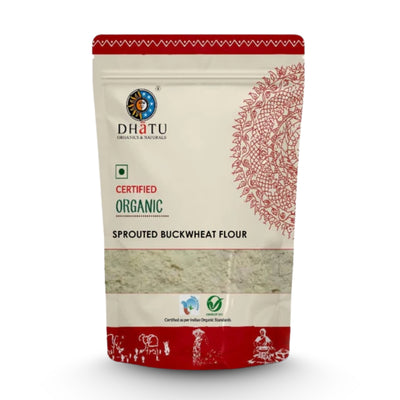
Sprouted buckwheat is soaked until it begins to germinate, then dried and milled. Many people find sprouted buckwheat flour milder and less bitter, and easier to use in rotis and baking. Both sprouted and regular buckwheat flour are gluten-free.
How to use buckwheat flour
- Kuttu ki roti and puri for Navratri and vrat days (mix with boiled potato to help the dough bind)
- Kuttu pakoras with potato or paneer
- Pancakes and crêpes: buckwheat galettes are a classic in France
- Gluten-free baking: blend with rice or millet flour for muffins and cookies
Dhatu spotlight
Try our sprouted buckwheat flour for a milder taste, or organic buckwheat flour for traditional kuttu recipes. Both are gluten-free. Explore more in our sprouted flours range.
Bhāvi's Signal
Buckwheat is a perfect example of the gap between "promising in the lab" and "proven in people". The rutin and fibre story is scientifically interesting, and I'd love to see larger, well-designed human trials, especially on everyday foods like kuttu rotis rather than extracts. Until then, buckwheat earns its place as a nutritious, gluten-free staple, and that's already a good reason to cook with it.
Citations
- Giménez-Bastida JA, Zieliński H. Buckwheat as a Functional Food and Its Effects on Health. J Agric Food Chem. 2015;63(36):7896–7913. PMID 26270637
- U.S. Department of Agriculture, FoodData Central. Buckwheat flour, whole-groat (FDC ID 170687). fdc.nal.usda.gov
- Luthar Z, et al. Breeding Buckwheat for Increased Levels and Improved Quality of Protein. Plants (Basel). 2020;10(1):14. PMID 33374117
- Llanaj E, et al. Buckwheat and Cardiometabolic Health: A Systematic Review and Meta-Analysis. J Pers Med. 2022;12(12):1940. PMID 36556161
- Valido E, et al. Systematic Review of Human and Animal Evidence on the Role of Buckwheat Consumption on Gastrointestinal Health. Nutrients. 2022;15(1):1. PMID 36615659