

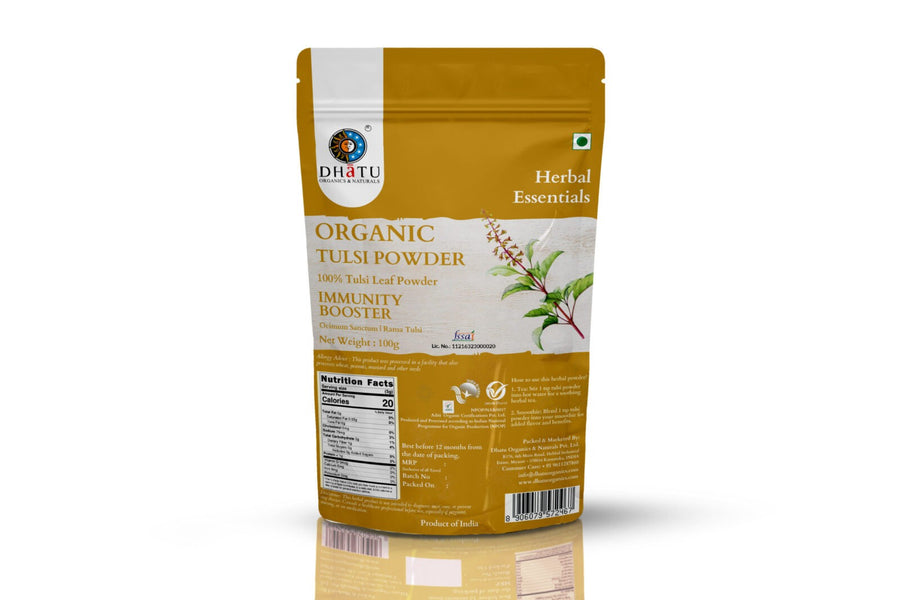
Organic Tulsi Leaf Powder 100g
₹ 190.00
Dhatu Organics Organic Tulsi Leaf Powder is made from whole Ocimum tenuiflorum leaves — the sacred Rama Tulsi variety revered for over 3,000 years in Ayurvedic medicine. Grow... Read more ↓
100% Organic
No Additives
Free Delivery ₹499+
Organic Tulsi Leaf Powder (Ocimum tenuiflorum — Rama variety)
Nutrition Facts
| Nutrient | Per serving | Per 100g | % RDA* |
|---|---|---|---|
| Energy | 2.5 kcal | 251 kcal | <1% |
| Protein | 0.15 g | 14.7 g | <1% |
| Carbohydrates | 0.38 g | 38.2 g | <1% |
| Dietary Fibre | 0.14 g | 13.8 g | <1% |
| Total Fat | 0.04 g | 4.0 g | <1% |
| Calcium | 21.1 mg | 2113 mg | 2.1% |
| Iron | 0.89 mg | 89 mg | 5.2% |
| Vitamin K | ~4 µg | ~400 µg | 7.3% |
| Eugenol (active) | 10–30 mg | 1–3% |
* % RDA based on a 2000 kcal reference diet (FSSAI). Values are approximate and may vary by batch.
We deliver across India within 3–5 business days via trusted logistics partners.
- Free delivery on orders above ₹499.
- Orders dispatched within 1 business day of payment confirmation.
- Perishable goods cannot be returned once dispatched. Non-perishable items may be returned within 7 days in original, unopened condition.
- For damaged or incorrect items, contact info@dhatuorganics.com within 48 hours of delivery.
Choose Your Pack
Dhatu Organics Organic Tulsi Leaf Powder is made from whole Ocimum tenuiflorum leaves — the sacred Rama Tulsi variety revered for over 3,000 years in Ayurvedic medicine. Grown organically and cold-dried to preserve volatile oils and eugenol, this powder delivers the full spectrum of adaptogenic and antimicrobial phytochemicals in their most bioavailable leaf form. Nothing is added. Nothing is extracted out.
The Adaptogen Advantage: Tulsi is classified as a Rasayana in classical Ayurvedic texts — a class of herbs that normalise physiological function under stress. Modern research confirms it modulates the HPA axis (hypothalamic-pituitary-adrenal axis), effectively reducing cortisol and supporting a balanced stress response.
🌿 Ingredients
Organic Tulsi Leaf Powder (Ocimum tenuiflorum — Rama variety)
100% whole leaf. No stems, seeds, or fillers. No preservatives. Cold-dried to preserve volatile oils.
Certified Organic
Non-GMO
Gluten-Free
Vegan
📊 Nutrition Facts
Per 100g · Per 1g serving (approx. ⅓ tsp)
| Nutrient | Per 100g | Per 1g |
|---|---|---|
| Energy | ~251 kcal | 2.5 kcal |
| Protein | 14.7 g | 0.15 g |
| Carbohydrates | 38.2 g | 0.38 g |
| Total Fat | 4.0 g | 0.04 g |
| Dietary Fibre | 13.8 g | 0.14 g |
| Calcium | 2113 mg | 21.1 mg |
| Iron | 89 mg | 0.89 mg |
| Vitamin K | ~400 µg | ~4 µg |
| Eugenol (active) | 1–3% | 10–30 mg |
Values approximate. Source: USDA FoodData Central / published literature.
Key Benefits
- Natural Adaptogen — Stress and Cortisol Support: Tulsi’s ursolic acid and ocimumosides A and B regulate corticosterone release and normalise neurotransmitter levels. A double-blind RCT found daily Tulsi supplementation reduced stress scores by 39% over 6 weeks.[1]
- Immune System Support: Tulsi stimulates macrophage activity, increases natural killer (NK) cell counts, and boosts secretory IgA — the antibody that lines the respiratory and digestive tracts.[2]
- Antimicrobial Properties: Eugenol and linalool — the key volatile oils in Tulsi — demonstrate broad-spectrum antibacterial and antifungal activity in vitro against common pathogens including S. aureus and E. coli.[3]
- Respiratory Comfort: Traditional Ayurvedic use for respiratory wellness is supported by modern evidence showing Tulsi reduces histamine response and supports bronchodilation.[2]
- Supports Healthy Blood Sugar Balance: Tulsi extract modestly reduces fasting blood glucose and postprandial glucose levels through mechanisms involving α-glucosidase inhibition.[1]
- Antioxidant-Rich: Rich in orientin, vicenin, and rosmarinic acid — potent flavonoid antioxidants that protect cells from oxidative damage.
- Skin and Hair Wellness: High zinc and antifungal activity support clear skin; anti-androgenic properties in Tulsi traditionally used to support scalp health.
Research at a Glance
| Benefit | Study Finding | Reference |
|---|---|---|
| Stress & cognitive function | 39% reduction in stress scores; improved memory and attention in RCT | Bhattacharyya et al., 2008[1] |
| Immune support | Increased NK cells, macrophage activity, and secretory IgA levels | Mondal et al., 2011[2] |
| Antimicrobial | Broad-spectrum inhibition of gram-positive and gram-negative bacteria | Pattanayak et al., 2010[3] |
| Blood sugar balance | Reduced fasting glucose via α-glucosidase inhibition | Bhattacharyya et al., 2008[1] |
How to Use
- Daily Tea: Mix ⅓ tsp (1g) in a cup of warm water or herbal tea, after meals. Add ginger and honey for flavour.
- Face Mask: Combine ½ tsp Tulsi powder with rose water or yogurt to form a paste; apply to skin for 10–15 minutes and rinse.
- Smoothie Add-in: Blend with mango, mint, and coconut water for an immune-boosting smoothie.
- Kadha: Add to traditional kadha (herbal decoction) with ginger, pepper, and jaggery for respiratory and immune support.
Suggested daily use: ⅓ tsp (1g) twice daily with water after meals.
Frequently Asked Questions
What is the difference between Rama, Krishna, and Vana Tulsi?
All three are varieties of Ocimum tenuiflorum/sanctum, but differ in phytochemical profiles. Rama Tulsi (used in this product) has a clove-like scent from high eugenol content and is the most widely studied for adaptogenic and antimicrobial properties. Krishna Tulsi is peppery and used more in respiratory blends. Vana Tulsi grows wild and has the mildest flavour.
Can Tulsi be taken daily long-term?
Yes. Tulsi is classified as a Rasayana herb — one intended for long-term tonic use. Regular daily use over 3–6 months is considered safe and is common in traditional practice. As with any herb, periodic breaks (e.g., one week off per month) are a traditional recommendation to maintain sensitivity.
Is Tulsi safe for children?
Tulsi tea in mild concentrations is traditionally given to children for colds and fevers in India. For powdered supplemental form, half the adult dose is typically used for children over 6. Consult a paediatrician for children under 6.
Does Tulsi have a strong taste?
Tulsi powder has a warm, slightly clove-like and peppery flavour with mild bitterness. Mixed in warm water or tea with honey, most people find it pleasant. It blends well with ginger, lemon, and mint.
Can I use Tulsi powder as a face mask?
Yes. Tulsi powder has traditionally been used as a face pack for its antibacterial, anti-inflammatory, and mildly astringent properties. Mix with rose water or honey for oily/acne-prone skin, or with yogurt or aloe vera gel for dry/sensitive skin. Leave on for 10–15 minutes and rinse with cool water.
Explore More from Dhatu Organics
- Ashwagandha Powder — the complementary adaptogen for strength and sleep
- Neem Leaf Powder — another powerful antimicrobial and skin herb
- All Health Supplements
Scientific References
- Bhattacharyya D, et al. Controlled programmed trial of Ocimum sanctum leaf on generalized anxiety disorders. Nepal Med Coll J. 2008;10(3):176–9. PubMed:19253862
- Mondal S, et al. Double-blinded randomized controlled trial for immunomodulatory effects of Tulsi (Ocimum sanctum Linn.) leaf extract on healthy volunteers. J Ethnopharmacol. 2011;136(3):452–6. doi:10.1016/j.jep.2011.05.012
- Pattanayak P, et al. Ocimum sanctum Linn. A reservoir plant for medicine. J Adv Pharm Technol Res. 2010;1(1):7–24. doi:10.4103/2231-4040.70997