

 48% OFF
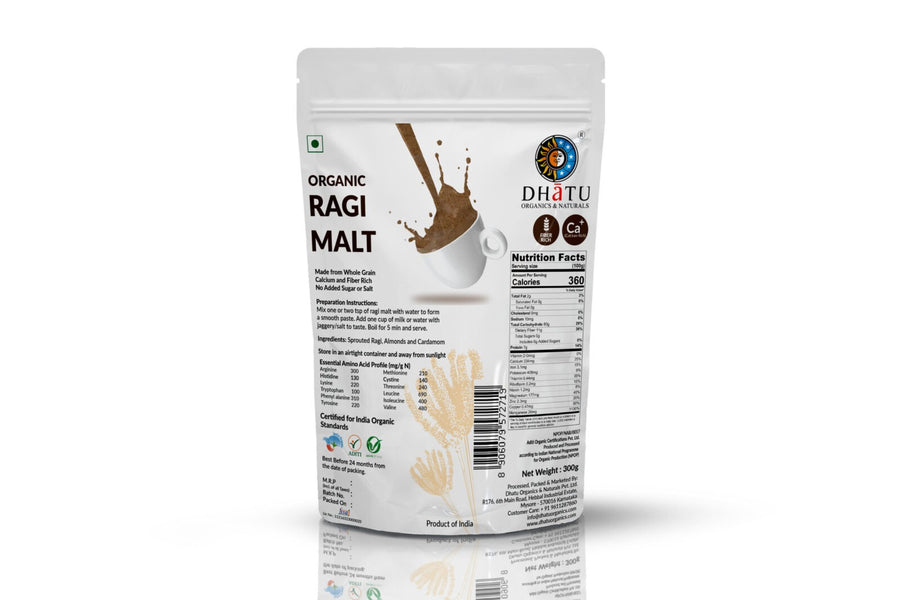
Organic Ragi Malt 300g
₹ 210.00
Dhatu Organics Ragi Malt is a wholesome breakfast drink powder made from three whole-food ingredients — sprouted finger millet (ragi), almonds, and cardamom. Ragi (Eleusine ... Read more ↓
100% Organic
No Additives
Free Delivery ₹499+
Sprouted Finger Millet / Ragi (Eleusine coracana), Almonds (Prunus dulcis), Cardamom (Elettaria cardamomum)
Nutrition FactsServing: 25g (2 tbsp)
| Nutrient | Per serving | Per 100g | % RDA* |
|---|---|---|---|
| Energy | 86 kcal | 345 kcal | 4.3% |
| Protein | 2.4 g | 9.5 g | 4.8% |
| Total Fat | 2.3 g | 9.0 g | 4% |
| of which Saturated Fat | 0.2 g | 0.9 g | <1% |
| of which Trans Fat | 0 g | 0 g | — |
| Total Carbohydrates | 15.5 g | 62.0 g | — |
| of which Dietary Fibre | 1.1 g | 4.5 g | — |
| of which Sugars | 0.6 g | 2.5 g | 1.3% |
| Calcium | 80 mg | 320 mg | 8% |
| Iron | 0.9 mg | 3.5 mg | 4.5% |
| Magnesium | 21 mg | 85 mg | 6% |
| Vitamin E | 1 mg | 4 mg | 6.7% |
| Sodium | <2 mg | <5 mg | <1% |
* % RDA based on a 2000 kcal reference diet (FSSAI). Values are approximate and may vary by batch.
We deliver across India within 3–5 business days via trusted logistics partners.
- Free delivery on orders above ₹499.
- Orders dispatched within 1 business day of payment confirmation.
- Perishable goods cannot be returned once dispatched. Non-perishable items may be returned within 7 days in original, unopened condition.
- For damaged or incorrect items, contact info@dhatuorganics.com within 48 hours of delivery.
Choose Your Pack
Dhatu Organics Ragi Malt is a wholesome breakfast drink powder made from three whole-food ingredients — sprouted finger millet (ragi), almonds, and cardamom. Ragi (Eleusine coracana) is one of India's oldest cultivated cereals, celebrated for its high calcium content and naturally low glycaemic index. Sprouting the ragi before cold-milling improves mineral bioavailability by reducing antinutrients. Whole almonds add creaminess, plant protein, healthy fats, and Vitamin E — replacing the need for any added maltodextrin or fillers. Cardamom provides aromatic warmth and traditional digestive comfort. No added sugar. No preservatives. No artificial flavours.
Three ingredients. Nothing else: Sprouted Ragi · Almonds · Cardamom · Certified organic · Gluten-free · ₹210 / 300g (~12 servings)
Ingredients & Nutrition
🌾 Ingredients
Sprouted Ragi
Eleusine coracana
One of the most calcium-rich cereals (344 mg/100g raw grain). Naturally gluten-free, low GI. Sprouting reduces phytic acid by 30–50%, improving mineral absorption.[1]
One of the most calcium-rich cereals (344 mg/100g raw grain). Naturally gluten-free, low GI. Sprouting reduces phytic acid by 30–50%, improving mineral absorption.[1]
Almonds
Prunus dulcis
Dense source of Vitamin E (alpha-tocopherol), healthy monounsaturated fats, additional calcium (~264 mg/100g), magnesium, and plant protein. Adds natural creaminess without fillers.
Dense source of Vitamin E (alpha-tocopherol), healthy monounsaturated fats, additional calcium (~264 mg/100g), magnesium, and plant protein. Adds natural creaminess without fillers.
Cardamom
Elettaria cardamomum
Contributes 1,8-cineole and aromatic terpenes. Used in Ayurveda as a carminative spice to support digestive comfort and enhance the palatability of grain drinks.
Contributes 1,8-cineole and aromatic terpenes. Used in Ayurveda as a carminative spice to support digestive comfort and enhance the palatability of grain drinks.
Certified OrganicGluten-FreeVeganLow GINo Added Sugar
📊 Nutrition Facts — Approximate
Per 100g blend · Per 25g serving (2 tbsp) · % RDA based on 2000 kcal (FSSAI)
| Nutrient | Per 100g | Per 25g |
|---|---|---|
| Energy | ~345 kcal | ~86 kcal |
| Protein | ~9.5 g | ~2.4 g |
| Total Fat | ~9 g | ~2.3 g |
| of which Saturated | ~0.9 g | ~0.2 g |
| Carbohydrates | ~62 g | ~15.5 g |
| of which Sugars | ~2.5 g | ~0.6 g |
| Dietary Fibre | ~4.5 g | ~1.1 g |
| Calcium | ~320 mg | ~80 mg |
| Iron | ~3.5 mg | ~0.9 mg |
| Magnesium | ~85 mg | ~21 mg |
| Vitamin E | ~4 mg | ~1 mg |
| Sodium | <5 mg | <2 mg |
Values approximate for the sprouted ragi + almond + cardamom blend based on IFCT 2017 and USDA composition data. Prepared with 200ml full-fat dairy milk adds ~120mg Ca, 3.5g protein, ~65 kcal. Actual values may vary due to natural crop variation.
Why Sprouted Ragi?
Sprouting is a controlled germination process that transforms the nutritional profile of whole grains in three important ways:
- Reduces Antinutrients: Raw millets contain phytic acid, tannins, and enzyme inhibitors that bind minerals and limit their absorption. Sprouting reduces phytic acid content by 30–50%, releasing calcium, iron, and zinc for uptake.[1]
- Increases Bioavailability: Germination activates the grain's native phytase enzyme, which continues breaking down phytates and makes minerals more accessible to the body.[2]
- Improves Digestibility: Complex starches are partially converted during sprouting, making the flour lighter and easier to digest. This is why sprouted ragi malt has been traditionally used as weaning food for infants and recovery food for the elderly across South Indian households.
- Enhances Amino Acid Profile: Sprouting increases free amino acid content — particularly methionine and lysine — improving the overall protein quality of the grain.[3]
Key Benefits
- Contributes to Daily Calcium Intake: The ragi-almond combination delivers calcium from two complementary plant sources, contributing to the adult reference intake of 1000 mg/day. Each 25g serving provides approximately 80 mg calcium from the dry powder alone — before milk addition.
- Sustained Energy, Low Glycaemic: Finger millet is a naturally low-GI cereal. The fat and protein from almonds further moderate post-meal glucose response — making this a suitable breakfast drink for those managing balanced blood sugar levels.
- Source of Vitamin E: Almonds are one of the richest plant sources of alpha-tocopherol (Vitamin E) — a fat-soluble antioxidant that contributes to normal cell protection from oxidative stress.[4]
- Iron from Whole Grain: Sprouted ragi provides a meaningful plant-based iron intake. Absorption is enhanced when consumed alongside Vitamin C sources — e.g. a glass of lime water or fresh orange juice with breakfast.
- Digestive Comfort: Cardamom contributes 1,8-cineole and other volatile oils traditionally associated with digestive ease and carminative effects in Ayurvedic usage.
- No Additives, No Fillers: Three ingredients only. No added sugar, no preservatives, no maltodextrin, no artificial flavours or colours.
- Gluten-Free & Vegan: Ragi, almonds, and cardamom are all naturally gluten-free. Contains no dairy — suitable for fully vegan preparation with plant-based milk.
Ragi Malt vs Common Breakfast Drinks
| Dhatu Ragi Malt | Commercial Malt Drinks* | Plain Ragi Flour | Oats Porridge | |
|---|---|---|---|---|
| Key Ingredients | Sprouted ragi, almonds, cardamom | Wheat/barley malt, sugar, artificial vitamins | Unsprouted ragi only | Rolled oats |
| Added Sugar | None | 30–50% of weight | None | None (plain) |
| Calcium / 100g | ~320 mg | ~100–150 mg (fortified) | ~344 mg | ~54 mg |
| Gluten-Free | Yes | No (wheat/barley base) | Yes | Oats may contain traces |
| Mineral Bioavailability | High — sprouting reduces phytic acid | Moderate — fortified isolates | Lower — phytic acid intact | Moderate |
| Vitamin E | From whole almonds (~4mg/100g) | Synthetic addition | Absent | Low |
| Additives | None | Emulsifiers, flavours, colours | None | None (plain) |
| Price per serving | ~₹17 (25g, ₹210/300g) | ₹25–40 per serving | ~₹5–10 | ~₹8–15 |
*Commercial malt drink data based on typical label information for widely available brands. Individual products vary.
How to Prepare
| Preparation | Method | Ratio | Suggested Sweetener |
|---|---|---|---|
| Classic Ragi Malt Drink | Mix 2 tbsp in a little cold water first to form a smooth paste. Add 1 cup hot milk or water and stir continuously for 2–3 min. | 25g : 200ml | Jaggery or honey |
| Ragi Buttermilk (Majjige) | Mix 2 tbsp into a glass of fresh buttermilk. Add a pinch of rock salt. Stir and serve chilled. | 25g : 250ml | Rock salt (savoury) |
| Infant Porridge (8 months+) | Mix 1 tsp in warm water or breast milk to a thin, smooth consistency. No added salt or sugar for infants under 1 year. Contains almonds — introduce with caution. | 5g : 100ml | None for infants |
| Ragi Smoothie | Blend 2 tbsp with a banana, 1 cup chilled oat milk, and a pinch of cardamom. Serve cold. | 25g : 200ml | Optional — dates |
| Ragi Porridge (Kanji) | Cook 2 tbsp with 1 cup water over medium heat, stirring constantly, until thickened (5–7 min). Season with salt or sweeten with jaggery. | 25g : 200ml | Jaggery or rock salt |
Explore More Dhatu Organics Wellness Drinks
- All Wellness Drink Blends — view the complete collection
- Sprouted Multi Millet Malt 200g — four-millet blend: higher fibre (9.7g) and protein (10.3g) per 100g
- Turmeric Latte — The Golden Chai — curcumin-rich five-spice evening wellness drink
- Kashaya Powder 150g — seven-spice Ayurvedic herbal decoction, caffeine-free
- Sprouted & Whole Grain Flours — ragi, jowar, wheat and more for everyday cooking
Frequently Asked Questions
What are the exact ingredients in Dhatu Ragi Malt?
Dhatu Organics Ragi Malt contains three ingredients: Sprouted Finger Millet (Ragi), Almonds, and Cardamom. Nothing else — no added sugar, no preservatives, no artificial flavours, no fillers, no maltodextrin.
Is this the same as Ragi Java, Ragi Satva, or Ragi Ambli?
Ragi Malt, Ragi Java, Ragi Satva, and Ragi Ambli all describe preparations of finger millet flour cooked into a warm drink or porridge. Dhatu's version is distinct in three ways: the ragi is sprouted before milling (improving mineral bioavailability), whole almonds are included (adding creaminess and Vitamin E without synthetic fillers), and cardamom is blended in for flavour. It is a more nutritionally complete and flavourful preparation than a plain single-ingredient ragi flour.
Can I give this to my baby or toddler?
Sprouted ragi malt is a classical South Indian weaning food — traditionally introduced from around 6–8 months as a thin, diluted porridge. However, this specific product contains almonds (a tree nut). Tree nuts are among the more common food allergens in children. Introduce in a very small quantity first and monitor for any reaction. Do not add salt or sugar for infants under 1 year. Consult your paediatrician before introducing nut-containing foods to any infant.
Does this contain gluten?
Finger millet (ragi), almonds, and cardamom are all naturally gluten-free. This product is suitable for gluten-sensitive individuals. If you have coeliac disease with severe sensitivity, be aware that the product is processed in a facility that also handles other grains — assess cross-contamination risk based on your sensitivity level and consult your gastroenterologist.
How is this different from Bournvita, Horlicks, or other commercial malt drinks?
Commercial malt drinks are typically made from refined wheat or barley malt and contain added sugar (often 30–50% of total weight), synthetic vitamin premixes, emulsifiers, and artificial flavourings. Dhatu Ragi Malt has three whole-food ingredients with no added sugar and no synthetic additives. Calcium in Dhatu Ragi Malt comes from whole grain ragi and almonds (naturally present); in commercial malts it is typically added as a synthetic calcium carbonate or phosphate. The bioavailability profile of whole-food calcium differs from that of isolated mineral salts.
Is this suitable for people managing blood sugar levels?
Finger millet (ragi) has a well-documented lower glycaemic index compared to refined wheat or rice. Sprouting further reduces the glycaemic response. The fat and protein content from almonds provides additional blood glucose moderation. This makes Dhatu Ragi Malt a nutritionally appropriate breakfast option for those following a balanced diet for blood sugar management. It is a food product — not a medical treatment. Individuals with diabetes should consult their physician or registered dietitian for personalised guidance.
Can I use Ragi Malt in cooking or baking?
Yes. Substitute up to 20–25% of regular flour in chapati dough, pancake batter, idli/dosa batter, muffins, and energy balls. The almond and cardamom in the blend lend a pleasantly nutty, aromatic flavour to baked goods. For ragi cookies, you can replace up to 30–40% of the flour — ragi pairs particularly well with jaggery and ghee in baking.
How should I store this and what is the shelf life?
Store in a cool, dry place away from direct sunlight. Reseal the pack tightly after each use. Shelf life: 12 months from the date of manufacture when stored correctly. Once opened, consume within 3–4 months for best freshness and flavour. The almond content means the blend should be stored away from heat to prevent the natural oils from oxidising.
Scientific References
- Samtiya M, et al. Plant food anti-nutritional factors and their reduction strategies. Food Production, Processing and Nutrition. 2020;2:6. doi:10.1186/s43014-020-0020-5
- Nkhata SG, et al. Fermentation and sprouting effects on nutritional quality and bioavailability of nutrients. Food Sci Nutr. 2018;6(8):2446–58. doi:10.1002/fsn3.846
- Mbithi-Mwikya S, et al. Amino acid composition of finger millet before and after sprouting. J Agric Food Chem. 2000;48(7):2979–83. PubMed:10898651
- Ros E. Health benefits of nut consumption. Nutrients. 2010;2(7):652–82. doi:10.3390/nu2070652
- Indian Food Composition Tables (IFCT 2017), National Institute of Nutrition, ICMR. nin.res.in
- USDA FoodData Central — Almonds, raw. fdc.nal.usda.gov