

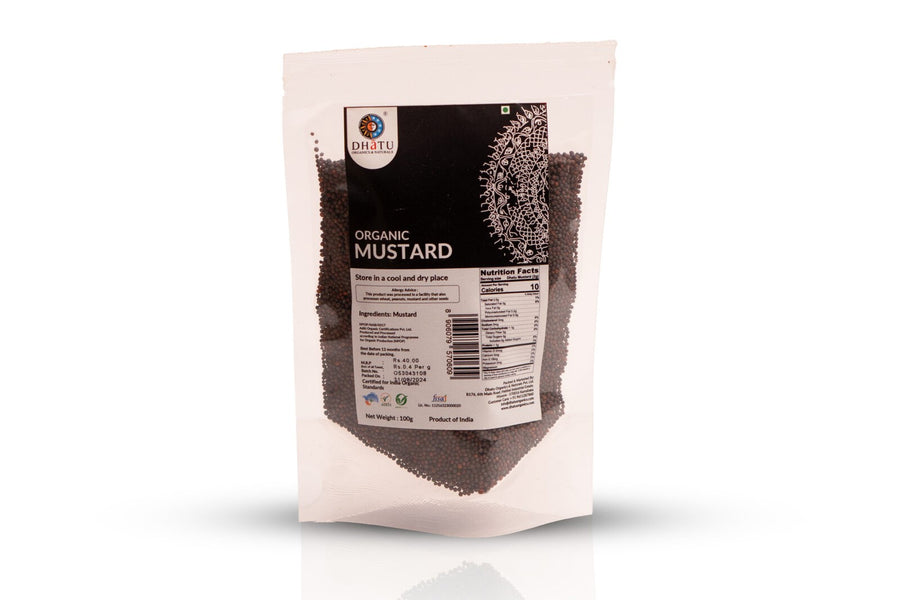
Organic Mustard Black 100g
₹ 50.00
Dhatu Organics Organic Black Mustard Seeds 100g delivers certified organic Brassica nigra — the pungent, sharp mustard variety that is the cornerstone of South Indian and Ben... Read more ↓
100% Organic
No Additives
Free Delivery ₹499+
Organic Black Mustard Seeds (Brassica nigra)
Nutrition Facts
| Nutrient | Per serving | Per 100g | % RDA* |
|---|---|---|---|
| Per 100g | Energy 508 kcal | Protein 26.1g | Carbohydrates 28.1g |
| Per 3g serving (1 tsp) | Energy 15.2 kcal | Protein 0.78g | Magnesium 11.1mg |
* % RDA based on a 2000 kcal reference diet (FSSAI). Values are approximate and may vary by batch.
We deliver across India within 3–5 business days via trusted logistics partners.
- Free delivery on orders above ₹499.
- Orders dispatched within 1 business day of payment confirmation.
- Perishable goods cannot be returned once dispatched. Non-perishable items may be returned within 7 days in original, unopened condition.
- For damaged or incorrect items, contact info@dhatuorganics.com within 48 hours of delivery.
Choose Your Pack
Dhatu Organics Organic Black Mustard Seeds 100g delivers certified organic Brassica nigra — the pungent, sharp mustard variety that is the cornerstone of South Indian and Bengali cooking. These small, round, dark seeds are essential for tadka (tempering), pickle-making, and the characteristic popping sound that signals the start of cooking in countless Indian kitchens.
Black vs. Yellow Mustard: Black mustard (Brassica nigra) is sharper and more pungent than the yellow mustard used in Western condiments. When black mustard seeds are tempered in hot oil, they undergo a chemical transformation — allyl isothiocyanate (the pungent compound) is volatilised, leaving a nutty, mellow warmth rather than sharp heat. This is why South Indian cooking starts with popping mustard: the heat changes the flavour profile completely.
Ingredients
Organic Black Mustard Seeds (Brassica nigra)
Single ingredient · No additives · No preservatives · Certified organic
Certified Organic
Non-GMO
Gluten-Free
Vegan
Nutrition Facts
Per 100g · Per 3g serving (approx. 1 tsp whole)
| Nutrient | Per 100g | Per 3g |
|---|---|---|
| Energy | 508 kcal | 15.2 kcal |
| Protein | 26.1 g | 0.78 g |
| Carbohydrates | 28.1 g | 0.84 g |
| Total Fat | 36.2 g | 1.09 g |
| Dietary Fibre | 12.2 g | 0.37 g |
| Calcium | 266 mg | 8.0 mg |
| Iron | 9.9 mg | 0.30 mg |
| Magnesium | 370 mg | 11.1 mg |
Values approximate. Source: USDA FoodData Central.
Key Benefits
- Glucosinolate Compounds: Mustard seeds contain sinigrin — a glucosinolate that breaks down into allyl isothiocyanate. These compounds have been studied for antioxidant, antimicrobial, and cellular-protective properties.[1]
- High Plant Protein: 26.1g protein per 100g — excellent for plant-based diets. Mustard proteins contain all essential amino acids, making them a complete protein source.[2]
- Rich in Magnesium: 370 mg magnesium per 100g supports muscle relaxation, nerve function, protein synthesis, and energy production — important for those on grain-heavy Indian diets often low in magnesium.
- Heart-Healthy Fat Profile: Mustard oil/fat is rich in erucic acid and alpha-linolenic acid (omega-3), giving it a favourable fatty acid profile for cardiovascular health when consumed in culinary quantities.
- Antioxidant Activity: Carotenoids, tocopherols, and phenolic compounds contribute broad-spectrum antioxidant protection.[1]
Research at a Glance
| Benefit | Study Finding | Reference |
|---|---|---|
| Glucosinolates | Sinigrin metabolites show antioxidant, antimicrobial, and cytoprotective activity | Minarini et al., 2015[1] |
| Protein quality | Mustard proteins are complete (all essential amino acids); 26.1g/100g | USDA FoodData Central[2] |
| Magnesium density | 370 mg/100g supports energy, nerve and muscle function | USDA FoodData Central[2] |
How to Use
- Tadka (Tempering): The essential first step in South Indian cooking — heat ghee or oil until shimmering, add mustard seeds, cover and wait for them to pop (5–10 seconds), then add curry leaves, chilli, and other spices.
- Chutneys: Ground mustard seeds add sharpness to tomato, coconut, and green chutneys.
- Pickles (Achaar): A key ingredient in Indian mango, lime, and mixed vegetable pickles — acts as both flavour and natural preservative.
- Sambhar and Rasam: Mustard tempering is the traditional finishing touch poured over finished sambar and rasam.
- Panch Phoron: One of five seeds in the Bengali whole spice blend (with cumin, fennel, nigella, fenugreek).
Frequently Asked Questions
Why do mustard seeds pop in hot oil?
When mustard seeds hit hot fat (around 180°C), the moisture inside them rapidly turns to steam, causing the seed coat to rupture — the “pop” sound and scattering movement. This also triggers the breakdown of sinigrin into allyl isothiocyanate, transforming sharp raw pungency into a warmer, nuttier flavour. Always use a lid when tempering mustard to avoid the seeds escaping the pan.
What is the difference between black, brown, and yellow mustard seeds?
Black mustard (Brassica nigra) is the most pungent and is used in South Asian cooking for tempering. Brown mustard (Brassica juncea) is slightly milder and used in Indian pickles and Chinese cooking. Yellow/white mustard (Sinapis alba) is the mildest, used in Western condiment mustard. Dhatu’s black mustard is the variety used in South Indian and Bengali tadka.
Can I grind mustard seeds to make mustard paste?
Yes. Grind whole seeds with a little water (and optionally turmeric and chilli) to make fresh mustard paste for fish curries, Bengali mustard preparations, and chutneys. The paste is pungent and freshest when made the day of use. Adding a pinch of salt before grinding helps control the enzyme reaction and reduces bitterness.
Are mustard seeds safe for people with mustard allergy?
No. Mustard is one of the 14 major allergens recognised in the EU and is also an allergen in many other countries. If you have a known mustard allergy, avoid this product. Cross-reactivity with other Brassica family foods (cabbage, broccoli, cauliflower) is possible but not universal.
How do I store black mustard seeds?
Store in an airtight container in a cool, dark cupboard. Whole mustard seeds last 3–4 years without significant loss of quality. Ground mustard becomes pungent and rancid faster — use within 6 months. The glucosinolates that make mustard sharp are more stable in the whole seed form.
Explore More from Dhatu Organics
- Organic Cumin Whole 100g — the classic tadka companion to mustard
- Organic Fennel 100g — for panch phoron and digestive blends
- Organic Fenugreek Whole 100g — another key seed spice for pickles and tadka
- All Organic Spices — browse our complete certified organic spice collection
Scientific References
- Minarini A, et al. Mustard (Brassica nigra): phytochemistry and pharmacological review. Nat Prod Res. 2015;29(17):1720–4. doi:10.1080/14786419.2014.988656
- USDA FoodData Central. Spices, mustard seed, yellow. fdc.nal.usda.gov