

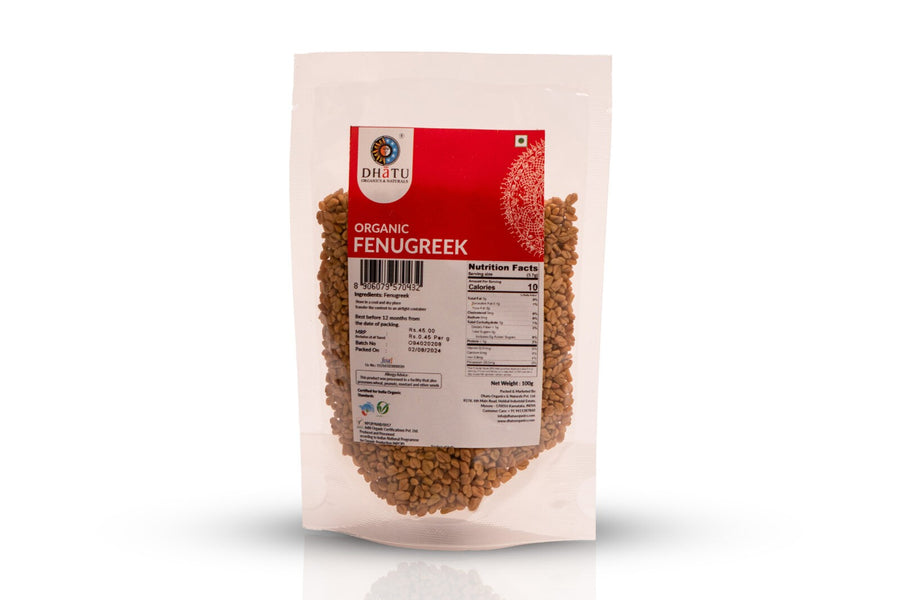
Organic Fenugreek Whole 100g
₹ 60.00
Dhatu Organics Organic Fenugreek Whole 100g delivers certified organic Trigonella foenum-graecum seeds — the amber, slightly bitter methi seeds that are a cornerstone of Indi... Read more ↓
100% Organic
No Additives
Free Delivery ₹499+
Organic Fenugreek Seeds (Trigonella foenum-graecum)
Nutrition Facts
| Nutrient | Per serving | Per 100g | % RDA* |
|---|---|---|---|
| Per 100g | Energy 323 kcal | Protein 23.0g | Carbohydrates 58.4g |
| Per 5g serving (1 tsp) | Energy 16.2 kcal | Protein 1.15g | Iron 1.68mg |
* % RDA based on a 2000 kcal reference diet (FSSAI). Values are approximate and may vary by batch.
We deliver across India within 3–5 business days via trusted logistics partners.
- Free delivery on orders above ₹499.
- Orders dispatched within 1 business day of payment confirmation.
- Perishable goods cannot be returned once dispatched. Non-perishable items may be returned within 7 days in original, unopened condition.
- For damaged or incorrect items, contact info@dhatuorganics.com within 48 hours of delivery.
Choose Your Pack
Dhatu Organics Organic Fenugreek Whole 100g delivers certified organic Trigonella foenum-graecum seeds — the amber, slightly bitter methi seeds that are a cornerstone of Indian pickles, spice blends, and traditional wellness practices. These whole seeds retain their full complement of steroidal saponins, galactomannans, and volatile compounds that are partially lost when ground.
Galactomannan Fibre: Fenugreek seeds contain a remarkable mucilaginous soluble fibre called galactomannan, which forms a thick gel in the digestive tract. This gel slows gastric emptying and nutrient absorption, producing a sustained feeling of fullness. Research on this fibre has generated significant scientific interest for its effects on digestive health and appetite regulation.
Ingredients
Organic Fenugreek Seeds (Trigonella foenum-graecum)
Single ingredient · No additives · No preservatives · Certified organic
Certified Organic
Non-GMO
Gluten-Free
Vegan
Nutrition Facts
Per 100g · Per 5g serving (approx. 1 tsp whole)
| Nutrient | Per 100g | Per 5g |
|---|---|---|
| Energy | 323 kcal | 16.2 kcal |
| Protein | 23.0 g | 1.15 g |
| Carbohydrates | 58.4 g | 2.92 g |
| Total Fat | 6.4 g | 0.32 g |
| Dietary Fibre | 24.6 g | 1.23 g |
| Iron | 33.5 mg | 1.68 mg |
| Magnesium | 191 mg | 9.55 mg |
| Calcium | 176 mg | 8.8 mg |
Values approximate. Source: USDA FoodData Central.
Key Benefits
- Extraordinary Iron Content: 33.5 mg iron per 100g — one of the highest iron concentrations in any spice or food. A single teaspoon provides approximately 1.68 mg iron, supporting haemoglobin production and oxygen transport.[1]
- Galactomannan Soluble Fibre: The unique galactomannan fibre in fenugreek seeds forms a viscous gel in the gut, slowing digestion, increasing satiety, and supporting gut microbiome diversity.[2]
- High Plant Protein: 23g protein per 100g including essential amino acids lysine and tryptophan, which are often limiting in legume and grain-heavy Indian diets.
- 4-Hydroxyisoleucine: A unique amino acid found only in fenugreek, studied for its effects on insulin secretion from pancreatic beta cells — one of the most researched compounds in this seed.[3]
- Traditional Hair and Skin Wellness: Fenugreek seeds soaked overnight and applied as a paste are used traditionally across India for hair conditioning and scalp health.
Research at a Glance
| Benefit | Study Finding | Reference |
|---|---|---|
| Iron density | 33.5 mg iron/100g — among highest of common foods; supports haemoglobin | USDA FoodData Central[1] |
| Satiety fibre | Galactomannan reduces appetite and slows gastric emptying in RCTs | Mathern et al., 2009[2] |
| 4-Hydroxyisoleucine | Unique amino acid in fenugreek studied for insulin-related mechanisms | Broca et al., 1999[3] |
How to Use
- Panch Phoron: One of five seeds in the Bengali whole spice blend — add whole to hot oil for instant tempering aroma.
- Pickles (Achaar): Whole fenugreek seeds are essential in traditional Indian mango and lemon pickles — they absorb the oil and spices and develop a wonderful bitter-savoury flavour over time.
- Dosa Batter: Soak 1–2 tsp of whole fenugreek seeds with rice when preparing dosa or idli batter — the seeds ferment along with the batter and make the finished dosa crisper and more flavourful.
- Overnight Soak: Soak 1 tsp in 250 ml water overnight; drink the water and chew the softened seeds in the morning as a traditional morning wellness ritual.
- Tadka: Add sparingly to hot oil — they turn dark and bitter quickly, so use less than you think (a pinch goes a long way).
Frequently Asked Questions
Why do fenugreek seeds taste bitter?
The bitterness comes from steroidal saponins, particularly diosgenin, which are present in the seed coat. This bitterness is an acquired taste for many and forms an important flavour dimension in South Indian pickles and Bengali cuisine. Dry-roasting fenugreek until just golden (not dark) mellows the bitterness significantly. Soaking in water overnight also reduces bitterness.
What is the recommended daily amount of fenugreek seeds?
Traditional use in Indian cooking involves small culinary amounts — typically ¼ to 1 teaspoon per dish. For the overnight soak practice, 1 teaspoon is conventional. As a supplement, doses of 5–30g per day have been used in clinical studies; however, consult a healthcare provider before using fenugreek for therapeutic purposes, as it can interact with certain medications and affect hormone-sensitive conditions.
Can I use whole fenugreek in place of fenugreek powder?
Yes, but they are not directly interchangeable by volume. Whole seeds have a firmer texture and slower flavour release; they are best added early in cooking (in hot oil/tadka) or soaked before use. Powder releases flavour immediately and works in batter, marinades, and ground spice blends. For pickles, whole seeds are always preferred. To convert: 1 tsp whole seeds is approximately equivalent to ½ tsp ground powder in intensity.
Is fenugreek the same as methi leaves?
No — both come from the same plant (Trigonella foenum-graecum), but they have quite different flavours and uses. Fenugreek seeds (methi dana) are hard, amber, intensely bitter seeds used as a spice. Methi leaves (fresh or dried) are the soft green herb used in methi paratha, dal methi, and countless sabzis. The leaves are milder and herbaceous; the seeds are more intensely flavoured and medicinal.
Can fenugreek seeds be used for hair care?
Yes — a traditional practice across India involves soaking fenugreek seeds overnight, blending into a paste, and applying to the scalp before washing. The mucilaginous galactomannan provides conditioning properties, while protein and saponins are thought to support scalp health. This is a cosmetic use and separate from its culinary applications.
Explore More from Dhatu Organics
- Organic Fenugreek Powder 100g — ground form for batters, curries, and spice blends
- Organic Black Mustard 100g — fellow panch phoron seed
- Organic Cumin Whole 100g — for tadka alongside fenugreek
- All Organic Spices — browse our complete certified organic spice collection
Scientific References
- USDA FoodData Central. Spices, fenugreek seed. fdc.nal.usda.gov
- Mathern JR, et al. Effect of fenugreek fiber on satiety, blood glucose and insulin response and energy intake in obese subjects. Phytother Res. 2009;23(11):1543–8. doi:10.1002/ptr.2795
- Broca C, et al. 4-Hydroxyisoleucine: experimental evidence of its insulinotropic and antidiabetic properties. Am J Physiol. 1999;277(4 Pt 1):E617–23. doi:10.1152/ajpendo.1999.277.4.E617