

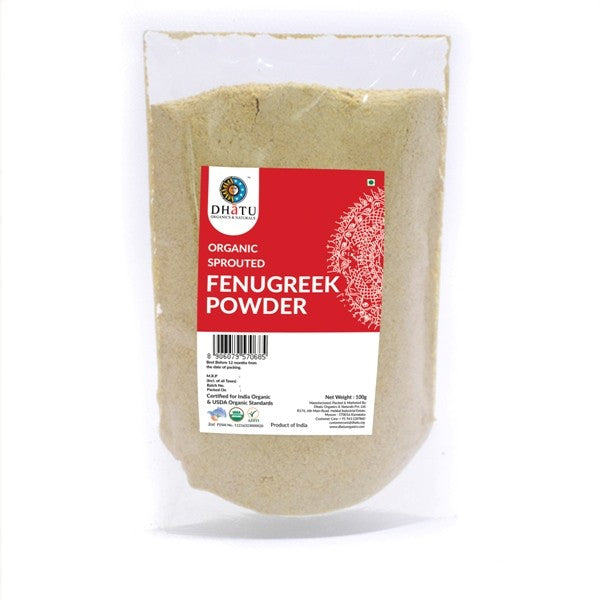
Organic Fenugreek Powder 100g
₹ 60.00
Dhatu Organics Organic Fenugreek Powder 100g is certified organic Trigonella foenum-graecum seeds, stone-ground to a fine powder — delivering all the bioactive compounds of wh... Read more ↓
100% Organic
No Additives
Free Delivery ₹749+
Organic Fenugreek Powder (Trigonella foenum-graecum)
Nutrition Facts
| Nutrient | Per serving | Per 100g | % RDA* |
|---|---|---|---|
| Per 100g | Energy 323 kcal | Protein 23.0g | Carbohydrates 58.4g |
| Per 5g (1 tsp) | Energy 16.2 kcal | Protein 1.15g | Iron 1.68mg |
* % RDA based on a 2000 kcal reference diet (FSSAI). Values are approximate and may vary by batch.
We deliver across India within 3–5 business days via trusted logistics partners.
- Free delivery on orders above ₹749.
- Orders dispatched within 1 business day of payment confirmation.
- Perishable goods cannot be returned once dispatched. Non-perishable items may be returned within 7 days in original, unopened condition.
- For damaged or incorrect items, contact info@dhatuorganics.com within 48 hours of delivery.
Choose Your Pack
Dhatu Organics Organic Fenugreek Powder 100g is certified organic Trigonella foenum-graecum seeds, stone-ground to a fine powder — delivering all the bioactive compounds of whole fenugreek in a ready-to-use form. Fenugreek powder has a distinct bitter, slightly sweet flavour profile and an unmistakable maple-like aroma from sotolone — the compound responsible for the characteristic fragrance of both fenugreek and maple syrup.
The Sotolone Connection: The compound responsible for fenugreek’s characteristic maple-like aroma is sotolone (3-hydroxy-4,5-dimethyl-2(5H)-furanone) — the same compound that gives maple syrup its distinctive smell. Sotolone is also produced in the body after consuming fenugreek: some individuals notice that their perspiration and urine acquire a mild maple-like smell after eating fenugreek, which is a harmless metabolic phenomenon. This fragrance marker is one reason fenugreek is easily identified in spice blends.
Ingredients
Organic Fenugreek Powder (Trigonella foenum-graecum)
Single ingredient · No additives · No preservatives · Certified organic
Certified Organic Non-GMO Gluten-Free Vegan
Nutrition Facts
Per 100g · Per 5g serving (approx. 1 tsp powder)
| Nutrient | Per 100g | Per 5g |
|---|---|---|
| Energy | 323 kcal | 16.2 kcal |
| Protein | 23.0 g | 1.15 g |
| Carbohydrates | 58.4 g | 2.92 g |
| Total Fat | 6.4 g | 0.32 g |
| Dietary Fibre | 24.6 g | 1.23 g |
| Iron | 33.5 mg | 1.68 mg |
| Calcium | 176 mg | 8.8 mg |
| Magnesium | 191 mg | 9.6 mg |
Values approximate. Source: USDA FoodData Central.
Key Benefits
- Outstanding Iron Content: 33.5 mg iron per 100g — among the highest of any common culinary spice. Even at a 5g serving, fenugreek powder provides 1.68 mg iron (approximately 9–21% of daily requirements depending on physiological state).
- Soluble Fibre (Galactomannan): Fenugreek’s primary functional fibre is galactomannan — a viscous soluble fibre that forms a gel in the GI tract, slowing absorption and prolonging satiety. Galactomannan has been extensively studied for its effects on digestive transit and satiety signalling.[1]
- 4-Hydroxyisoleucine (4-HI): A unique amino acid found almost exclusively in fenugreek, 4-HI has been studied in multiple trials for its effects on various metabolic parameters in research settings.[2]
- Digestive Bitter: Fenugreek’s characteristic bitterness stimulates bile secretion and digestive enzyme activity — one reason it is traditionally paired with fats and proteins in Indian cooking to aid digestion.[3]
- High Protein: 23g protein per 100g — more than most other spices. As a regular cooking ingredient, fenugreek powder contributes meaningfully to protein intake alongside its flavour and functional properties.
Research at a Glance
| Benefit | Study Finding | Reference |
|---|---|---|
| Galactomannan satiety | Fenugreek fibre supplementation significantly increases satiety and reduces food intake in trials | Mathern et al., 2009[1] |
| 4-Hydroxyisoleucine | 4-HI studied for metabolic effects in multiple controlled trials; unique to fenugreek | Jetté et al., 2009[2] |
| Digestive stimulation | Fenugreek bitters stimulate bile flow and digestive secretions | Platel & Srinivasan, 2004[3] |
How to Use
- Dal and Curries: Add ¼–½ tsp to the masala base of any dal or vegetable curry — fenugreek powder integrates into the sauce and contributes its signature earthy warmth without the textural presence of whole seeds.
- Sambar Powder: A key component of homemade sambar powder alongside coriander, cumin, and chilli.
- Methi Paratha: Add 1–2 tsp to whole wheat dough for methi-flavoured flatbreads without requiring fresh methi leaves.
- Spice Rubs: Mix with cumin, coriander, chilli, and turmeric as a dry rub for roasted vegetables or paneer.
- Pickle Spice: Fenugreek powder is an ingredient in traditional oil-preserved pickles, where its bitterness adds depth of flavour.
Frequently Asked Questions
Does fenugreek powder taste bitter?
Yes — fenugreek has a characteristic bitterness that is integral to its flavour. The bitterness comes from alkaloids (trigonelline) and saponins (diosgenin). In cooking, this bitterness is balanced by fat (oil or ghee), acid (tamarind), and other spices. Using more than the recommended amount of fenugreek powder makes dishes unpleasantly bitter — start with ¼ tsp per serving and adjust. The bitterness mellows with longer cooking times.
Can I use fenugreek powder instead of whole fenugreek seeds?
Yes — fenugreek powder is essentially ground fenugreek seeds. Use approximately ½ tsp of fenugreek powder to replace 1 tsp of whole seeds. The powder integrates more evenly into dishes and is better for sauces, gravies, and spice rubs. Whole seeds provide more textural contrast and a slightly different flavour release in tadka. Powder is better when even dispersion is important.
Why does my sweat smell like maple syrup after eating fenugreek?
This is a harmless and well-documented phenomenon. Fenugreek contains sotolone, which the body partially excretes through sweat and urine. The effect is temporary and typically resolves within 24 hours of consuming fenugreek. It is more noticeable when consuming larger quantities (as a supplement) than at typical culinary doses. The phenomenon is sometimes confused with a rare metabolic condition called Maple Syrup Urine Disease (MSUD), which is entirely different — in fenugreek consumers, there is no underlying metabolic issue.
Explore More from Dhatu Organics
- Organic Fenugreek Whole 100g — whole seeds for tadka and pickle making
- Organic Cumin Powder 100g — classic pairing with fenugreek in spice blends
- Organic Coriander Powder 100g — mild base for sambar and curry powder blends
- All Organic Spices — browse our complete certified organic spice collection
Scientific References
- Platel K, Srinivasan K. Digestive stimulant action of spices: a myth or reality? Indian J Med Res. 2004;119(5):167–79.