

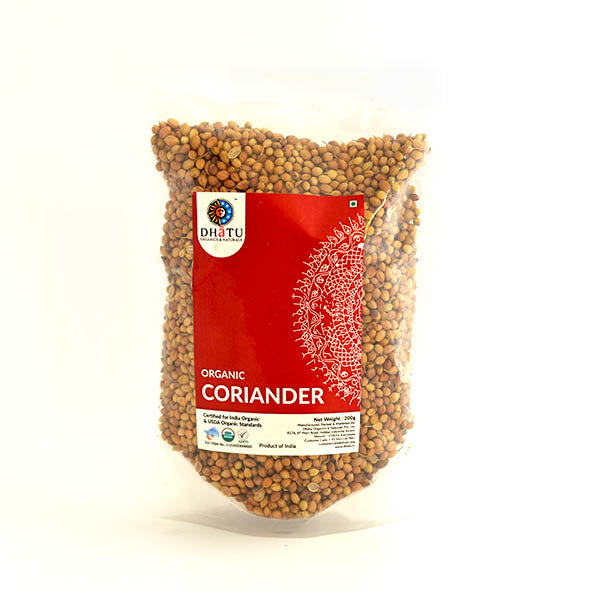
Organic Coriander Whole 200g
₹ 150.00
Dhatu Organics Organic Coriander Whole 200g brings you certified organic Coriandrum sativum seeds from India’s prime coriander-growing districts. These whole seeds are the ar... Read more ↓
100% Organic
No Additives
Free Delivery ₹499+
Organic Coriander Seeds (Coriandrum sativum). Single ingredient. No additives, no preservatives. Certified Organic.
Nutrition Facts
| Nutrient | Per serving | Per 100g | % RDA* |
|---|---|---|---|
| Energy 298 kcal | Protein 12.4g | Carbs 54.9g | Fat 17.8g | Fibre 41.9g | Iron 16.3mg | Calcium 709mg per 100g. Source | USDA FoodData Central. |
* % RDA based on a 2000 kcal reference diet (FSSAI). Values are approximate and may vary by batch.
We deliver across India within 3–5 business days via trusted logistics partners.
- Free delivery on orders above ₹499.
- Orders dispatched within 1 business day of payment confirmation.
- Perishable goods cannot be returned once dispatched. Non-perishable items may be returned within 7 days in original, unopened condition.
- For damaged or incorrect items, contact info@dhatuorganics.com within 48 hours of delivery.
Choose Your Pack
Dhatu Organics Organic Coriander Whole 200g brings you certified organic Coriandrum sativum seeds from India’s prime coriander-growing districts. These whole seeds are the aromatic foundation of Indian, Middle Eastern, and Mediterranean cooking — gently citrusy, mildly sweet, and the classic companion to cumin in every masala blend.
Remarkable Fibre Content: Whole coriander seeds contain 41.9g dietary fibre per 100g — one of the highest among common spices. Even at culinary doses, coriander contributes meaningful fibre to support digestive regularity and gut microbiome health. The seeds also contain linalool, a terpenoid compound studied for its calming and antimicrobial properties.
Ingredients
Organic Coriander Seeds (Coriandrum sativum)
Single ingredient · No additives · No preservatives · Certified organic
Certified Organic
Non-GMO
Gluten-Free
Vegan
Nutrition Facts
Per 100g · Per 2g serving (approx. 1 tsp whole)
| Nutrient | Per 100g | Per 2g |
|---|---|---|
| Energy | 298 kcal | 6.0 kcal |
| Protein | 12.4 g | 0.25 g |
| Carbohydrates | 54.9 g | 1.10 g |
| Total Fat | 17.8 g | 0.36 g |
| Dietary Fibre | 41.9 g | 0.84 g |
| Iron | 16.3 mg | 0.33 mg |
| Calcium | 709 mg | 14.2 mg |
Values approximate. Source: USDA FoodData Central.
Key Benefits
- Exceptional Dietary Fibre: At 41.9g fibre per 100g, coriander seeds support digestive regularity, prebiotic gut health, and satiety — among the highest fibre content of any common kitchen spice.[1]
- Digestive Carminative: Linalool and other volatile oils in coriander reduce intestinal spasm, relieve bloating, and ease gas — used for centuries in Ayurveda as a digestive tonic.[2]
- Antioxidant and Antimicrobial: Quercetin, kaempferol, and linalool in coriander show antioxidant and antimicrobial properties against food-spoiling bacteria.[2]
- Calcium-Rich: 709 mg calcium per 100g supports bone health, muscle function, and nerve transmission — notable for vegetarian and vegan diets.
- Iron Source: 16.3 mg iron per 100g makes coriander seeds a meaningful plant-based iron contributor, especially in dhania-based spice blends used daily.
Research at a Glance
| Benefit | Study Finding | Reference |
|---|---|---|
| Dietary fibre | 41.9g per 100g — among highest of common spices, supporting gut health | USDA FoodData Central[1] |
| Digestive and antimicrobial | Linalool and volatile oils reduce intestinal spasm; antimicrobial against common pathogens | Sahib et al., 2013[2] |
| Antioxidant activity | Quercetin and kaempferol show DPPH radical scavenging activity | Bhat et al., 2014[3] |
How to Use
- Masala Base (Tadka): Lightly toast whole coriander seeds in ghee or oil with cumin and mustard for a fragrant three-seed tempering that grounds curries and dals.
- Homemade Coriander Powder: Dry-roast and grind for fresh dhania powder far more aromatic than any commercial product.
- Rasam and Sambar: Whole or coarsely crushed coriander seeds add texture and flavour to South Indian rasam and sambar.
- Coriander Tea: Simmer 1 tsp seeds in 300 ml water for 10 minutes — a traditional digestive remedy after heavy meals.
- Pickles and Chutneys: Whole seeds used in achaar (pickle) blends and as a finishing garnish on fresh chutneys.
Frequently Asked Questions
Are coriander seeds and dhania the same thing?
Yes. Coriander seed and dhania refer to the same seed: the dried fruit of Coriandrum sativum. The fresh leaves of the same plant are called coriander leaves, cilantro, or hara dhania. This product is the dried seed used as a whole spice — not the fresh herb.
Should I toast coriander seeds before using?
Dry-toasting (no fat) in a pan for 1–2 minutes intensifies their citrusy, floral aroma by volatilising and activating the linalool content. Toast over medium heat until fragrant — not until they darken, which makes them bitter. Toast whole, then grind or add to dishes as needed.
What is the difference between whole seeds and coriander powder?
Whole seeds stay fresh 3–4 years; ground powder loses peak aroma in 3–6 months. If you use coriander frequently, buying whole seeds and grinding in batches ensures always-fresh powder. For convenience, Dhatu’s Organic Coriander Powder 100g is freshly milled without anti-caking agents.
Can I use coriander seeds in sweet dishes?
Yes. Coriander seeds have a mild, citrusy, slightly floral sweetness that pairs surprisingly well with citrus desserts, fruit chutneys, and spiced cookies. They are used in some South Indian and Rajasthani sweets and in certain chai blends for their aromatic lift.
How should I store the 200g pack?
Transfer to an airtight glass jar immediately. Store in a cool, dark cupboard away from heat and moisture. Whole coriander seeds maintain their aroma and nutritional profile for 3–4 years when properly stored. Use a dry spoon to prevent moisture from entering.
Explore More from Dhatu Organics
- Organic Coriander Powder 100g — freshly milled from the same whole seeds
- Dhaniya Powder 500g — economy size for heavy-use households
- Organic Cumin Whole 100g — the essential companion to coriander in Indian masalas
- Organic Garam Masala Powder 50g — a complete blend built on coriander and cumin
- All Organic Spices — browse our complete certified organic spice collection
Scientific References
- USDA FoodData Central. Spices, coriander seed. fdc.nal.usda.gov
- Sahib AS, et al. Coriander (Coriandrum sativum L.): A potential source of high-value components for functional foods and nutraceuticals. Phytochem Rev. 2013;12:535–548. doi:10.1007/s11101-013-9322-1
- Bhat S, et al. Antioxidant and antimicrobial properties of Coriandrum sativum. J Food Sci Technol. 2014;51(1):288–92.