

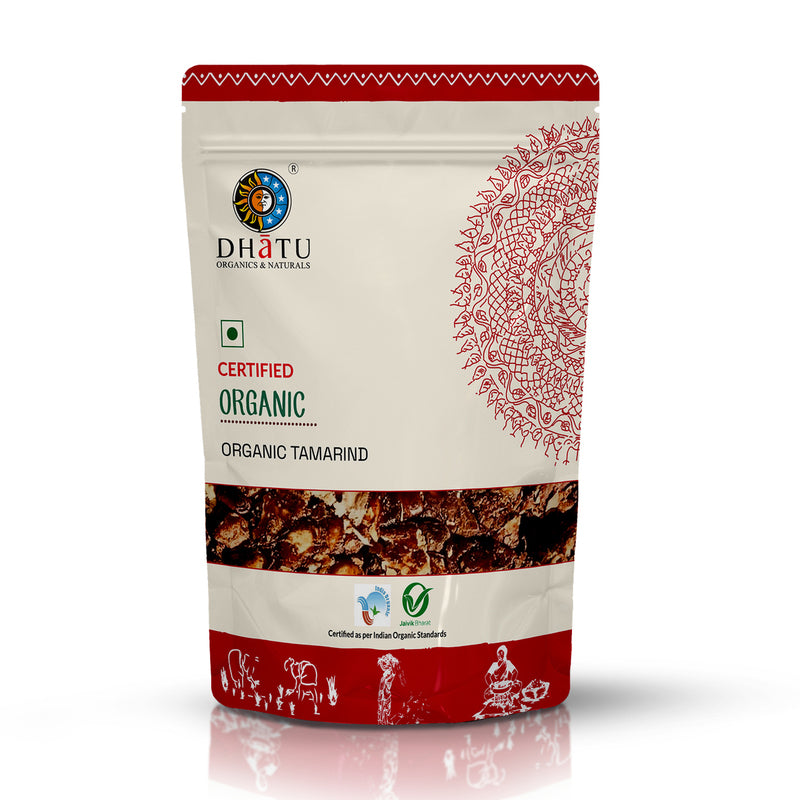
Organic Tamarind 500g
₹ 220.00
Dhatu Organics Organic Tamarind 500g is certified organic Tamarindus indica — the pod fruit of the tamarind tree, native to tropical Africa but cultivated across South Asia, ... Read more ↓
100% Organic
No Additives
Free Delivery ₹499+
Organic Tamarind Pulp (Tamarindus indica)
Nutrition Facts
| Nutrient | Per serving | Per 100g | % RDA* |
|---|---|---|---|
| Per 100g | Energy 239 kcal | Protein 2.8g | Carbohydrates 62.5g |
| Per 15g serving (1 tbsp paste) | Energy 35.9 kcal | Potassium 94.2mg |
* % RDA based on a 2000 kcal reference diet (FSSAI). Values are approximate and may vary by batch.
We deliver across India within 3–5 business days via trusted logistics partners.
- Free delivery on orders above ₹499.
- Orders dispatched within 1 business day of payment confirmation.
- Perishable goods cannot be returned once dispatched. Non-perishable items may be returned within 7 days in original, unopened condition.
- For damaged or incorrect items, contact info@dhatuorganics.com within 48 hours of delivery.
Choose Your Pack
Dhatu Organics Organic Tamarind 500g is certified organic Tamarindus indica — the pod fruit of the tamarind tree, native to tropical Africa but cultivated across South Asia, Southeast Asia, and Latin America for thousands of years. This sun-dried tamarind pulp is the backbone of South Indian cooking: the souring agent in sambar, rasam, puliyogare, and tamarind rice, as well as a key ingredient in chutneys, marinades, and tamarind-based sauces worldwide.
The Tartaric Acid Difference: Unlike most sour fruits that derive acidity from citric acid, tamarind’s tartness comes primarily from tartaric acid — the same organic acid found in grapes and wine. This gives tamarind a distinctive deep, rounded sourness that lingers differently on the palate than lemon or vinegar. Tartaric acid is also more stable in cooking, holding its sourness even through extended heat.
Ingredients
Organic Tamarind Pulp (Tamarindus indica)
Single ingredient · No additives · No preservatives · Certified organic
Certified Organic
Non-GMO
Gluten-Free
Vegan
Nutrition Facts
Per 100g raw pulp · Per 15g serving (approx. 1 tbsp paste)
| Nutrient | Per 100g | Per 15g |
|---|---|---|
| Energy | 239 kcal | 35.9 kcal |
| Protein | 2.8 g | 0.42 g |
| Carbohydrates | 62.5 g | 9.38 g |
| Total Fat | 0.6 g | 0.09 g |
| Dietary Fibre | 5.1 g | 0.77 g |
| Potassium | 628 mg | 94.2 mg |
| Magnesium | 92 mg | 13.8 mg |
| Iron | 2.8 mg | 0.42 mg |
Values approximate. Source: USDA FoodData Central.
Key Benefits
- Rich in Tartaric Acid: The primary organic acid in tamarind, tartaric acid acts as a natural antioxidant, chelates metals, and gives tamarind its characteristic rounded sourness more stable under cooking than citric acid.[1]
- Digestive Aid: Tamarind is a traditional digestive remedy — the tartaric acid and potassium stimulate digestive enzyme activity, and fibre content supports gut motility. Used across Ayurvedic and traditional medicine systems for digestive complaints.[2]
- High Potassium: 628 mg potassium per 100g supports electrolyte balance, cardiac function, and blood pressure regulation — at culinary doses a useful mineral contribution.
- Antimicrobial Properties: Tamarind seed extract and bark compounds show inhibitory activity against multiple bacteria and fungi in laboratory studies.[3]
- Natural Souring Agent: Replaces synthetic citric acid or tamarind-flavoured powders in cooking, providing a complex, layered sourness that processed souring agents cannot replicate.
Research at a Glance
| Benefit | Study Finding | Reference |
|---|---|---|
| Tartaric acid antioxidant | Tartaric acid chelates metal ions; antioxidant activity confirmed in-vitro | De Caluwé et al., 2010[1] |
| Digestive activity | Tamarind pulp used across South Asian medicine for digestive stimulation; fibre supports motility | El-Siddig et al., 2006[2] |
| Antimicrobial | Tamarind extracts show inhibition against S. aureus, E. coli, and Candida species | Maiti et al., 2007[3] |
How to Use
- Tamarind Paste: Soak a golf-ball sized piece (approximately 30g) in 200 ml of warm water for 15–20 minutes, squeeze well, and strain. This tamarind extract is used in sambar, rasam, and puliyogare.
- South Indian Curries: Replaces lemon in many South Indian and Sri Lankan dishes — the depth of tartness rounds out coconut and spice bases.
- Chutneys: Sweet tamarind chutney (imli chutney) — cook with jaggery, cumin, and chilli for the classic accompaniment to chaat, samosas, and kebabs.
- Rasam: Thin tamarind water simmered with tomato, pepper, and cumin — the classic South Indian digestive soup traditionally served with rice.
- Marinades: Tamarind’s natural acids tenderize proteins; use tamarind paste in marinades for paneer, vegetables, or meat.
Frequently Asked Questions
How do I make tamarind paste from block tamarind?
Break off the required amount from the block. Soak in warm water (1 part tamarind : 4–5 parts water) for 15–20 minutes. Squeeze and work the pulp with your fingers to dissolve into the water, then strain through a sieve pressing firmly. The resulting liquid is tamarind extract; reduce by simmering for a thicker paste. Refrigerate unused paste in an airtight jar for 2–3 weeks.
Can I substitute lemon for tamarind?
Lemon juice can approximate tamarind’s sourness in a pinch, but the flavour profile is distinctly different. Tamarind has a deeper, fruitier, more complex sourness from tartaric acid; lemon is brighter and sharper from citric acid. Tamarind’s sourness is also more stable in prolonged cooking. For authentic South Indian dishes like sambar or puliyogare, there is no equivalent substitute.
How do I store block tamarind?
Store in an airtight container at room temperature for 6–12 months. Tamarind keeps very well at room temperature due to its high acid content, which inhibits mould. For longer storage, refrigerate or freeze. Do not store in direct sunlight, which accelerates oxidation and flavour loss.
What is the difference between raw tamarind and sweet tamarind?
The tamarind used in Indian cooking is the fully ripe, dried pulp (sour tamarind) — deeply tart. Sweet tamarind is a different cultivar with lower acidity, eaten as a fresh fruit in Southeast Asia. Dhatu’s product is the culinary sour variety, appropriate for all South Indian cooking applications.
Why is tamarind used in South Indian cooking instead of lemon?
Tamarind became the primary souring agent in South Indian cuisine for both flavour and practical reasons: it was abundant, preserved easily, and provided a deeper, more rounded sourness than fresh citrus that works better in slow-cooked dishes. Tamarind’s acidity also acts as a natural preservative, which was important before refrigeration. Culturally, tamarind-based sourness is considered complementary to the spices, lentils, and coconut of South Indian cuisine in a way that lemon is not.
Explore More from Dhatu Organics
- Organic Coriander Powder 100g — key component of sambar alongside tamarind
- Organic Cumin Whole 100g — for rasam and sambar tempering
- Organic Red Chilli Powder 100g — the spice that balances tamarind’s sourness
- All Organic Spices — browse our complete certified organic spice collection
Scientific References
- De Caluwé E, et al. Tamarindus indica L. — A review of traditional uses, phytochemistry and pharmacology. Afrika Focus. 2010;23(1):53–83.
- El-Siddig K, et al. Tamarind (Tamarindus indica). Southampton: International Centre for Underutilised Crops, University of Southampton; 2006.
- Maiti R, et al. Hepatoprotective effect of aqueous extract of Tamarindus indica seeds. J Ethnopharmacol. 2007;119(1):135–41. doi:10.1016/j.jep.2008.06.006