

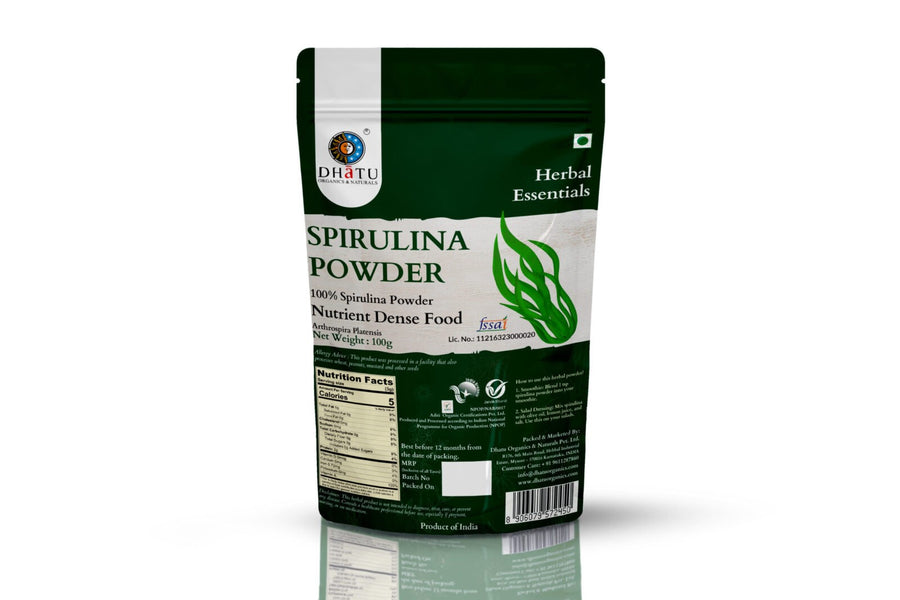
Organic Spirulina Powder 100g
₹ 380.00
Dhatu Organics Organic Spirulina Powder is made from Arthrospira platensis — a blue-green microalgae and one of the most nutrient-dense foods on Earth. Spirulina contains 57–... Read more ↓
100% Organic
No Additives
Free Delivery ₹499+
Organic Spirulina Powder (Arthrospira platensis)
Nutrition Facts
| Nutrient | Per serving | Per 100g | % RDA* |
|---|---|---|---|
| Energy | 14.5 kcal | 290 kcal | <1% |
| Protein (complete) | 2.9 g | 57.5 g | 5.8% |
| Carbohydrates | 1.2 g | 23.9 g | <1% |
| Total Fat | 0.39 g | 7.7 g | <1% |
| Iron | 1.43 mg | 28.5 mg | 8.4% |
| Copper | 0.31 mg | 6.1 mg | 34.4% |
| Vitamin B1 (Thiamine) | 0.12 mg | 2.38 mg | 10.9% |
| Vitamin B2 (Riboflavin) | 0.18 mg | 3.67 mg | 13.9% |
| Vitamin B3 (Niacin) | 0.64 mg | 12.8 mg | 4.6% |
| Phycocyanin | 750 mg | ~15 g |
* % RDA based on a 2000 kcal reference diet (FSSAI). Values are approximate and may vary by batch.
We deliver across India within 3–5 business days via trusted logistics partners.
- Free delivery on orders above ₹499.
- Orders dispatched within 1 business day of payment confirmation.
- Perishable goods cannot be returned once dispatched. Non-perishable items may be returned within 7 days in original, unopened condition.
- For damaged or incorrect items, contact info@dhatuorganics.com within 48 hours of delivery.
Choose Your Pack
Dhatu Organics Organic Spirulina Powder is made from Arthrospira platensis — a blue-green microalgae and one of the most nutrient-dense foods on Earth. Spirulina contains 57–65g of complete protein per 100g (more than any animal or plant food), along with iron, B vitamins, and phycocyanin — its signature blue pigment and one of the most potent anti-inflammatory compounds in the natural world. Our spirulina is grown in controlled alkaline freshwater ponds, spray-dried at low temperature, and certified free of microcystins and heavy metals.
NASA's Superfood for Space: NASA and the European Space Agency (ESA) have both studied Spirulina as a potential crop for long-term space missions due to its extraordinary nutrient density per gram. One kilogram of Spirulina provides equivalent nutrition to approximately one tonne of mixed vegetables.
57gComplete Protein per 100g
28.5mgIron per 100g
20%GDA Copper per tbsp
~15%Phycocyanin (active)
🌿 Ingredients
Organic Spirulina Powder (Arthrospira platensis)
Single-ingredient. Grown in controlled alkaline freshwater ponds. Spray-dried at low temperature. Third-party tested for heavy metals, microcystins, and microbial safety.
Certified Organic
Non-GMO
Gluten-Free
Vegan
Complete Protein
📊 Nutrition Facts
Per 100g · Per 5g serving (1 tsp)
| Nutrient | Per 100g | Per 5g |
|---|---|---|
| Energy | 290 kcal | 14.5 kcal |
| Protein (complete) | 57.5 g | 2.9 g |
| Carbohydrates | 23.9 g | 1.2 g |
| Total Fat | 7.7 g | 0.39 g |
| Iron | 28.5 mg | 1.43 mg |
| Vitamin B1 (Thiamine) | 2.38 mg | 0.12 mg |
| Vitamin B2 (Riboflavin) | 3.67 mg | 0.18 mg |
| Vitamin B3 (Niacin) | 12.8 mg | 0.64 mg |
| Copper | 6.1 mg | 0.31 mg |
| Phycocyanin | ~15 g | 750 mg |
Source: USDA FoodData Central (NDB 11667).
Key Benefits
- Highest Protein Density of Any Whole Food: Spirulina contains 57–65% protein by dry weight — more than soy (36%), lentils (25%), or chicken (31%). It is a complete protein containing all 9 essential amino acids including leucine, the primary trigger for muscle protein synthesis.[1]
- Powerful Anti-Inflammatory via Phycocyanin: Phycocyanin — the blue pigment unique to Spirulina — is one of the most potent natural COX-2 inhibitors (the same enzyme targeted by ibuprofen). It simultaneously inhibits NF-κB and reduces pro-inflammatory cytokines including TNF-α and IL-6.[2]
- Antioxidant Activity: Spirulina has an ORAC value of ~5,700 µmol TE per gram — among the highest of any food. Phycocyanin alone scavenges hydroxyl radicals more effectively than glutathione in vitro.[2]
- Supports Healthy Lipid Profiles: Multiple RCTs show Spirulina reduces LDL cholesterol and triglycerides while increasing HDL — with effects observed within 4–8 weeks at 1–4g/day.[3]
- Supports Healthy Blood Sugar Balance: Spirulina reduces fasting blood glucose and post-meal glucose elevation by improving insulin sensitivity and reducing glycation of haemoglobin (HbA1c) in clinical trials.[4]
- Iron-Rich for Energy: With 28.5 mg iron per 100g, spirulina is one of the richest plant sources of iron in a highly absorbable form.[1]
- Natural Energy Support: The combination of B vitamins, iron, phycocyanin, and complete amino acids supports cellular energy production without caffeine — providing a sustained energy lift throughout the day.
Research at a Glance
| Benefit | Study Finding | Reference |
|---|---|---|
| Protein and nutrition | All essential amino acids; 57–65% protein by dry weight; recognised by WHO/NASA as priority food | Deng & Chow, 2010[1] |
| Anti-inflammatory | Phycocyanin inhibits COX-2 and reduces TNF-α, IL-6; comparable to NSAIDs in vitro | Romay et al., 2003[2] |
| Cholesterol | Reduced LDL, raised HDL; lowered triglycerides in multiple RCTs (1–8g/day) | Mazokopakis et al., 2014[3] |
| Blood sugar balance | Reduced fasting glucose and HbA1c vs placebo (12-week RCT) | Parikh et al., 2001[4] |
How to Use
- Green Smoothie (Most Popular): Blend 1 tsp with banana, mango, coconut water, and ginger. The fruit sweetness completely masks the sea-like flavour.
- Spirulina Lemonade: Mix ½ tsp in 300 ml cold water with lemon juice, honey or jaggery, and a pinch of black salt. Deeply refreshing and energising.
- Morning Energy Shot: Stir 1 tsp into 100 ml water or orange juice and take in one go.
- Protein Supplement: Add 1–2 tsp to post-workout protein shakes for an additional 3–6g of complete amino acids.
Suggested daily use: 1 tsp (5g) per day. Athletes or those targeting specific nutritional benefits may use up to 2–3 tsp/day. Best taken in the morning.
Frequently Asked Questions
Does Spirulina taste like the sea?
Yes — Spirulina has a distinctive mild oceanic, slightly sulfurous flavour that most people find challenging on its own. However, when blended with fruit (particularly mango, banana, pineapple, or berries) the flavour disappears completely. Blend it in a smoothie first to find a combination you enjoy.
Is Spirulina a reliable source of B12 for vegans?
This is a common misconception. While Spirulina contains a compound called pseudovitamin B12, this form is largely not bioavailable and does not meet human B12 requirements. The WHO and most nutrition authorities do not classify spirulina as a reliable B12 source for vegans. Vegans should still use certified B12 supplements or fortified foods. Spirulina does provide excellent B1, B2, and B3 in bioavailable forms.
Is Spirulina safe for daily use long-term?
Yes. Spirulina has been consumed safely by humans for centuries and is GRAS (Generally Recognised as Safe) by the US FDA. At 1–3g/day, it has an excellent long-term safety record in human clinical studies spanning up to 12 months. Always choose certified organic, third-party tested Spirulina to ensure it is free of heavy metals and microcystins.
Can Spirulina cause green or blue-coloured stools?
Yes, this is normal and harmless. The high chlorophyll and phycocyanin content will temporarily colour stools green or teal, particularly when first starting or at higher doses. This is a sign the product is absorbing and metabolising normally — no different from the green stool effect seen with high spinach or broccoli intake.
Explore More from Dhatu Organics
- Wheatgrass Powder — the complementary green superfood high in chlorophyll
- Moringa Powder — for iron, calcium, and broad-spectrum vitamins
- All Health Supplements
Scientific References
- Deng R, Chow TJ. Hypolipidemic, antioxidant, and antiinflammatory activities of microalgae Spirulina. Cardiovasc Ther. 2010;28(4):e33–45. doi:10.1111/j.1755-5922.2010.00200.x
- Romay C, et al. C-phycocyanin: a biliprotein with antioxidant, anti-inflammatory and neuroprotective effects. Curr Protein Pept Sci. 2003;4(3):207–16. doi:10.2174/1389203033487216
- Mazokopakis EE, et al. The hypolipidaemic effects of Spirulina supplementation in a Cretan population. Eur J Nutr. 2014;53(4):1273–9. doi:10.1007/s00394-013-0634-4
- Parikh P, et al. Role of Spirulina in the control of glycemia and lipidemia in type 2 diabetes mellitus. J Med Food. 2001;4(4):193–9. doi:10.1089/10966200152744463