

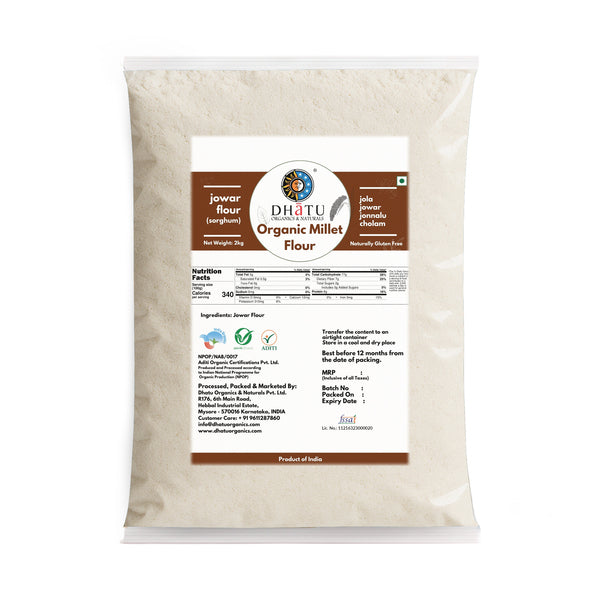
Organic Jowar Flour (Jowar Atta) – Stone-Ground Sorghum
₹ 110.00
Dhatu Organics Jowar Flour is organic jowar atta stone cold-milled from whole sorghum. Known as jola in Kannada, jonna in Telugu and jwari in Marathi, jowar flour has a mild, sl... Read more ↓
100% Organic
No Additives
Free Delivery ₹749+
100% Organic Sorghum (Jowar / Jonna / Jola / Cholam). Vegan. Naturally gluten-free. No preservatives, no additives, no artificial flavours or colours.
Nutrition FactsServing: 30g (3 tbsp)
| Nutrient | Per serving | Per 100g | % RDA* |
|---|---|---|---|
| Energy | 102 kcal | 339 kcal | 5.1% |
| Protein | 3.1g | 10.4g | 6.2% |
| Carbohydrates | 21.8g | 72.6g | 6.7% |
| Of which Sugars | 0.3g | 1g | <1% |
| Total Fat | 0.6g | 1.9g | <1% |
| Of which Saturated Fat | <0.1g | 0.3g | <1% |
| Dietary Fibre | 2.2g | 7.2g | 8.6% |
| Sodium | 3mg | 10mg | <1% |
| Iron | 1.3mg | 4.4mg | 7.6% |
| Magnesium | 50mg | 165mg | 14.6% |
| Niacin (B3) | 1.1mg | 3.7mg | 6.9% |
* % RDA based on a 2000 kcal reference diet (FSSAI). Values are approximate and may vary by batch.
We deliver across India within 3–5 business days via trusted logistics partners.
- Free delivery on orders above ₹749.
- Orders dispatched within 1 business day of payment confirmation.
- Perishable goods cannot be returned once dispatched. Non-perishable items may be returned within 7 days in original, unopened condition.
- For damaged or incorrect items, contact info@dhatuorganics.com within 48 hours of delivery.
Choose Your Pack
Dhatu Organics Jowar Flour is organic jowar atta stone cold-milled from whole sorghum. Known as jola in Kannada, jonna in Telugu and jwari in Marathi, jowar flour has a mild, slightly sweet taste and is the flour for jolada rotti, bhakri and soft gluten-free rotis.
What is jowar flour?
Jowar (Sorghum bicolor) is the traditional dryland grain of the Deccan. Jowar flour, or jowar atta, is the whole grain milled fine, with nothing removed. Its names in Indian languages:
- Kannada: jola (jolada hittu) · Telugu: jonna (jonna pindi) · Marathi: jwari · Tamil: cholam · Hindi: jowar
Of all the millet flours, jowar has one of the mildest flavours, so it is a good place to start if you are new to millet rotis.
Nutrition (per 100g, approx.)
- Magnesium: 165mg
- Protein: 10.4g
- Iron: 4.4mg
- Naturally gluten-free: 100% sorghum, no wheat
How to make soft jowar rotis
- Bring 1 cup of water to the boil with a pinch of salt.
- Add 1 cup of jowar flour, switch off the heat, stir and cover for 5 minutes.
- Knead the warm dough until smooth, adding a little water if it cracks.
- Pat or roll between two sheets, cook on a hot tawa and puff on the flame.
More ways to use jowar atta
- Jolada rotti and bhakri: thin Karnataka rottis or thick Maharashtrian bhakri, served with ennegai, pitla or chutney.
- Jowar dosa: mix into dosa batter, or use our ready jowar dosa mix.
- Ambali: a thin jowar porridge with buttermilk, a traditional summer drink.
- Multigrain atta: mix with whole wheat and ragi flour.
- Baking: blend with besan or other flours for cookies, muffins and pancakes.
Which pack should I buy?
Choose 500g to try it, and 2kg if jowar rotis are a regular part of your meals.
Frequently asked questions
Is jowar flour gluten-free?
Yes. Jowar is naturally gluten-free. If you have coeliac disease, please contact us about how it is packed before ordering.
Why do my jowar rotis crack?
Jowar has no gluten, so the dough needs heat to bind. Use boiling water, knead while warm and keep the dough covered.
What is the difference between jowar flour and sprouted jowar flour?
Our sprouted jowar flour is made from grain that is sprouted and dried before milling, which gives a milder taste and softer dough. This jowar flour is milled directly from the whole grain.
How should I store it?
Keep it airtight in a cool, dry place and use within 2–3 months of opening.
Explore all millet flours, including bajra atta and multi millet atta.
Frequently Asked Questions
Jowar (sorghum) has a mild, slightly sweet flavour that makes it one of the most versatile gluten-free flours for rotis, bhakri, dosa and baking. It provides about 165mg magnesium, 10.4g protein and 4.4mg iron per 100g (ICMR-NIN 2017).
Jowar is a whole grain, but it is still a carbohydrate food. Please ask your doctor or dietitian how jowar fits into your meal plan.
Heat water to near boiling. Gradually add jowar flour and knead quickly into a smooth, pliable dough (the heat gelatinises some starch, aiding binding). Pat into thin rotis on a damp surface. Cook on a dry tawa over high heat for 30–45 seconds per side, then hold with tongs over direct flame for 10 seconds for authentic char marks. Serve hot with ghee.
Jowar (sorghum) has a milder, more neutral taste, while bajra (pearl millet) is earthier and stronger. Bajra has more iron (8 vs 4.4mg per 100g) and jowar has more magnesium (165 vs 137mg per 100g). Bajra is traditionally a winter grain in western India, while jowar is eaten year-round across the Deccan.