

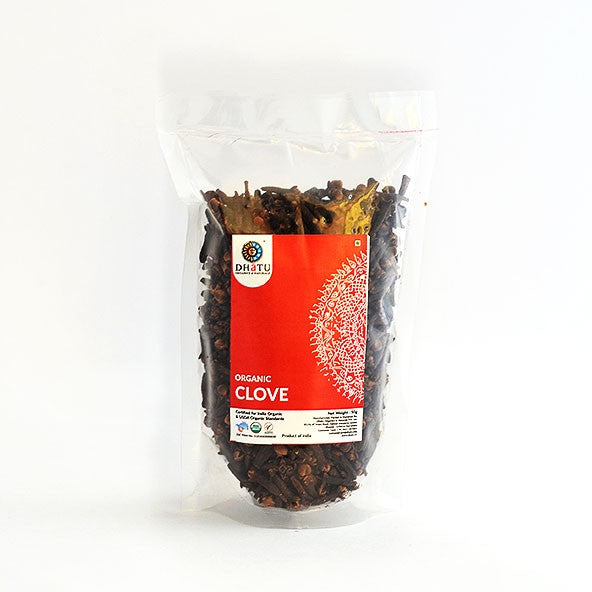
Organic Clove Whole 50g
₹ 180.00
Dhatu Organics Organic Clove Whole 50g delivers certified organic Syzygium aromaticum flower buds — one of the most intensely aromatic spices in existence, harvested before o... Read more ↓
100% Organic
No Additives
Free Delivery ₹499+
Organic Clove Whole (Syzygium aromaticum)
Nutrition Facts
| Nutrient | Per serving | Per 100g | % RDA* |
|---|---|---|---|
| Per 100g | Energy 274 kcal | Protein 5.97g | Carbohydrates 65.5g |
| Per 2g serving (2 cloves) | Energy 5.5 kcal | Manganese 1.20mg | Calcium 12.6mg |
* % RDA based on a 2000 kcal reference diet (FSSAI). Values are approximate and may vary by batch.
We deliver across India within 3–5 business days via trusted logistics partners.
- Free delivery on orders above ₹499.
- Orders dispatched within 1 business day of payment confirmation.
- Perishable goods cannot be returned once dispatched. Non-perishable items may be returned within 7 days in original, unopened condition.
- For damaged or incorrect items, contact info@dhatuorganics.com within 48 hours of delivery.
Choose Your Pack
Dhatu Organics Organic Clove Whole 50g delivers certified organic Syzygium aromaticum flower buds — one of the most intensely aromatic spices in existence, harvested before opening and sun-dried to concentrate their extraordinary eugenol content. Cloves are among the highest antioxidant foods measured by ORAC (Oxygen Radical Absorbance Capacity), the primary bioactive compound eugenol accounts for 70–90% of clove’s essential oil.
The Antioxidant Extraordinary: Cloves hold one of the highest ORAC values of any whole food — approximately 290,000 µmol TE/100g in some measurements. Eugenol, the main compound, is a potent phenolic antioxidant, antiseptic, and COX-2 inhibitor. Even at culinary doses (1–2 whole cloves per dish), cloves provide significant antioxidant and flavour contributions to the meal.
Ingredients
Organic Clove Whole (Syzygium aromaticum)
Single ingredient · No additives · No preservatives · Certified organic
Certified Organic
Non-GMO
Gluten-Free
Vegan
Nutrition Facts
Per 100g · Per 2g serving (approx. 2 whole cloves)
| Nutrient | Per 100g | Per 2g |
|---|---|---|
| Energy | 274 kcal | 5.5 kcal |
| Protein | 5.97 g | 0.12 g |
| Carbohydrates | 65.5 g | 1.31 g |
| Total Fat | 13.0 g | 0.26 g |
| Dietary Fibre | 33.9 g | 0.68 g |
| Manganese | 60.1 mg | 1.20 mg |
| Vitamin K | 141.8 µg | 2.84 µg |
| Calcium | 632 mg | 12.6 mg |
Values approximate. Source: USDA FoodData Central.
Key Benefits
- Highest Antioxidant Spice: Cloves’ ORAC value is among the highest of any food. Eugenol (70–90% of essential oil) is a potent phenolic antioxidant that neutralises reactive oxygen species and inhibits lipid peroxidation.[1]
- Eugenol Anti-inflammatory: Eugenol inhibits COX-2 enzyme and NF-κB inflammatory signalling pathway — the same targets as common anti-inflammatory drugs, though at much lower concentrations in food.[2]
- Extraordinary Manganese: 60.1 mg manganese per 100g — manganese is essential for bone formation, antioxidant enzyme (SOD) activation, and carbohydrate metabolism. Even 2 whole cloves provide notable manganese.
- Natural Antiseptic: Eugenol’s antimicrobial properties are well-documented; clove oil has been used in dentistry as a topical antiseptic. The same compounds make clove valuable for food preservation.[3]
- Calcium-Rich: 632 mg calcium per 100g — though used in small quantities, cloves are a concentrated calcium source.
Research at a Glance
| Benefit | Study Finding | Reference |
|---|---|---|
| Antioxidant (ORAC) | Cloves among the highest ORAC values of measured foods; eugenol dominant | USDA ORAC database; Shan et al., 2005[1] |
| COX-2 inhibition | Eugenol inhibits COX-2 and NF-κB; anti-inflammatory in vitro and in vivo | Yogalakshmi et al., 2010[2] |
| Antimicrobial | Clove EO inhibits S. aureus, E. coli, and Candida; used clinically in dentistry | Chaieb et al., 2007[3] |
How to Use
- Biryani and Pulao: Add 2–4 whole cloves to rice while cooking for a signature warming aroma throughout the dish.
- Chai: Crack or lightly crush 2 cloves and add while simmering for intensely aromatic masala chai.
- Garam Masala: One of the key components — dry-roast and grind with other whole spices for homemade garam masala powder.
- Chole and Rogan Josh: Whole cloves added to the hot oil in the beginning release eugenol into the cooking medium, infusing the entire dish.
- Dental Relief: Traditional use: clamp a whole clove against a sore tooth for temporary relief — the eugenol has a numbing effect. This is a traditional remedy, not a substitute for dental care.
Frequently Asked Questions
Should I remove cloves before eating?
Yes — whole cloves are intensely flavoured and have a tough texture; biting into one accidentally is unpleasant. Remove whole cloves from rice and curries before serving, or train diners to set them aside on their plate. Ground clove (in garam masala or baked goods) integrates without this issue.
How do I know if my cloves are fresh and high quality?
High-quality cloves should: (1) float vertically in water (low quality/old cloves float horizontally or sink — this indicates low essential oil content); (2) leave an oily residue on paper — press a clove; fresh cloves have high eugenol content. The aroma should be intensely warm and sweet. Dull aroma = old or poor quality.
Can I use clove oil for toothache?
Clove oil contains concentrated eugenol and has been used in dentistry as a topical analgesic. A small amount on a cotton ball applied directly to the affected area can provide temporary numbing relief. However, undiluted clove oil can irritate gum tissue — use sparingly and consult a dentist for any ongoing dental issue. Dhatu’s product is a whole food spice, not pharmaceutical grade clove oil.
How do I store whole cloves?
Store in an airtight container away from light and heat. Whole cloves maintain their essential oil and aroma for 2–4 years if properly stored. Ground clove loses potency within 6–12 months. For maximum shelf life, grind only as needed rather than storing ground clove.
Explore More from Dhatu Organics
- Organic Cinnamon Whole 100g — the classic flavour partner to clove in masalas and chai
- Organic Garam Masala Powder 50g — features clove as a key component
- Masala Chai — contains clove as part of our warming spice blend
- All Organic Spices — browse our complete certified organic spice collection
Scientific References
- Shan B, et al. The in vitro antibacterial activity of dietary spice and medicinal herb extracts. Int J Food Microbiol. 2007;117(1):112–9. doi:10.1016/j.ijfoodmicro.2007.03.003
- Yogalakshmi B, et al. Clove bud (Eugenia caryophyllus): a review. Med Aromat Plant Sci Biotechnol. 2010;4(S1):87–100.
- Chaieb K, et al. The chemical composition and biological activity of clove essential oil, Eugenia caryophyllata. Phytother Res. 2007;21(6):501–6. doi:10.1002/ptr.2124