

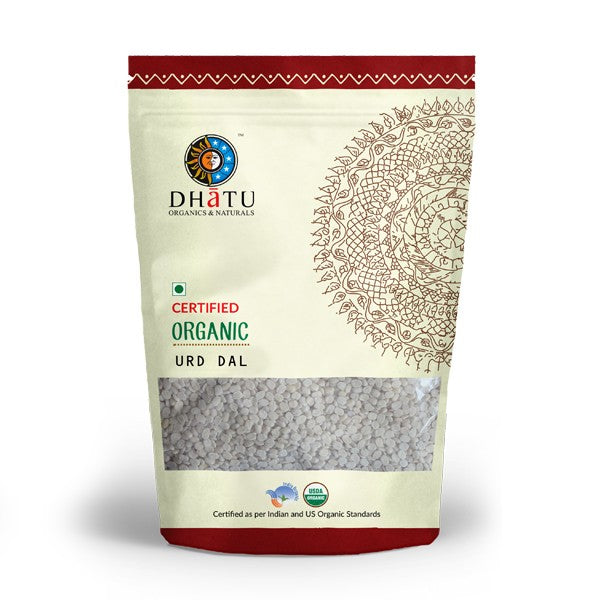
Organic Urd Dal 500g
₹ 150.00
Dhatu Organic Urd Dal 500g — Highest Protein of All Common Dals & the Foundation of South Indian BreakfastUrd Dal — split and dehusked black gram (Vigna mungo) — is one of t... Read more ↓
100% Organic
No Additives
Free Delivery ₹749+
100% Organic Urd Dal / Split Black Gram (Vigna mungo)
Nutrition FactsServing: 40 g (dry)
| Nutrient | Per serving | Per 100g | % RDA* |
|---|---|---|---|
| Energy | 139 kcal | 347 kcal | 6.9% |
| Protein | 10.0 g | 25.1 g | 20.1% |
| Carbohydrates | 23.8 g | 59.6 g | 7.9% |
| Total Fat | 0.6 g | 1.4 g | 0.8% |
| Dietary Fibre | 0.4 g | 0.9 g | 1.5% |
| Calcium | 62 mg | 154 mg | 6.2% |
| Iron | 3.6 mg | 9.1 mg | 21.3% |
* % RDA based on a 2000 kcal reference diet (FSSAI). Values are approximate and may vary by batch.
We deliver across India within 3–5 business days via trusted logistics partners.
- Free delivery on orders above ₹749.
- Orders dispatched within 1 business day of payment confirmation.
- Perishable goods cannot be returned once dispatched. Non-perishable items may be returned within 7 days in original, unopened condition.
- For damaged or incorrect items, contact info@dhatuorganics.com within 48 hours of delivery.
Choose Your Pack
Dhatu Organic Urd Dal 500g — Highest Protein of All Common Dals & the Foundation of South Indian Breakfast
Urd Dal — split and dehusked black gram (Vigna mungo) — is one of the most nutritionally impressive dals in the Indian pantry, yet consistently underestimated. With about 26.1g of protein per 100g dry weight — among the highest of commonly consumed Indian dals — and 154mg calcium per 100g, it is an exceptionally rich plant-based source of both macronutrients and minerals. Known as Urad Dal in Hindi, Uddina Bele in Kannada, Ulundu Paruppu in Tamil and Minumulu Pappu in Telugu, it is the structural foundation of South Indian breakfast culture: without urd dal, there is no idli, no dosa, no medu vada.
Dhatu's Organic Urd Dal is NPOP certified, sourced from chemical-free farms and supplied unpolished. The split seeds are white to cream in colour, with a slightly matte surface — the natural appearance of an unprocessed dal.
Nutritional Profile (per 100g, dry weight)
- Single ingredient: Organic Urd Dal / Split Black Gram (Vigna mungo)
- 26.1g protein per 100g — the highest protein content of all five common Indian dals; an outstanding plant protein source
- 154mg calcium per 100g — the highest calcium of all five common dals; a useful contribution for those on plant-based diets
- 7.3mg iron per 100g — second only to moong dal among the five; pairs well with vitamin C-rich foods for improved absorption
- 18.3g dietary fibre per 100g — the highest fibre of all five common dals
- 347 kcal per 100g (dry); approximately 105 kcal per 100g cooked
- Naturally gluten-free, dairy-free, vegan
- NPOP Certified Organic — no synthetic pesticides, no polishing agents, no additives
Urd Dal: How It Compares to Other Dals
| Dal | Protein | Calcium | Fibre | Iron |
|---|---|---|---|---|
| Urd Dal ✦ | 26.1g ✦ | 154mg ✦ | 18.3g ✦ | 7.3mg |
| Moong Dal | 24.5g | 75mg | 16.3g | 8.5mg ✦ |
| Toor Dal | 22.3g | 73mg | 15.0g | 2.7mg |
| Chana Dal | 20.4g | 56mg | 11.8g | 3.3mg |
✦ = Highest in category. Source: ICMR — Nutritive Value of Indian Foods (Gopalan et al., NIN Hyderabad).
Urd Dal in South Indian Cooking — The Idli & Dosa Foundation
The fermented batter for idli and dosa is a two-ingredient preparation: rice and urd dal. The urd dal is soaked (4–6 hours), ground very finely with cold water to an airy, smooth batter, then combined with ground rice (or rice flour) and left to ferment overnight. Fermentation — driven by naturally occurring Lactobacillus bacteria — acidifies the batter, develops flavour, increases B-vitamin content and creates the characteristic lightness of a well-made idli. Dhatu's unpolished urd dal retains more of its natural bran surface, which actively supports fermentation.
Other Uses for Urd Dal
- Dal Makhani: A North Indian restaurant classic — whole black urad cooked low and slow with kidney beans, cream, butter and spices. (Note: whole urad, not split, is used here — soak overnight.)
- Medu Vada: Ground urd dal batter, shaped into rings and deep-fried — the crispy, spongy savoury doughnut served with coconut chutney and sambar.
- Papad (Urad Papad): Thin, crispbread made from urd dal flour — sun-dried or roasted.
- Urd Dal Tadka: Cooked urd dal tempered with ghee, cumin, garlic and dried red chilli — a protein-rich North Indian side preparation.
How to Cook Urd Dal (Split)
For dal tadka: Rinse well. Soak 30 minutes (optional but speeds cooking). Add 1 part dal to 3 parts water. Pressure cook 3–4 whistles or simmer covered 30–35 minutes. The cooked dal is naturally thick and slightly sticky — characteristic of urd dal. Temper with ghee, cumin, garlic and dried red chilli.
For idli/dosa batter: Soak dal 4–6 hours separately from rice. Drain, rinse and grind with cold water in a high-power blender or wet grinder until the batter is completely smooth, white and voluminous (the batter should nearly double in volume when ground correctly — air incorporation is key). Combine with ground rice, add salt, ferment 8–12 hours at room temperature (24–26°C).
About Dhatu Organics
Dhatu Organics sources certified organic dals from traditional farming communities across India. Every batch is cleaned, graded and packed without chemical treatment, polishing agents or additives. Single-ingredient, minimally processed, exactly as nature intended.