

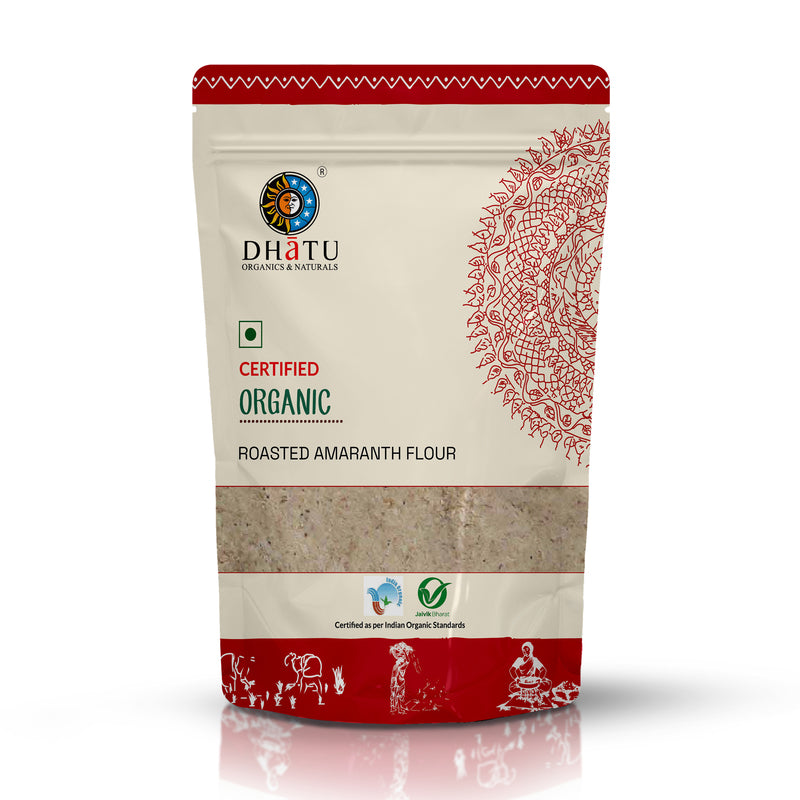
Organic Roasted Amaranth Flour (Rajgira Atta)
₹ 140.00
Dhatu Organics Roasted Amaranth Flour is organic rajgira atta, made from amaranth seeds that are dry-roasted and then milled. Roasting gives the flour a nutty flavour and means ... Read more ↓
100% Organic
No Additives
Free Delivery ₹749+
100% Organic Roasted Amaranth (Rajgira / Ramdana / Chaulai — Amaranthus hypochondriacus). Vegan. Naturally gluten-free. No preservatives, no additives, no artificial flavours or colours.
Nutrition FactsServing: 30g (3 tbsp)
| Nutrient | Per serving | Per 100g | % RDA* |
|---|---|---|---|
| Energy | 111 kcal | 371 kcal | 5.6% |
| Protein | 4.1g | 13.6g | 8.2% |
| Carbohydrates | 20.8g | 69.2g | 6.4% |
| Of which Sugars | 0.5g | 1.7g | <1% |
| Total Fat | 2g | 6.5g | 3% |
| Of which Saturated Fat | 0.5g | 1.6g | 2.3% |
| Dietary Fibre | 2g | 6.7g | 8% |
| Sodium | 5mg | 18mg | <1% |
| Calcium | 48mg | 159mg | 4.8% |
| Iron | 2.3mg | 7.6mg | 13.4% |
| Magnesium | 74mg | 248mg | 21.8% |
* % RDA based on a 2000 kcal reference diet (FSSAI). Values are approximate and may vary by batch.
We deliver across India within 3–5 business days via trusted logistics partners.
- Free delivery on orders above ₹749.
- Orders dispatched within 1 business day of payment confirmation.
- Perishable goods cannot be returned once dispatched. Non-perishable items may be returned within 7 days in original, unopened condition.
- For damaged or incorrect items, contact info@dhatuorganics.com within 48 hours of delivery.
Choose Your Pack
Dhatu Organics Roasted Amaranth Flour is organic rajgira atta, made from amaranth seeds that are dry-roasted and then milled. Roasting gives the flour a nutty flavour and means it can be stirred into warm milk for a quick porridge. It is naturally gluten-free and a traditional flour for Navratri and vrat cooking.
What is amaranth flour (rajgira atta)?
Amaranth (Amaranthus) is a seed, not a true cereal, which is why it is widely eaten on fasting days. In India it is called rajgira, ramdana or chaulai. Amaranth flour is the whole seed milled fine; ours is roasted before milling.
Nutrition (per 100g, approx.)
- Protein: 13.6g, including lysine, an amino acid that most cereals are low in
- Iron: 7.6mg · Magnesium: 248mg · Calcium: 159mg
- Dietary fibre: 6.7g
- Naturally gluten-free
Source: USDA FoodData Central.
How to use rajgira atta
- Rajgira roti and thepla (vrat): amaranth has no gluten, so bind it with boiled mashed potato. Knead with warm water, roll between two sheets and cook on a tawa with ghee.
- Rajgira sheera and laddoo: roast in ghee, add jaggery, cardamom and nuts.
- Quick porridge: because the flour is pre-roasted, stir 2–3 tbsp into warm milk with jaggery. No long cooking needed.
- Gluten-free baking: replace 20–30% of the flour in cookies, muffins and pancakes.
Which pack should I buy?
Choose 300g for fasting days, and 1kg if you cook with amaranth regularly.
Frequently asked questions
Is amaranth flour the same as rajgira atta?
Yes. Rajgira is the Hindi name for amaranth, so rajgira atta, rajgira flour and amaranth atta all mean the same thing.
Can I eat rajgira atta during Navratri?
Rajgira atta is one of the most common flours for Navratri and Ekadashi fasting. Customs differ between families, so follow your own tradition.
Is amaranth flour gluten-free?
Yes, amaranth is naturally gluten-free. If you have coeliac disease, please contact us about how it is packed before ordering.
How should I store it?
Keep airtight in a cool, dry place and use within 2–3 months of opening.
Also try whole amaranth seeds (rajgira) and puffed amaranth, or see more fasting flours like kuttu atta.
Frequently Asked Questions
Most plant proteins lack one or more essential amino acids. Amaranth contains all nine essential amino acids in balanced proportions, including lysine — an amino acid deficient in most cereal grains. This makes amaranth flour one of the few plant-based "complete proteins," with a protein quality (PDCAAS score) comparable to eggs and casein. A 30g serving provides 4.1g of high-quality complete protein.
Like buckwheat, amaranth (rajgira) is a seed rather than a true cereal, so it is widely eaten as a phalahar (fasting food). Rajgira laddoo, porridge and rotis are traditional Navratri foods. Roasting gives our flour a deeper, nutty flavour. Fasting customs differ between families, so follow your own tradition.
Roasting pre-cooks the starch, so the flour can be stirred into warm liquid for porridge without long cooking. It also develops a deeper, nuttier flavour and reduces the natural bitterness of the seed coat.
Amaranth is one of the highest plant-based sources of iron — 7.6mg per 100g, or 13.4% RDA per 30g serving. However, amaranth also contains phytic acid, which reduces iron absorption. To maximise iron uptake, consume amaranth flour dishes with vitamin C-rich foods (lemon juice, tomatoes) or combine with fermented preparations. The roasting process partially reduces phytic acid content.