

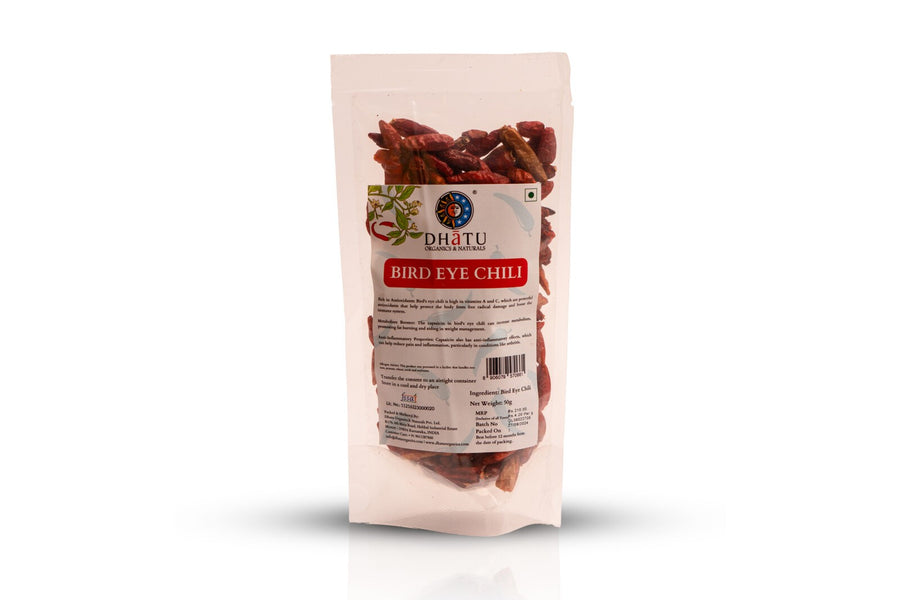
Organic Red birds eye chilli 50g
₹ 190.00
Dhatu Organics Organic Red Birds Eye Chilli 50g is certified organic Capsicum frutescens — the small, slender, intensely hot bird’s eye chilli. Also known as Thai chilli, kan... Read more ↓
100% Organic
No Additives
Free Delivery ₹499+
Organic Red Birds Eye Chilli (Capsicum frutescens)
Nutrition Facts
| Nutrient | Per serving | Per 100g | % RDA* |
|---|---|---|---|
| Per 100g | Energy 282 kcal | Protein 13.5g | Fat 14.3g |
| Per 1g (1 small chilli) | Energy 2.8 kcal | Vitamin A 20.8mcg |
* % RDA based on a 2000 kcal reference diet (FSSAI). Values are approximate and may vary by batch.
We deliver across India within 3–5 business days via trusted logistics partners.
- Free delivery on orders above ₹499.
- Orders dispatched within 1 business day of payment confirmation.
- Perishable goods cannot be returned once dispatched. Non-perishable items may be returned within 7 days in original, unopened condition.
- For damaged or incorrect items, contact info@dhatuorganics.com within 48 hours of delivery.
Choose Your Pack
Dhatu Organics Organic Red Birds Eye Chilli 50g is certified organic Capsicum frutescens — the small, slender, intensely hot bird’s eye chilli. Also known as Thai chilli, kanthari (in Kerala), and dhani chilli, these tiny chillies deliver a sharp, clean, immediate heat of 50,000–100,000+ SHU (Scoville Heat Units) — significantly hotter than Guntur whole chillies and approximately 5–10 times hotter than regular red chilli powder.
Bird’s Eye vs. Guntur: Understanding the Heat Difference: The smaller the chilli, the more capsaicin per gram — a general rule explained by the higher surface-to-volume ratio of capsaicin glands (placenta) relative to flesh. Bird’s eye chillies have proportionally more placenta (white inner membrane where capsaicin is concentrated) relative to their total mass compared to large Guntur chillies. They are used sparingly — typically 1–2 per recipe — for instant, direct heat rather than the gradual warmth of larger varieties.
Ingredients
Organic Red Birds Eye Chilli (Capsicum frutescens)
Single ingredient · No additives · No artificial colour · Certified organic
Certified Organic
Non-GMO
Gluten-Free
Vegan
Nutrition Facts
Per 100g · Per 1g (approx. 1 small whole chilli)
| Nutrient | Per 100g | Per 1g |
|---|---|---|
| Energy | 282 kcal | 2.8 kcal |
| Protein | 13.5 g | 0.14 g |
| Total Fat | 14.3 g | 0.14 g |
| Dietary Fibre | 34.8 g | 0.35 g |
| Vitamin C | 76.4 mg | 0.76 mg |
| Vitamin A | 2081 mcg RAE | 20.8 mcg |
| Capsaicin | Very high | 50,000–100,000+ SHU |
Nutritional values based on dried red chilli data. Capsaicin content is variety-specific.
Key Benefits
- High Capsaicin Concentration: Bird’s eye chillies have significantly higher capsaicin per gram compared to larger varieties, making them more potent for thermogenesis and the metabolic effects of capsaicin at smaller quantities.[1]
- Vitamin A and C: Rich in provitamin A carotenoids (2,081 mcg RAE per 100g) and vitamin C (76.4 mg per 100g) — vital for immune function, vision, and skin health.
- Antimicrobial Properties: High capsaicin concentrations provide strong antimicrobial activity, historically used in chilli-fermented and pickled preparations across South and Southeast Asian cuisines.[2]
- Thermogenic Effect: Capsaicin activates TRPV1 receptors, increasing thermogenesis and energy expenditure. At higher concentrations in bird’s eye chillies, even small culinary amounts can trigger this response.[3]
- Authentic South Asian Heat: Bird’s eye (kanthari) chillies are essential for authentic Kerala, Thai, Vietnamese, and Sri Lankan cooking — the sharp heat that regular chillies cannot replicate.
Research at a Glance
| Benefit | Study Finding | Reference |
|---|---|---|
| Capsaicin thermogenesis | Capsaicin increases 24h energy expenditure and fat oxidation vs. placebo | Taghizadeh et al., 2017[1] |
| Antimicrobial | Capsaicin inhibits gram-positive and gram-negative bacteria at low concentrations | Cichewicz & Thorpe, 1996[2] |
| TRPV1 thermogenesis | TRPV1 receptor activation by capsaicin increases brown adipose thermogenesis in multiple studies | Yoneshiro et al., 2013[3] |
How to Use
- Kerala Cooking: The kanthari chilli is an essential component of authentic Kerala fish curries, prawn preparations, and beef curries — add 1–3 whole chillies to the curry base or use split chillies in coconut-based gravies.
- Thai and Southeast Asian Curries: Bird’s eye chillies are the standard Thai curry chilli — pound with garlic and galangal for Thai green or red curry paste base.
- Fresh Chilli Sauce: Grind with garlic, vinegar, and salt for a fast, intensely hot chilli sauce.
- Tadka and Stir-Fries: Add whole or split to hot oil at the start of any stir-fry for immediate sharp heat — they blossom within seconds in hot fat.
- Heat Control: Remove before eating if you want flavour without full heat impact. Keep seeds in for maximum heat; remove them for moderate levels.
Frequently Asked Questions
How hot are bird’s eye chillies compared to Guntur or Kashmiri chillies?
Significantly hotter. Kashmiri chillies: 1,000–2,000 SHU (mild, mostly colour). Standard Guntur: 25,000–35,000 SHU. Bird’s eye chillies: 50,000–100,000+ SHU. This means bird’s eye chillies are approximately 3–5x hotter than Guntur and 50–100x hotter than Kashmiri. Use 1 bird’s eye chilli where you would use 3–5 Guntur chillies for equivalent heat.
Can I use these as a Guntur chilli substitute?
You can substitute for heat, but not for colour or flavour profile. Bird’s eye chillies provide sharp, direct heat with less colour than Guntur varieties. In a dish where colour matters (like a red curry), use fewer bird’s eye chillies alongside Kashmiri chilli powder for colour, rather than replacing Guntur entirely with bird’s eye.
How should I handle these safely?
Bird’s eye chillies are significantly more potent than standard chillies. Wear disposable gloves when handling quantities. Never touch your eyes, nose, or mouth after handling. Wash hands thoroughly with soap and water (not just water — capsaicin is oil-soluble and requires soap to remove). If you experience skin irritation, wash with milk or yoghurt (the casein protein binds capsaicin) rather than water alone.
Explore More from Dhatu Organics
- Organic Red Chillie Whole 100g (Guntur) — milder heat with intense colour
- Organic Red Chilli Powder 100g — ground chilli for easy, even heat in curries
- Organic Black Mustard 100g — classic tadka companion to whole chillies
- All Organic Spices — browse our complete certified organic spice collection
Scientific References
- Taghizadeh M, et al. The effects of dietary capsaicin on metabolic syndrome risk factors. J Res Med Sci. 2017;22:111. doi:10.4103/jrms.JRMS_487_17
- Cichewicz RH, Thorpe PA. The antimicrobial properties of chile peppers. J Ethnopharmacol. 1996;52(2):61–70. doi:10.1016/0378-8741(96)01384-0
- Yoneshiro T, et al. Recruited brown adipose tissue as an antiobesity agent in humans. J Clin Invest. 2013;123(8):3404–8. doi:10.1172/JCI67803