

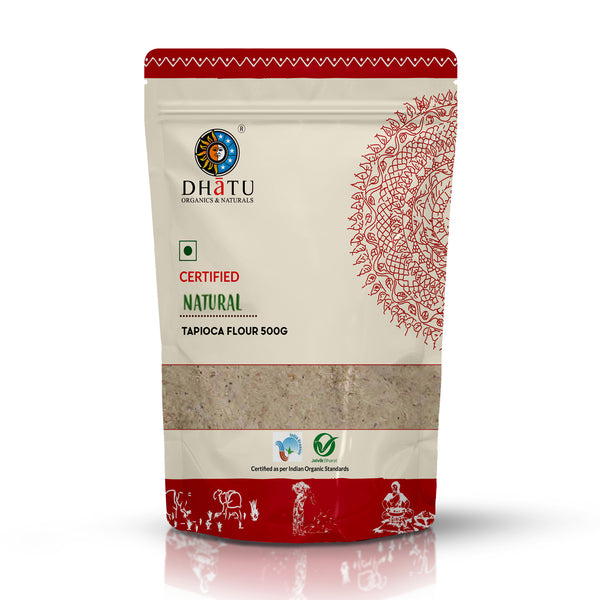
Tapioca Flour 500g
₹ 165.00
Tapioca flour (cassava starch) is one of the most useful tools in a gluten-free baker's pantry — not as a standalone flour, but as the secret ingredient that gives gluten-free ... Read more ↓
100% Organic
No Additives
Free Delivery ₹499+
100% Natural Tapioca Starch extracted from Cassava Root (Manihot esculenta). Vegan. Naturally gluten-free and grain-free. No preservatives, no additives.
Nutrition FactsServing: 30g (3 tbsp)
| Nutrient | Per serving | Per 100g | % RDA* |
|---|---|---|---|
| Energy | 107 kcal | 358 kcal | 5.4% |
| Protein | <0.1g | 0.2g | <1% |
| Carbohydrates | 26.6g | 88.7g | 8.2% |
| Of which Sugars | <0.1g | 0.1g | <1% |
| Total Fat | <0.1g | 0g | <1% |
| Of which Saturated Fat | 0g | 0g | 0% |
| Dietary Fibre | 0.1g | 0.4g | <1% |
| Sodium | 2mg | 8mg | <1% |
| Iron | <0.1mg | 0.2mg | <1% |
* % RDA based on a 2000 kcal reference diet (FSSAI). Values are approximate and may vary by batch.
We deliver across India within 3–5 business days via trusted logistics partners.
- Free delivery on orders above ₹499.
- Orders dispatched within 1 business day of payment confirmation.
- Perishable goods cannot be returned once dispatched. Non-perishable items may be returned within 7 days in original, unopened condition.
- For damaged or incorrect items, contact info@dhatuorganics.com within 48 hours of delivery.
Choose Your Pack
Tapioca flour (cassava starch) is one of the most useful tools in a gluten-free baker's pantry — not as a standalone flour, but as the secret ingredient that gives gluten-free doughs chewiness, stretch, and the glossy texture that pure starch-free blends can't achieve. It is the gluten-free world's closest approximation to gluten's stretchy, binding quality.
What is Tapioca Flour?
Tapioca flour (also called tapioca starch) is the purified starch extracted from cassava root (Manihot esculenta) by a wet-milling and drying process. Unlike cassava flour (whole root, milled), tapioca flour removes all fibre, protein and fat, leaving only the pure starch. This makes it nutritionally simple (essentially just carbohydrate) but functionally exceptional — it creates smooth, glossy textures, adds elasticity and chewiness to gluten-free doughs, and thickens sauces to a clear, glossy consistency without cloudiness.
Key Functional Properties
- Excellent thickener — Creates a clearer, glossier gel than cornstarch or arrowroot; ideal for fruit pies, gravies and puddings
- Adds chewiness — In gluten-free doughs, tapioca provides stretch and chew that other gluten-free starches cannot
- Light texture — In combination with other flours, it lightens the texture of dense gluten-free baked goods
- Freeze-stable — Unlike cornstarch, tapioca thickened sauces freeze and thaw well without breaking
- Neutral flavour — Does not add any taste to recipes
- Naturally gluten-free and grain-free — From a root vegetable, not a cereal
Tapioca Flour vs Other Starches (Functional Comparison)
| Property | Tapioca Flour | Cornstarch | Arrowroot |
|---|---|---|---|
| Thickening power | High | High | Medium |
| Clarity of gel | Clear, glossy | Slightly opaque | Clear |
| Chewiness in baking | High (best) | None | Low |
| Freeze-thaw stability | Good | Poor (breaks down) | Poor |
| Origin | Cassava root | Corn | Arrowroot plant |
Functional comparison based on food science literature: BeMiller & Whistler, Starch: Chemistry and Technology, 2009.
How to Use Tapioca Flour
- Gluten-free flour blend — Use 20–25% tapioca in any blend: 60% rice flour + 25% tapioca + 15% besan is a versatile base
- Thickener for gravies and sauces — Mix with cold water first; add to hot sauce; stir until clear and glossy
- Brazilian cheese bread (pao de queijo) — Mix tapioca with eggs, cheese and butter for chewy, airy cheese puffs
- Bubble tea pearls (boba) — Tapioca starch is the traditional ingredient for chewy boba pearls
- Fruit pie filling — Use 2 tbsp tapioca per 4 cups fruit; creates clear, glossy filling that holds when sliced
- Crispy coating — Dust food in tapioca flour before frying for an extra-crispy, light crust
Frequently Asked Questions
Tapioca flour (also called tapioca starch) is the pure starch extracted from cassava root. It is almost entirely carbohydrate with virtually no protein, fat or fibre. It functions as an excellent thickener for gravies, soups and puddings, and adds chewiness to gluten-free baked goods. It is also used in bubble tea (boba pearls), Brazilian cheese bread (pao de queijo) and as a crispy coating for fried foods.
Similar, but not identical. All three are pure starches used as thickeners. Tapioca creates a glossier, more elastic gel; cornstarch creates a more opaque, firmer gel; arrowroot is most stable at lower temperatures and freezes better. Tapioca is the preferred thickener for fruit pies (remains clear and glossy) and for gluten-free doughs requiring chewiness and stretch.
Not effectively on its own — pure starch creates very sticky, gummy textures when used alone. It is best used as 20–30% of a gluten-free flour blend to improve texture and structure. For example: 60% rice flour + 25% tapioca + 15% besan creates a versatile all-purpose gluten-free blend for bread, pancakes and cookies.
Tapioca has a high glycaemic index (approximately 70+) because it is essentially pure rapidly-digested starch. Small amounts used as a thickener are unlikely to cause glycaemic concern, but large portions should be avoided in diabetic meal plans. For a lower-GI alternative in gluten-free cooking, cassava flour (whole root) or millet-based flours are better choices.