

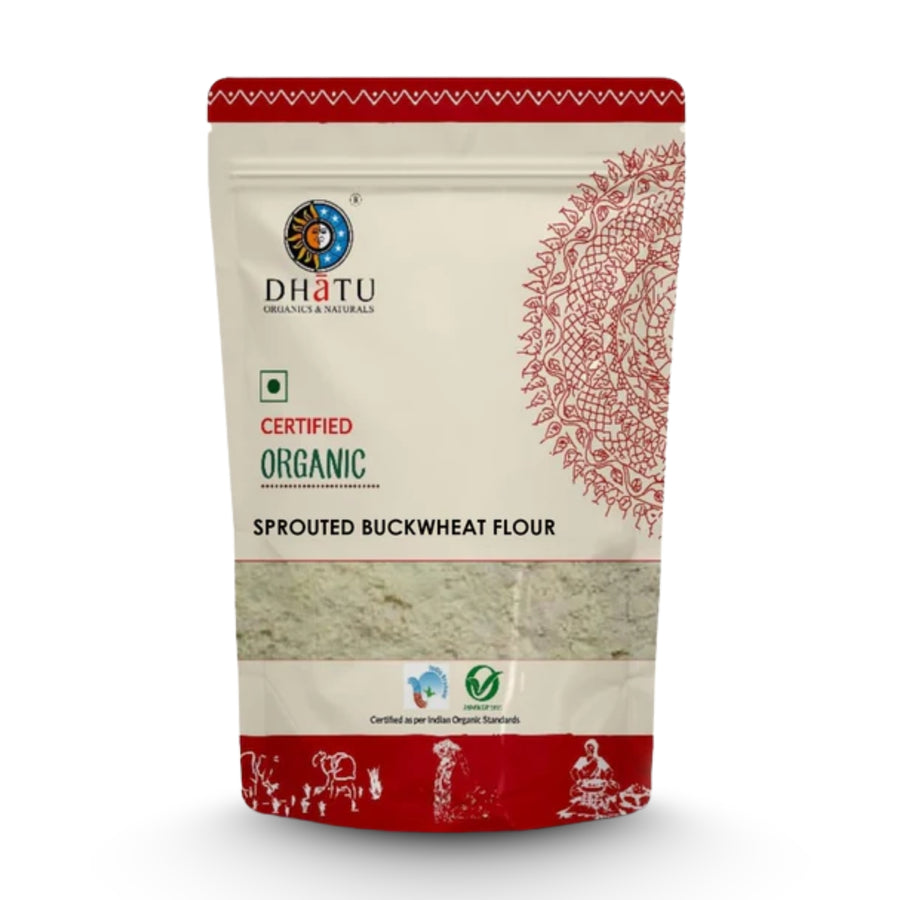
Sprouted Buckwheat Flour 500g | Gluten-Free
₹ 299.00
Buckwheat is not wheat — it is a flowering seed, completely unrelated to the grass family, and naturally free of gluten. Sprouting unlocks rutin and quercetin — two of the most... Read more ↓
100% Organic
No Additives
Free Delivery ₹499+
100% Sprouted Buckwheat (Fagopyrum esculentum) — Naturally Gluten-Free
Nutrition FactsServing: 30g
| Nutrient | Per serving | Per 100g | % RDA* |
|---|---|---|---|
| Energy | 102 kcal | 340 kcal | 5.1% |
| Protein | 3.9 g | 13 g | 7.8% |
| Carbohydrates | 20.4 g | 68 g | 6.8% |
| of which Sugars | 0.9 g | 3 g | 1.8% |
| Dietary Fibre | 3 g | 10 g | 12% |
| Fat | 1 g | 3.4 g | 1.6% |
| of which Saturated Fat | 0.21 g | 0.7 g | <1% |
| Iron | 1.2 mg | 4 mg | 7.1% |
| Calcium | 14.1 mg | 47 mg | 1.4% |
| Potassium | 173 mg | 577 mg | 4.3% |
| Magnesium | 69.3 mg | 231 mg | 17.3% |
| Zinc | 0.93 mg | 3.1 mg | 7.8% |
| Phosphorus | 104 mg | 347 mg | 10.4% |
* % RDA based on a 2000 kcal reference diet (FSSAI). Values are approximate and may vary by batch.
We deliver across India within 3–5 business days via trusted logistics partners.
- Free delivery on orders above ₹499.
- Orders dispatched within 1 business day of payment confirmation.
- Perishable goods cannot be returned once dispatched. Non-perishable items may be returned within 7 days in original, unopened condition.
- For damaged or incorrect items, contact info@dhatuorganics.com within 48 hours of delivery.
Choose Your Pack
Buckwheat is not wheat — it is a flowering seed, completely unrelated to the grass family, and naturally free of gluten. Sprouting unlocks rutin and quercetin — two of the most potent contains naturally occurring antioxidant plant compoundsantioxidants found in any grain flour.
What is Buckwheat?
Despite the name, buckwheat (kuttu) contains no wheat and no gluten. It is the seed of a flowering plant related to rhubarb and sorrel, making it a pseudo-grain — grain-like in use but botanically a seed. This means it is inherently gluten-free and suitable for coeliac disease. It is also one of the few plant foods containing all 9 essential amino acids, making it a complete protein source. Sprouting activates dormant enzymes, breaks down antinutrients, and dramatically boosts the concentration of rutin and quercetin — bioactive compounds with strong contains naturally occurring antioxidant plant compoundsand cardiovascular benefits.
Key Benefits
- 100% naturally gluten-free — safe for coeliac and wheat-sensitive individuals
- High in rutin — a powerful flavonoid antioxidant that supports blood vessel integrity and
- 231mg magnesium per 100g — one of the richest plant sources of magnesium, essential for sleep, muscle, and heart health
- Complete protein — contains all 9 essential amino acids, rare for a plant food
- 10g dietary fibre — feeds beneficial gut bacteria and supports digestive health
- Low GI — slower starch digestion means steadier blood sugar
- Rich in quercetin — antioxidant with contains naturally occurring antioxidant plant compounds, antihistamine, and immune-modulating properties
How to Use
- Use in gluten-free pancakes, crepes (galettes), and waffles
- Traditionally used for kuttu ki roti and pakoras during Navratri fasting
- Use in gluten-free pasta, noodles, and flatbreads
- Add to muffins, banana bread, and brownies (combine with other GF flours for best texture)
- Use as a thickener in gluten-free gravies and soups
- Make savoury galettes topped with vegetables and cheese
Frequently Asked Questions
Is buckwheat actually wheat?
No. Despite the name, buckwheat is botanically unrelated to wheat. It is the seed of Fagopyrum esculentum, a flowering plant in the family Polygonaceae — the same family as rhubarb. It contains zero gluten and is safe for people with coeliac disease and wheat allergy.
Why is it used for Navratri fasting?
Kuttu (buckwheat) is permitted during Hindu fasting periods (vrats) because it is not a grain in the botanical sense — it is a seed. Its use in kuttu ki roti and pakoras during Navratri and other fasts is a longstanding tradition across North India.
Does sprouted buckwheat flour taste different?
Sprouted buckwheat flour has a slightly milder, less bitter flavour than unsprouted. The characteristic earthy, nutty buckwheat taste remains but is more balanced. Many people find the sprouted version easier to incorporate into baked goods without the strong flavour being overpowering.
Can I use it 1:1 to replace wheat flour?
Not directly — buckwheat flour lacks gluten, which gives wheat dough its elasticity. For baked goods, blend with other gluten-free flours (rice flour, tapioca) or use xanthan gum. For rustic pancakes, crepes, and flatbreads, it works beautifully on its own.
What is rutin and why does it matter?
Rutin is a flavonoid antioxidant found in particularly high concentrations in buckwheat. Research shows it supports capillary strength,