

 42% OFF
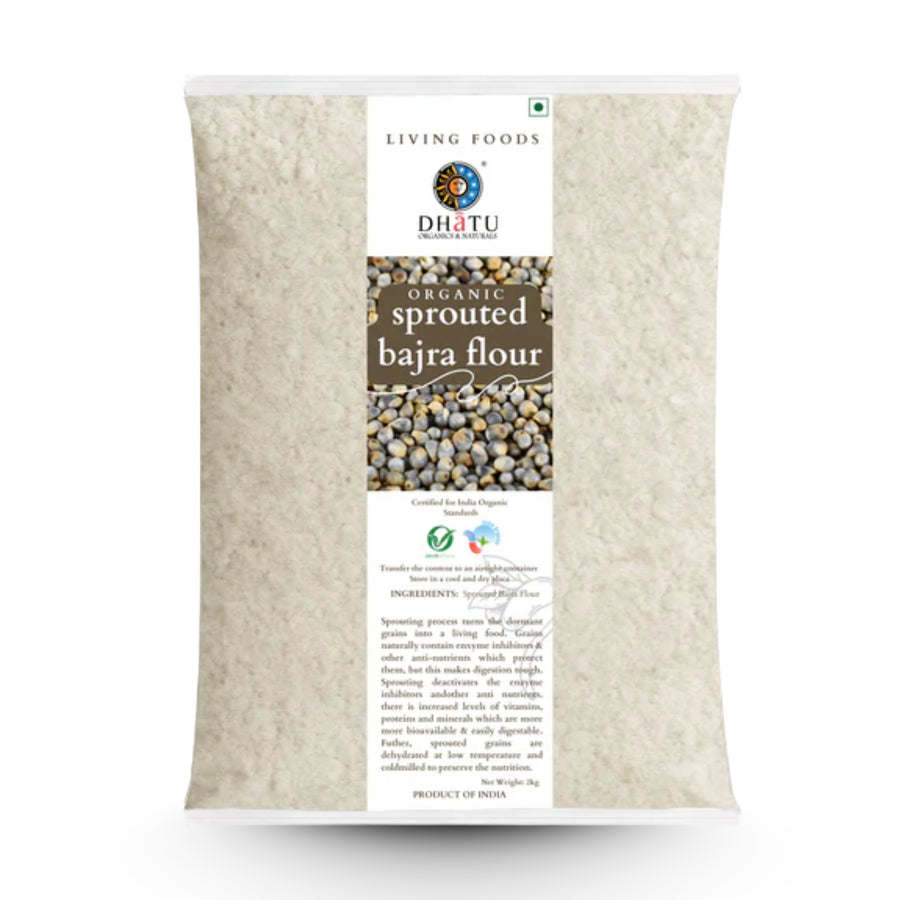
Sprouted Bajra Flour
₹ 160.00
Bajra has the highest iron content of any millet — 8mg per 100g, 44% of your daily requirement. Sprouting then unlocks that iron by dissolving the phytic acid that blocks its a... Read more ↓
100% Organic
No Additives
Free Delivery ₹749+
100% Sprouted Bajra (Pearl Millet / Pennisetum glaucum)
Nutrition FactsServing: 30g
| Nutrient | Per serving | Per 100g | % RDA* |
|---|---|---|---|
| Energy | 105 kcal | 349 kcal | 5.2% |
| Protein | 3.3 g | 11 g | 6.6% |
| Carbohydrates | 20.4 g | 68 g | 6.8% |
| of which Sugars | 0.6 g | 2 g | 1.2% |
| Dietary Fibre | 2.4 g | 8 g | 9.6% |
| Fat | 1.5 g | 5 g | 2.3% |
| of which Saturated Fat | 0.27 g | 0.9 g | 1.2% |
| Iron | 2.4 mg | 8 mg | 14.1% |
| Calcium | 12.6 mg | 42 mg | 1.3% |
| Potassium | 92.1 mg | 307 mg | 2.3% |
| Magnesium | 41.1 mg | 137 mg | 10.3% |
| Phosphorus | 88.8 mg | 296 mg | 8.9% |
| Zinc | 0.93 mg | 3.1 mg | 7.8% |
| Vitamin B3 (Niacin) | 0.69 mg | 2.3 mg | 4.3% |
* % RDA based on a 2000 kcal reference diet (FSSAI). Values are approximate and may vary by batch.
We deliver across India within 3–5 business days via trusted logistics partners.
- Free delivery on orders above ₹749.
- Orders dispatched within 1 business day of payment confirmation.
- Perishable goods cannot be returned once dispatched. Non-perishable items may be returned within 7 days in original, unopened condition.
- For damaged or incorrect items, contact info@dhatuorganics.com within 48 hours of delivery.
Choose Your Pack
Bajra has the highest iron content of any millet — 8mg per 100g, 44% of your daily requirement. Sprouting then unlocks that iron by dissolving the phytic acid that blocks its absorption. The most effective iron-rich flour in your kitchen.
What is Sprouted Bajra Flour?
Bajra (pearl millet) has been a staple of Rajasthani, Gujarati, and Haryanvi kitchens for thousands of years — a robust, drought-resistant crop that thrives where wheat cannot. It is particularly prized in winter for its warming, energy-dense nature. Sprouted Bajra Flour starts with whole pearl millet that is germinated to activate enzymes, reduce antinutrients, and improve mineral bioavailability — then gently dried and stone-ground. The result is a flour that delivers bajra's exceptional iron content in a form your body can actually absorb.
Key Benefits
- 8mg iron per 100g
- Sprouted: a traditional step that reduces phytic acid, a natural compound that binds minerals
- High in healthy fats (5g) — unlike other millets, bajra contains beneficial unsaturated fats
- 3.1mg zinc per 100g
- 137mg magnesium per 100g
- Naturally gluten-free: bajra contains no gluten
- Warming grain — traditionally consumed in winter for its thermogenic properties in Ayurveda
How to Use
- Bajra roti / bhakri — the classic Rajasthani staple, served with ghee and jaggery or dal baati
- Make bajra khichdi with moong dal for a warming, protein-rich meal
- Use in gluten-free flatbreads and wraps
- Make traditional Rajasthani rabri (bajra porridge) for breakfast
- Mix with jowar and ragi flour for a nutritious multigrain roti
- Use in laddoos with jaggery and sesame seeds
Frequently Asked Questions
Why is bajra considered a winter grain?
In Ayurveda and traditional nutrition, bajra is classified as a warming, heating grain that increases body temperature and provides dense caloric energy — ideal for the cold months when the body requires more energy to maintain warmth. In North and West India, bajra rotis with ghee are a winter staple consumed specifically during colder months.
Can bajra roti be made as easily as wheat roti?
Bajra roti (bhakri) has a different technique — it is typically hand-patted rather than rolled, as the dough lacks gluten and tears when rolled thin. Knead with warm water until the dough is smooth. Some people mix in a small amount of whole wheat flour (10–15%) to make rolling easier while retaining bajra's nutritional benefits.
Is bajra rich in iron?
Bajra is naturally rich in iron, and eating it with vitamin C–rich foods such as lemon, tomato or amla helps your body absorb plant iron. If you have been told you are low in iron, please follow your doctor's advice.
I have diabetes. Can I eat bajra?
Bajra is a whole grain with plenty of fibre, but it is still a carbohydrate food. If you have diabetes, please ask your doctor or dietitian how it fits into your meals.