

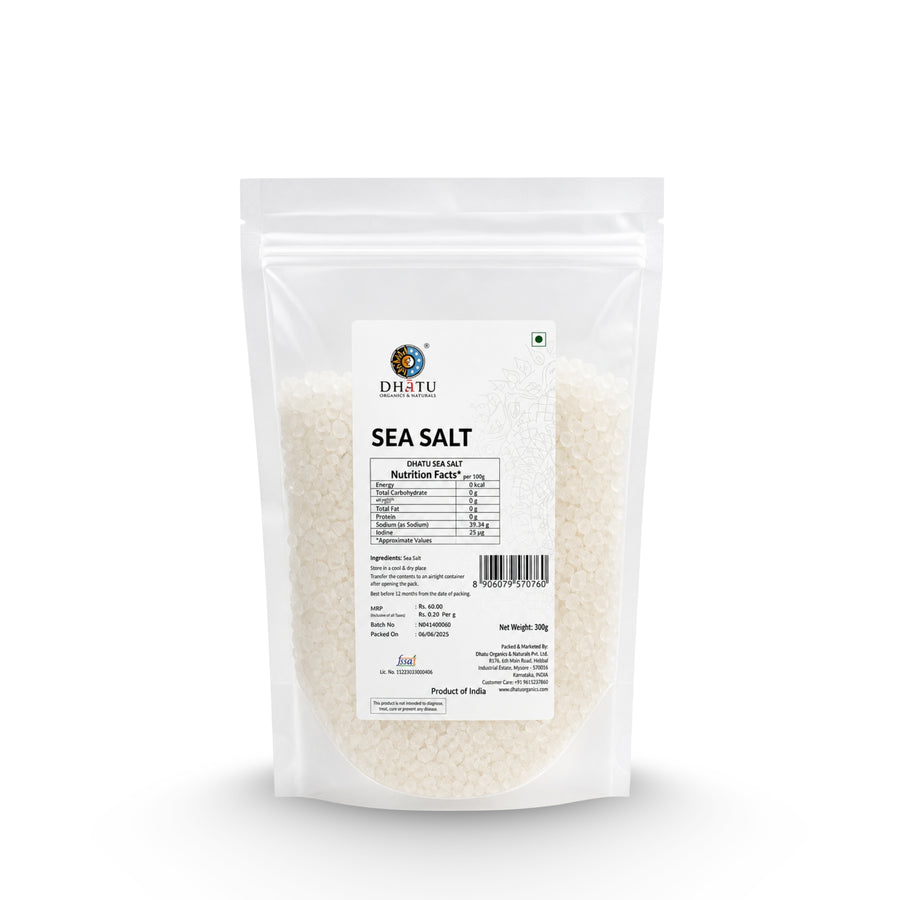
Sea Salt White 500g | 1 Kg | Natural Unrefined Sea Salt | No Anti-Caking Agents
₹ 60.00
Sea Salt White — 500g | 1 Kg — Dhatu Organics’ naturally evaporated sea salt is the clean, everyday salt your kitchen deserves. Produced by evaporating seawater in open-air salt... Read more ↓
100% Organic
No Additives
Free Delivery ₹749+
Iodized sea salt (iodine added). Produced by natural evaporation of clean seawater. No anti-caking agents.
Nutrition Facts
| Nutrient | Per serving | Per 100g | % RDA* |
|---|---|---|---|
| Energy | 0 kcal | 0 kcal | 0% |
| Protein | 0 g | 0 g | 0% |
| Total Fat | 0 g | 0 g | 0% |
| of which Saturated Fat | 0 g | 0 g | 0% |
| Total Carbohydrates | 0 g | 0 g | 0% |
| of which Sugars | 0 g | 0 g | 0% |
| Dietary Fibre | 0 g | 0 g | 0% |
| Sodium | 38,000 mg | 570 mg | 29% |
| Calcium | 26 mg | 0.4 mg | <1% |
| Magnesium | 30 mg | 0.5 mg | <1% |
| Potassium | 8 mg | 0.1 mg | <1% |
* % RDA based on a 2000 kcal reference diet (FSSAI). Values are approximate and may vary by batch.
We deliver across India within 3–5 business days via trusted logistics partners.
- Free delivery on orders above ₹749.
- Orders dispatched within 1 business day of payment confirmation.
- Perishable goods cannot be returned once dispatched. Non-perishable items may be returned within 7 days in original, unopened condition.
- For damaged or incorrect items, contact info@dhatuorganics.com within 48 hours of delivery.
Choose Your Pack
Sea Salt White — 500g | 1 Kg — Dhatu Organics’ naturally evaporated sea salt is the clean, everyday salt your kitchen deserves. Produced by evaporating seawater in open-air salt pans under the sun, it retains naturally occurring sea minerals — without bleaching or anti-caking agents. Iodized as per FSSAI standards to support your daily nutritional needs.
Why Choose Natural White Sea Salt
- No anti-caking chemicals — No sodium aluminosilicate, no sodium ferrocyanide — just pure sea salt with nothing added except iodine
- Iodized for daily nutrition — Fortified with iodine to support thyroid function, cognitive development, and meet FSSAI daily requirements
- Fine-grain versatility — Works in all cooking applications: boiling, sautéing, baking, and table seasoning
- Trace minerals preserved — Contains naturally occurring magnesium, calcium, and potassium from seawater, absent in heavily refined table salt
- Clean, pure flavour — No chemical aftertaste from anti-caking agents; just the clean salinity of the sea
How to Use White Sea Salt
- Everyday cooking — Use in dals, curries, sabzis, rice, and soups exactly as you would table salt
- Baking — Dissolves evenly in doughs and batters; ideal for breads, rotis, cookies, and cakes
- Vinegar-based pickling — Excellent for vinegar-preserved pickles and traditional Indian achaar
- Pasta and blanching — Salt the boiling water generously to season pasta, noodles, and blanched vegetables from within
- Seasoning at the table — Sprinkle over salads, sliced fruits, avocado toast, and cooked vegetables
How is this different from regular iodised table salt?
Both are iodized to support daily iodine needs. The key difference is what’s not in our sea salt: no anti-caking agents (no sodium aluminosilicate, no sodium ferrocyanide), no bleaching, and no flow agents. Regular table salt is heavily processed and may contain multiple anti-caking chemicals to stay free-flowing. Our sea salt is naturally evaporated, retains trace minerals from seawater, and delivers clean salinity without added chemicals.
Why does natural sea salt sometimes clump?
Clumping is a sign of purity. Natural sea salt is hygroscopic — it attracts moisture from the air. Without anti-caking agents, natural salt clumps in humid conditions. This is completely harmless and does not affect taste, quality, or nutrition. Store in an airtight glass or ceramic container away from the stove, and use a dry spoon when measuring.
How much salt should I consume per day?
The WHO recommends less than 5g of total salt per day for adults (approximately 1 teaspoon), equivalent to about 2000mg of sodium. This covers all salt from cooking, seasoning, and processed foods. Regardless of which salt you choose, moderation is key.
Can I use white sea salt for pickling?
It works excellently for vinegar-based pickles and traditional Indian achaar. For lacto-fermentation (kanji, kimchi, brine-fermented vegetables), non-iodised salt is generally preferred, as iodine can slow the activity of the beneficial bacteria responsible for fermentation. For lacto-fermentation projects, our Grey Sea Salt — naturally harvested without added iodine — is a better fit.