

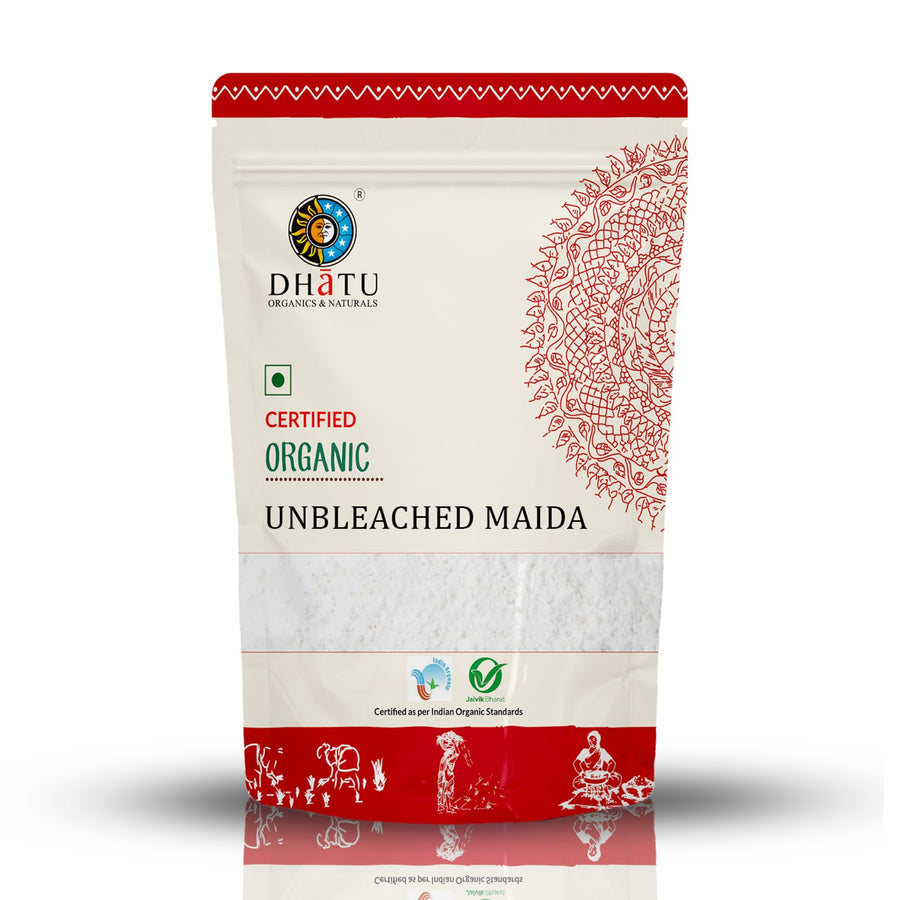
Organic Unbleached Maida Flour, 500g | Chemical-Free
₹ 300.00
Every bag of conventional white maida in India was bleached. Chlorine dioxide, benzoyl peroxide, or both — applied to turn naturally cream-coloured wheat flour an artificial wh... Read more ↓
100% Organic
No Additives
Free Delivery ₹749+
100% Organic Refined Wheat Flour (Triticum aestivum), unbleached. Vegan. Contains gluten. No bleaching agents (no chlorine, no benzoyl peroxide), no preservatives, no additives.
Nutrition FactsServing: 30g (3 tbsp)
| Nutrient | Per serving | Per 100g | % RDA* |
|---|---|---|---|
| Energy | 104 kcal | 346 kcal | 5.2% |
| Protein | 3.3g | 11g | 6.6% |
| Carbohydrates | 22.3g | 74.2g | 6.8% |
| Of which Sugars | 0.3g | 0.9g | <1% |
| Total Fat | 0.5g | 1.6g | <1% |
| Of which Saturated Fat | <0.1g | 0.2g | <1% |
| Dietary Fibre | 0.8g | 2.7g | 3.2% |
| Sodium | 3mg | 10mg | <1% |
| Iron | 0.5mg | 1.5mg | 2.6% |
| Magnesium | 7mg | 22mg | 2% |
* % RDA based on a 2000 kcal reference diet (FSSAI). Values are approximate and may vary by batch.
We deliver across India within 3–5 business days via trusted logistics partners.
- Free delivery on orders above ₹749.
- Orders dispatched within 1 business day of payment confirmation.
- Perishable goods cannot be returned once dispatched. Non-perishable items may be returned within 7 days in original, unopened condition.
- For damaged or incorrect items, contact info@dhatuorganics.com within 48 hours of delivery.
Choose Your Pack
Every bag of conventional white maida in India was bleached. Chlorine dioxide, benzoyl peroxide, or both — applied to turn naturally cream-coloured wheat flour an artificial white. Dhatu's unbleached maida skips every chemical: it is certified organic wheat, refined in the traditional way, aged naturally to cream-white. Same functionality, zero bleaching agents.
What is Unbleached Maida?
Maida is refined wheat flour — the starchy endosperm of wheat, separated from the bran and germ during milling. Conventional maida is then treated with bleaching chemicals (primarily chlorine dioxide or benzoyl peroxide) to achieve an artificially white appearance and to accelerate gluten maturation. These chemicals react with the natural pigments in flour (xanthophylls) and leave residues detectable in finished flour. Dhatu's unbleached maida uses certified organic wheat that is refined without bleaching, allowing natural ageing to develop the flour's gluten structure over time. The result is a cream-coloured, chemica-lly clean all-purpose flour.
Key Features
- Zero bleaching agents — no chlorine dioxide, no benzoyl peroxide, no potassium bromate
- Certified organic wheat — grown without synthetic pesticides or fertilisers
- Natural cream colour — the natural colour of unbleached wheat flour; not artificially whitened
- No preservatives or additives — pure refined wheat flour, nothing added
- Identical functionality — performs exactly like bleached maida in all Indian and baking applications
- Better flavour — many bakers describe unbleached flour as having a more "wheaty," complex flavour base
Bleached vs Unbleached Maida: What's the Difference?
| Parameter | Dhatu Unbleached Maida | Conventional Bleached Maida |
|---|---|---|
| Colour | Cream-white (natural) | Bright white (artificial) |
| Bleaching agents | None | Chlorine dioxide, benzoyl peroxide |
| Potassium bromate | Absent | Historically present (banned India 2016) |
| Taste | Mild wheaty flavour | Neutral / slightly chemical |
| Organic certified | Yes | No |
Potassium bromate classification: IARC Monograph Vol. 73, 1999 (classified as possibly carcinogenic to humans, Group 2B). FSSAI banned potassium bromate in India via Food Safety and Standards (Food Products Standards and Food Additives) Amendment Regulations, 2016.
How to Use Unbleached Maida
- Puri and bhatura — Deep-fries beautifully; natural wheat flavour enhances taste
- Naan and kulcha — Excellent stretch and bubbling on tandoor or tawa
- Cakes and pastries — Use wherever all-purpose flour is called for; identical performance
- Pasta and noodles — Superior to bleached maida for pasta; more natural flavour
- Sourdough starter — Retains more natural microflora from the grain; better starter activity
Frequently Asked Questions
Conventional maida is bleached with chemicals (typically chlorine dioxide, benzoyl peroxide or potassium bromate) to make it artificially white and to accelerate gluten maturation. These agents leave trace residues and alter the flour's natural chemistry. Unbleached maida ages naturally, retains its natural cream colour, and contains no chemical additives. Its gluten structure also behaves more naturally in baking, producing better flavour and texture.
Nutritionally, unbleached and bleached maida have similar macro profiles (both are refined, low-fibre flours). The key advantage of unbleached is the absence of chemical bleaching agents. Potassium bromate in particular has been classified as a possible human carcinogen by the IARC and is banned in the EU, UK, Canada and India (FSSAI 2016). Choosing unbleached maida eliminates this risk entirely.
Yes, 1:1. Unbleached maida behaves identically to bleached maida in all applications — cakes, cookies, pastry, pooris, bhatura, naan, pasta and Indian mithai. The only visible difference is a slightly more cream-coloured product rather than pure white. The flavour is often described as more "wheaty" and complex by bakers who have switched.
Yes. Unbleached flour retains more of the natural microflora present on wheat, which can support sourdough starter activity. Many artisan bakers insist on unbleached flour for sourdough for this reason. Combine with our whole wheat or emmer flour for a more nutritious sourdough loaf with better flavour complexity.