

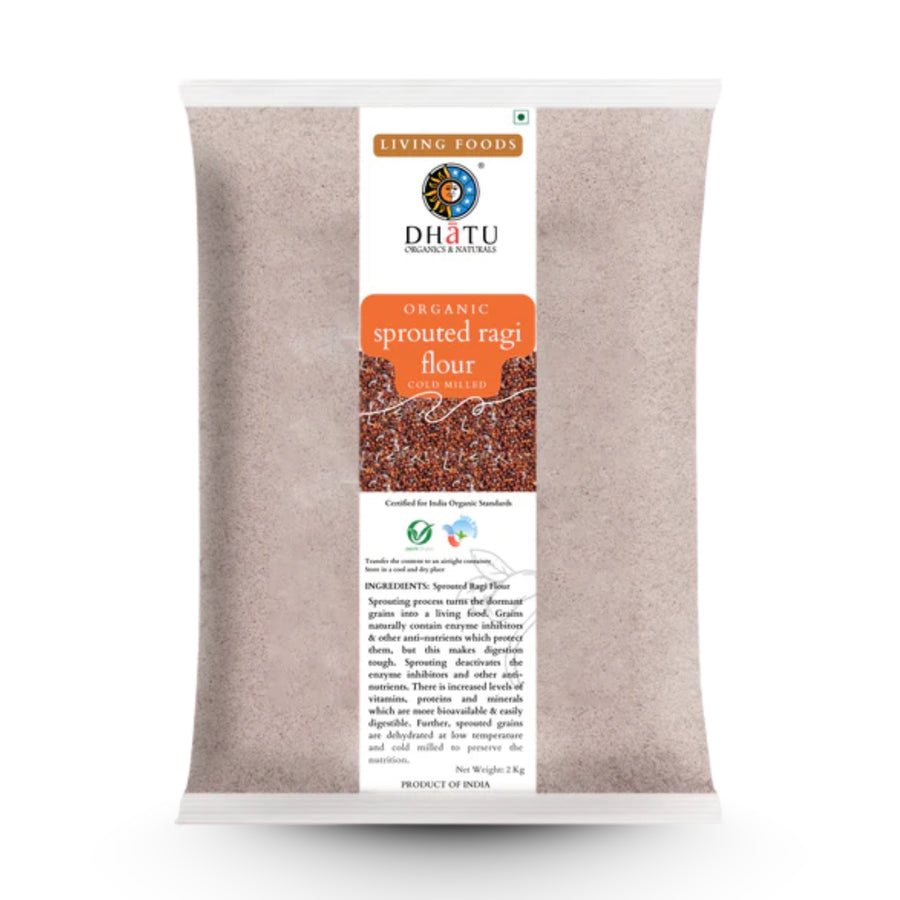
Organic Sprouted Ragi Flour | 1kg & 2kg Packs
₹ 320.00
The same Nachani Satva — more of it, better value. For families who use ragi flour daily for rotis, porridge, baby food, or laddoos, the 1kg and 2kg packs offer significantly ... Read more ↓
100% Organic
No Additives
Free Delivery ₹499+
100% Organic Sprouted Ragi (Finger Millet / Eleusine coracana)
Nutrition FactsServing: 30g
| Nutrient | Per serving | Per 100g | % RDA* |
|---|---|---|---|
| Energy | 101 kcal | 336 kcal | 5% |
| Protein | 2.4 g | 8 g | 4.8% |
| Carbohydrates | 21.6 g | 72 g | 7.2% |
| of which Sugars | 0.6 g | 2 g | 1.2% |
| Dietary Fibre | 3.3 g | 11 g | 13.2% |
| Fat | 0.45 g | 1.5 g | <1% |
| of which Saturated Fat | 0.09 g | 0.3 g | <1% |
| Calcium | 109 mg | 364 mg | 10.9% |
| Iron | 1.2 mg | 3.9 mg | 6.9% |
| Potassium | 122 mg | 408 mg | 3.1% |
| Magnesium | 41.1 mg | 137 mg | 10.3% |
| Phosphorus | 84.9 mg | 283 mg | 8.5% |
| Zinc | 0.69 mg | 2.3 mg | 5.8% |
* % RDA based on a 2000 kcal reference diet (FSSAI). Values are approximate and may vary by batch.
We deliver across India within 3–5 business days via trusted logistics partners.
- Free delivery on orders above ₹499.
- Orders dispatched within 1 business day of payment confirmation.
- Perishable goods cannot be returned once dispatched. Non-perishable items may be returned within 7 days in original, unopened condition.
- For damaged or incorrect items, contact info@dhatuorganics.com within 48 hours of delivery.
Choose Your Pack
The same Nachani Satva — more of it, better value. For families who use ragi flour daily for rotis, porridge, baby food, or laddoos, the 1kg and 2kg packs offer significantly better value without any compromise in quality.
Why Sprouted Ragi?
Ragi (finger millet) has the highest calcium content of any cereal — 364mg per 100g, more than milk. But ragi also contains tannins and phytic acid, antinutrients that bind to calcium and iron and block their absorption. Sprouting reduces these antinutrients by 50–70%, transforming ragi from a food that merely contains calcium into one that actually delivers it. This is why the sprouted form — Nachani Satva — is the traditional preparation used in Indian households for babies, the elderly, and those managing diabetes or osteoporosis.
Why the Bulk Pack?
- Best price per gram — maximum value for daily ragi users
- Family-sized — ideal for households making ragi porridge, rotis, or baby food regularly
- Identical quality — same certified organic, sprouted, cold-milled flour as the 500g
- Reduced packaging waste — one large pack over multiple small ones
How to Use
- Ragi porridge / kanji — mix with water or milk, cook until thick, sweeten with jaggery
- Ragi mudde — traditional Karnataka staple, served with sambar or rasam
- Ragi dosa and uttapam — mix with rice and urad dal batter
- Ragi roti / bhakri — knead with hot water, roll and cook on tawa
- Baby food — thin with milk or water to appropriate consistency
- Ragi laddoo — roast lightly, mix with jaggery, ghee, and cardamom
Frequently Asked Questions
How long does a 2kg pack last?
For a family of four using ragi daily in porridge or rotis, a 2kg pack typically lasts 3–4 weeks. Store in an airtight container away from moisture. Best consumed within 3 months of opening.
Is the quality the same as the 500g?
Yes — identical. Same certified organic ragi, same sprouting process, same cold milling. The only difference is pack size and price per gram.
Can I use ragi flour for everyday cooking replacing wheat?
Yes, especially for rotis and porridges. Ragi dough handles differently from wheat — it does not have gluten so it does not stretch. Knead with hot water for best results. Many South Indian households use ragi as a primary grain and do not miss wheat at all.
Is it safe for babies?
Yes — Nachani Satva is a traditional first food for infants in Maharashtra and Karnataka, used for generations. Suitable from 6 months with appropriate thinning. Consult your paediatrician for quantities.