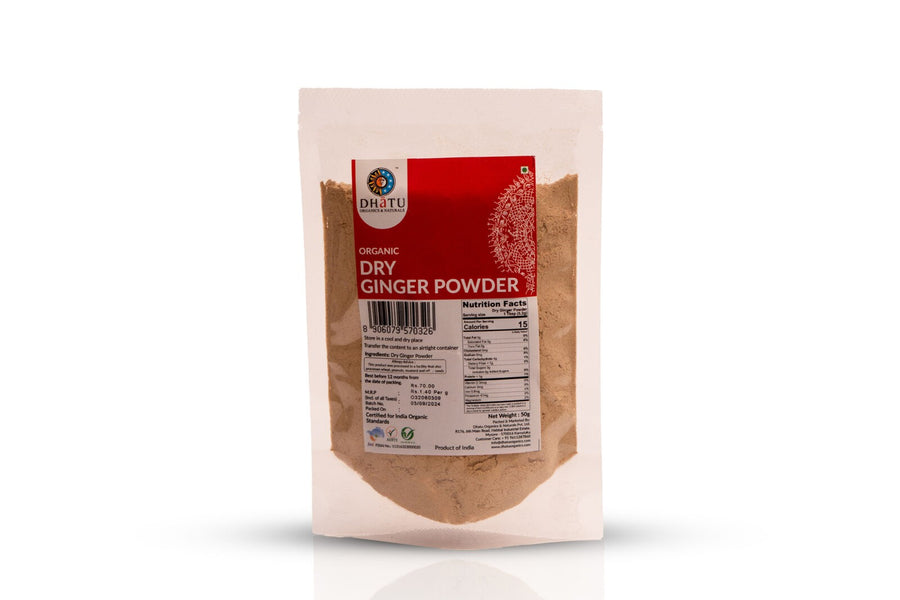
Organic dry Ginger Powder 50g
Dhatu Organics Organic Dry Ginger Powder 50g (Sonth / Saunth) is certified organic Zingiber officinale rhizome, sun-dried and ground to a fine powder. Dry ginger is pharmacol... Read more ↓
Organic Dry Ginger Powder (Zingiber officinale)
| Nutrient | Per serving | Per 100g | % RDA* |
|---|---|---|---|
| Per 100g | Energy 335 kcal | Protein 8.98g | Carbohydrates 71.6g |
| Per 2g serving (1 tsp) | Energy 6.7 kcal | Iron 0.40mg | Magnesium 3.68mg |
* % RDA based on a 2000 kcal reference diet (FSSAI). Values are approximate and may vary by batch.
We deliver across India within 3–5 business days via trusted logistics partners.
- Free delivery on orders above ₹499.
- Orders dispatched within 1 business day of payment confirmation.
- Perishable goods cannot be returned once dispatched. Non-perishable items may be returned within 7 days in original, unopened condition.
- For damaged or incorrect items, contact info@dhatuorganics.com within 48 hours of delivery.
Dhatu Organics Organic Dry Ginger Powder 50g (Sonth / Saunth) is certified organic Zingiber officinale rhizome, sun-dried and ground to a fine powder. Dry ginger is pharmacologically distinct from fresh ginger: drying converts unstable gingerols to shogaols — compounds with significantly greater anti-inflammatory and antioxidant potency. Used in Ayurveda as one of the “three pungents” (Trikatu), dry ginger is a cornerstone of traditional medicine and culinary warming blends across Asia.
Ingredients
Organic Dry Ginger Powder (Zingiber officinale)
Single ingredient · No additives · No preservatives · Certified organic
Nutrition Facts
Per 100g · Per 2g serving (approx. 1 tsp powder)
| Nutrient | Per 100g | Per 2g |
|---|---|---|
| Energy | 335 kcal | 6.7 kcal |
| Protein | 8.98 g | 0.18 g |
| Carbohydrates | 71.6 g | 1.43 g |
| Total Fat | 4.24 g | 0.08 g |
| Dietary Fibre | 14.1 g | 0.28 g |
| Iron | 19.8 mg | 0.40 mg |
| Magnesium | 184 mg | 3.68 mg |
| Potassium | 1320 mg | 26.4 mg |
Values approximate. Source: USDA FoodData Central.
Key Benefits
- Shogaol Anti-inflammatory Activity: [6]-shogaol, the predominant compound in dried ginger, inhibits COX-2 and pro-inflammatory cytokines at concentrations achievable through dietary intake — among the most potent food-derived anti-inflammatory compounds studied.[1]
- Digestive Carminative: Dry ginger stimulates gastric acid secretion, bile flow, and digestive enzyme activity — making it one of the oldest and most widely validated digestive remedies across cultures.[2]
- Nausea Relief: Multiple randomised trials confirm ginger’s antiemetic (anti-nausea) efficacy, particularly for morning sickness, motion sickness, and post-operative nausea, primarily attributed to gingerol/shogaol action on the 5-HT3 receptor.[3]
- Extraordinary Iron: 19.8 mg iron per 100g — one of the highest iron values of any culinary spice; even at 2g serving contributes meaningful iron to the diet.
- Thermogenic Warming: Used in Trikatu (ginger, black pepper, long pepper) for its pungent warming properties in Ayurveda; increases circulation and body warmth.
Research at a Glance
| Benefit | Study Finding | Reference |
|---|---|---|
| Anti-inflammatory | [6]-shogaol inhibits COX-2 and NF-κB; more potent than gingerol | Dugasani et al., 2010[1] |
| Digestive enzyme stimulation | Dry ginger increases pancreatic lipase, amylase, and protease activity | Platel & Srinivasan, 2000[2] |
| Antiemetic (anti-nausea) | Ginger effective for morning sickness and motion sickness vs. placebo (meta-analysis) | Viljoen et al., 2014[3] |
How to Use
- Masala Chai: A pinch of sonth powder in ginger tea makes it richer and more warming than fresh ginger alone — the shogaols provide depth that gingerols alone cannot.
- Garam Masala: Dry ginger is a traditional component in North Indian garam masala — add to your own spice blends.
- Kashaya / Herbal Decoction: Simmer dry ginger with jaggery, pepper, and other warming spices for traditional immune-support decoctions.
- Baking: The classic warming spice in gingerbread, ginger biscuits, and South Asian mithai like ginger barfi.
- Curries and Dals: Add ¼ tsp to dals and curries for a warming base note in place of or alongside fresh ginger.
Frequently Asked Questions
Can I substitute dry ginger powder for fresh ginger?
The two are interchangeable in some recipes but not all. As a rough guide: ¼ tsp dry ginger powder substitutes for 1 tsp fresh grated ginger in cooked dishes. However, dry ginger has earthier, more intense warmth from shogaols, while fresh ginger is brighter and more pungent from gingerols. In chai and cooked curries, either works; for fresh chutneys or salad dressings where raw ginger is needed, fresh ginger is preferred.
What is the difference between ginger powder and sonth?
Sonth (also spelled saunth or shunthi) is simply the Hindi/Sanskrit term for dried ginger root powder. They are the same product. The name is most common in North India and Ayurvedic contexts. Dry ginger powder, sonth, and saunth are all identical in composition.
How do I use dry ginger in Ayurveda?
In Ayurvedic practice, dry ginger (shunthi) is one of the three pungents (Trikatu) along with black pepper and long pepper. It is considered a digestive fire (agni) stimulant and warming herb. Common preparations include mixing ¼ tsp with warm water and honey before meals, or decocting with jaggery and tulsi for respiratory wellness support. Consult a qualified Ayurvedic practitioner for therapeutic protocols.
Is dry ginger safe during pregnancy?
Culinary amounts (up to 1g/day) are generally considered safe during pregnancy and have been used in studies for morning sickness relief. High supplemental doses should be avoided during pregnancy. Always consult your obstetrician before using ginger therapeutically during pregnancy.
Explore More from Dhatu Organics
- Organic Black Pepper Whole 100g — the companion “pungent” to ginger in Trikatu
- Masala Chai — contains dry ginger as a key warming ingredient
- Organic Garam Masala Powder 50g — includes dry ginger in the blend
- All Organic Spices — browse our complete certified organic spice collection
Scientific References
- Dugasani S, et al. Comparative antioxidant and anti-inflammatory effects of [6]-gingerol, [8]-gingerol, [10]-gingerol and [6]-shogaol. J Ethnopharmacol. 2010;127(2):515–20. doi:10.1016/j.jep.2009.10.004
- Platel K, Srinivasan K. Influence of dietary spices and their active principles on pancreatic digestive enzymes in albino rats. Nahrung. 2000;44(1):42–6.
- Viljoen E, et al. A systematic review and meta-analysis of the effect and safety of ginger in the treatment of pregnancy-associated nausea and vomiting. Nutr J. 2014;13:20. doi:10.1186/1475-2891-13-20