

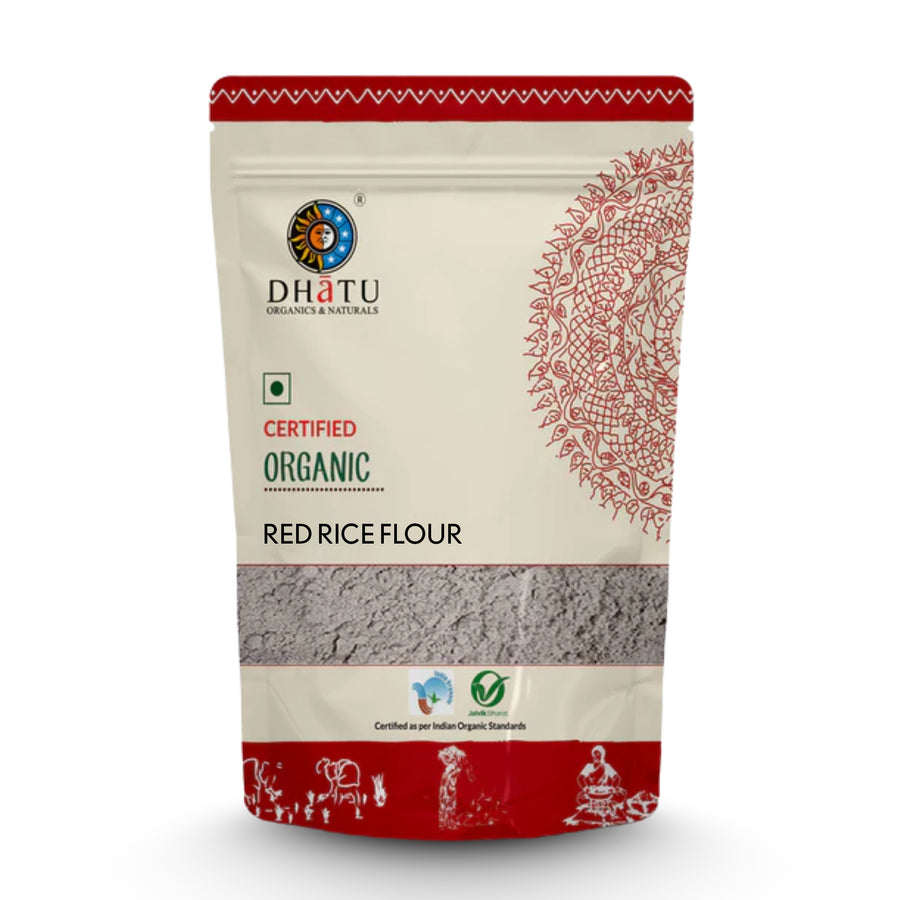
Dhatu Organics Organic Red Rice Flour 500g
₹ 150.00
Red rice gets its deep ruby colour from anthocyanins, natural pigments in its bran. Our red rice flour keeps that bran layer, giving rotis, dosas and puttu a nutty flavour and ... Read more ↓
100% Organic
No Additives
Free Delivery ₹749+
100% Organic Red Rice (Oryza sativa — pigmented variety). Vegan. Naturally gluten-free. No preservatives, no bleaching agents, no additives.
Nutrition FactsServing: 30g (3 tbsp)
| Nutrient | Per serving | Per 100g | % RDA* |
|---|---|---|---|
| Energy | 107 kcal | 356 kcal | 5.3% |
| Protein | 2.3g | 7.5g | 4.5% |
| Carbohydrates | 23g | 76.7g | 7.1% |
| Of which Sugars | 0.2g | 0.5g | <1% |
| Total Fat | 0.8g | 2.8g | 1.2% |
| Of which Saturated Fat | 0.2g | 0.6g | <1% |
| Dietary Fibre | 1.1g | 3.5g | 4.2% |
| Sodium | 3mg | 10mg | <1% |
| Iron | 0.5mg | 1.5mg | 2.6% |
| Magnesium | 43mg | 143mg | 12.6% |
* % RDA based on a 2000 kcal reference diet (FSSAI). Values are approximate and may vary by batch.
We deliver across India within 3–5 business days via trusted logistics partners.
- Free delivery on orders above ₹749.
- Orders dispatched within 1 business day of payment confirmation.
- Perishable goods cannot be returned once dispatched. Non-perishable items may be returned within 7 days in original, unopened condition.
- For damaged or incorrect items, contact info@dhatuorganics.com within 48 hours of delivery.
Choose Your Pack
Red rice gets its deep ruby colour from anthocyanins, natural pigments in its bran. Our red rice flour keeps that bran layer, giving rotis, dosas and puttu a nutty flavour and a lovely colour.
What is Red Rice Flour?
Red rice (Oryza sativa — pigmented variety) is an unpolished whole grain rice with a distinctive reddish-brown bran layer rich in anthocyanins, proanthocyanidins and other polyphenols. Grown in South India (particularly Karnataka and Odisha), red rice has been cultivated for generations as a more nutritious alternative to polished white rice. Our red rice flour is stone cold-milled from certified organic red rice to preserve its bran, germ and full antioxidant profile.
Key Nutritional Benefits
- Anthocyanins: the natural pigments that give red rice its colour
- 6x more fibre than white rice flour — 3.5g vs 0.4g per 100g from the intact bran layer
- 27% more protein than white rice flour — 7.5g vs 5.9g per 100g
- 6x more magnesium than white rice flour — 143mg vs 23mg per 100g
- Naturally gluten-free: rice contains no gluten
- Lower GI than white rice flour — intact bran slows starch digestion
Red Rice vs White Rice vs Brown Rice Flour (per 100g)
| Nutrient | Red Rice Flour | Brown Rice Flour | White Rice Flour |
|---|---|---|---|
| Protein (g) | 7.5 | 7.2 | 5.9 |
| Dietary Fibre (g) | 3.5 | 3.5 | 0.4 |
| Magnesium (mg) | 143 | 143 | 23 |
| Anthocyanins | High (pigmented bran) | None | None |
| Iron (mg) | 1.5 | 1.5 | 0.7 |
Nutrient data: ICMR-NIN 2017; USDA FoodData Central. Anthocyanin presence in red rice bran: Hou et al., Journal of Agricultural and Food Chemistry 2013.
How to Use Red Rice Flour
- Akki rotti — Traditional Karnataka rice roti; red rice version has distinctive colour and nutty flavour
- Red rice dosa — Blend with urad dal; ferment overnight for nutritious, colourful dosas
- Red rice porridge — Cook with milk and jaggery; natural pink hue is visually appealing for children
- Gluten-free baking — Use in cookies, pancakes and muffins for added nutrition and colour
- Thickener — Use in red gravies and curries; adds colour and body
Frequently Asked Questions
Red rice gets its colour from anthocyanins, natural flavonoid pigments in the bran layer (the same family of pigments found in pomegranates and purple cabbage). Red rice flour keeps the bran, unlike white rice flour.
Red rice flour keeps the bran layer, so it has more fibre (about 3.5g vs 0.4g per 100g), protein (7.5g vs 5.9g) and magnesium (143mg vs 23mg) than white rice flour, plus the natural red pigment.
Red rice has a nuttier, earthier and slightly more robust flavour than white rice. When milled into flour, this translates to a more complex taste in dosas, rotis and baked goods. The deep reddish-pink colour also makes dishes visually distinctive. Many people find the flavour superior to white rice flour for traditional preparations like akki rotti (Karnataka rice roti).
Yes, 1:1. Red rice flour absorbs slightly more water due to its higher fibre content, so add liquid gradually. The resulting dishes will have a darker hue and earthier flavour. For dosas, the batter may need slightly longer fermentation. Red rice flour works particularly well in pancakes, porridge, roti and as a thickener in gravies.