

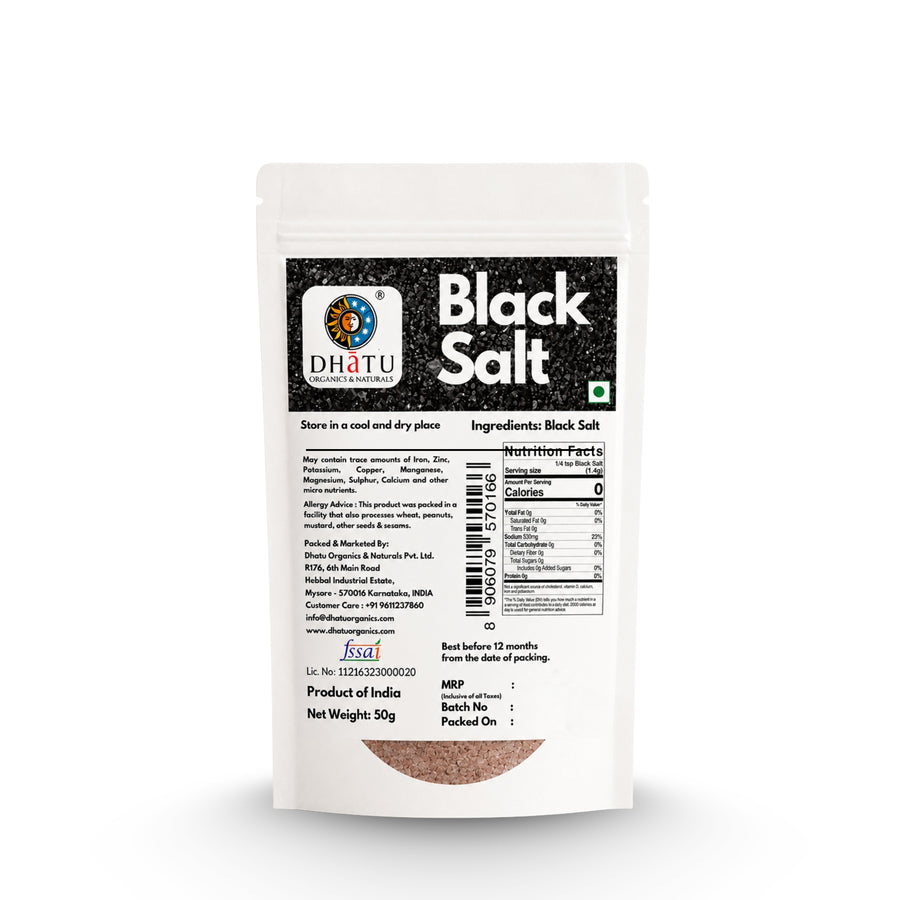
Black Salt (Kala Namak) 50g | Authentic Indian Kala Namak | Chaat & Vegan Cooking
₹ 40.00
Black Salt — Kala Namak 50g — an authentic Indian volcanic mineral salt with a deeply distinctive sulphurous, egg-like aroma that is irreplaceable in Indian street food and chaa... Read more ↓
100% Organic
No Additives
Free Delivery ₹499+
Black salt — Kala Namak (sodium chloride, sodium sulfate, sodium bisulfate, sodium sulfide, ferrous sulfide). Naturally occurring mineral rock salt, traditionally kiln-processed. No additives, no anti-caking agents.
Nutrition Facts
| Nutrient | Per serving | Per 100g | % RDA* |
|---|---|---|---|
| Energy | 0 kcal | 0 kcal | 0% |
| Protein | 0 g | 0 g | 0% |
| Total Fat | 0 g | 0 g | 0% |
| of which Saturated Fat | 0 g | 0 g | 0% |
| Total Carbohydrates | 0 g | 0 g | 0% |
| of which Sugars | 0 g | 0 g | 0% |
| Dietary Fibre | 0 g | 0 g | 0% |
| Sodium | 36,000 mg | 540 mg | 27% |
| Iron | 0.5 mg | 0.007 mg | <1% |
* % RDA based on a 2000 kcal reference diet (FSSAI). Values are approximate and may vary by batch.
We deliver across India within 3–5 business days via trusted logistics partners.
- Free delivery on orders above ₹499.
- Orders dispatched within 1 business day of payment confirmation.
- Perishable goods cannot be returned once dispatched. Non-perishable items may be returned within 7 days in original, unopened condition.
- For damaged or incorrect items, contact info@dhatuorganics.com within 48 hours of delivery.
Choose Your Pack
Black Salt — Kala Namak 50g — an authentic Indian volcanic mineral salt with a deeply distinctive sulphurous, egg-like aroma that is irreplaceable in Indian street food and chaat cuisine. Sourced from Himalayan mineral deposits and traditionally kiln-processed, our kala namak retains its characteristic pinkish-grey colour and signature flavour — the defining ingredient in chaat masala, pani puri water, jaljeera, and raita across India.
What Makes Kala Namak Special
- Unique sulphurous flavour profile — Iron sulfide and sodium sulfate compounds give kala namak an aroma no other salt can replicate; essential for authentic chaat, pani puri, and street food flavour
- Used in Ayurveda for digestion — Kala namak is classified in Ayurveda as a digestive aid and carminative (gas-relieving agent), traditionally used to relieve bloating, flatulence, and acidity
- Vegan egg substitute — Its sulphurous, egg-like taste makes it the go-to ingredient in vegan scrambled tofu, chickpea omelettes, and vegan egg salads globally
- No additives or anti-caking agents — Pure mineral salt, nothing synthetic added
- Lower sodium than table salt — Slightly lower sodium concentration due to the presence of sulphur-based mineral salts alongside NaCl
- Enhances cooling drinks — A pinch in chaas, jaljeera, nimbu pani, or watermelon juice adds the classic Indian summer drink character
How to Use Kala Namak
- Chaat and street food — Essential in chaat masala, pani puri water (golgappa jal), bhel puri, aloo chaat, and papdi chaat
- Raita and curd dishes — A pinch transforms plain curd, boondi raita, or cucumber raita
- Summer drinks — Add to jaljeera, nimbu pani, shikanji, aam panna, and lassi for authentic Indian flavour
- Fruit chaat — Sprinkle over cut mango, watermelon, papaya, or mixed fruit chaat with chilli and lemon
- Vegan cooking — Add 1/4 tsp to scrambled tofu, chickpea omelettes, or vegan egg mayo for a convincing egg-like flavour
- Digestive remedy — 1/4 tsp kala namak in warm water with ginger juice and lime — a traditional Ayurvedic digestive tonic after heavy meals
What is kala namak (black salt) made of?
Kala namak is a mineral rock salt from the Himalayan region, traditionally processed by heating in a kiln with charcoal and harad seeds (Terminalia chebula). The high-temperature kiln process converts some sodium chloride to sodium sulfide, hydrogen sulfide, and ferrous compounds — these give black salt its dark colour in crystalline form and pinkish-grey colour when finely ground. The key minerals are sodium chloride (~80–85%), sodium sulfate, sodium bisulfate, sodium sulfide, and iron compounds. The characteristic sulphurous aroma comes primarily from hydrogen sulfide released when the salt contacts moisture or food.
Is kala namak good for digestion?
Kala namak has a well-documented history in Ayurveda as a digestive and carminative agent. The sulphur compounds and sodium sulfate it contains are believed to stimulate bile flow, activate digestive enzymes, and reduce gas formation in the gut. A traditional Ayurvedic preparation is kala namak dissolved in warm water with fresh ginger juice and lime — taken 15–20 minutes after a heavy meal to prevent bloating. While modern clinical research specifically on kala namak is limited, its traditional use across thousands of years in Indian medicine is consistent with its mineral composition.
Can I cook with kala namak or only use it as a finishing salt?
Both. Kala namak can be used in cooking, though much of its sulphurous aroma volatilises with heat. For maximum flavour impact in chaat, raita, and drinks, add it at the end or after cooking. In dishes like curries or dals where the flavour cooks through, a small quantity (1/4 tsp per serving) adds a distinctive depth. It should be used in much smaller quantities than regular salt — a little goes a very long way.
Is black salt the same as activated charcoal black salt?
No — they are very different products. Kala namak is a naturally occurring mineral salt with sulphur compounds that give it a dark crystalline colour and an unmistakeable egg-like aroma. Activated charcoal salt is ordinary white salt mixed with food-grade charcoal powder — it is purely black in colour, has no sulphurous flavour, and is used mainly for visual effect. Kala namak is a distinct geological and culinary product with a centuries-long history in Indian cuisine and Ayurveda, unrelated to activated charcoal.
Is kala namak safe for everyday use?
Yes, in typical culinary quantities. Its sodium content is slightly lower than table salt and its sulphur compounds are present in trace amounts that are safe for regular consumption. As with all salts, the WHO recommendation of less than 5g total salt per day applies. Kala namak is typically used in very small pinches (1/4 to 1/2 tsp at most per dish), so daily exposure to its sulphur compounds is minimal. People with specific sulphur sensitivities should consult a physician.