

 28% OFF
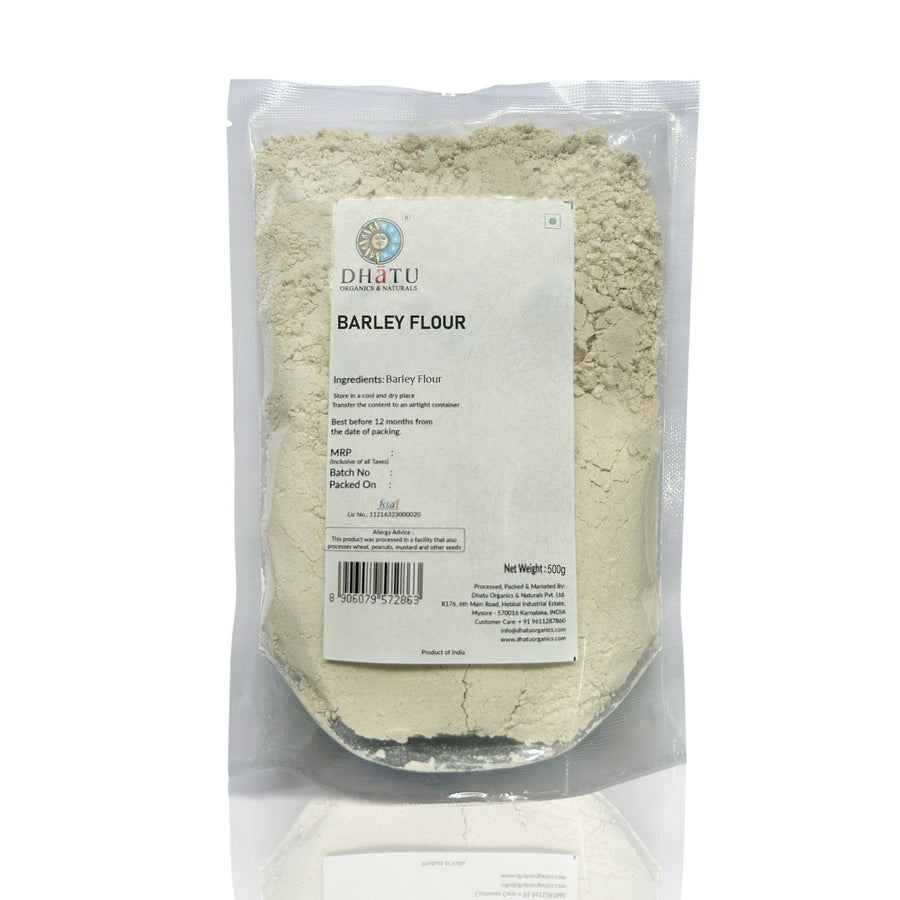
Barley Flour 500g – Natural, Stone-Ground
₹ 140.00
₹ 195.00
Barley flour contains approximately 7g of beta-glucan per 100g — a soluble dietary fibre found in high concentration in barley. The European Food Safety Authority and food scie... Read more ↓
100% Organic
No Additives
Free Delivery ₹749+
100% Organic Barley (Jau / Yava). Vegan. Contains gluten. No preservatives, no additives, no artificial flavours or colours.
Nutrition FactsServing: 30g (3 tbsp)
| Nutrient | Per serving | Per 100g | % RDA* |
|---|---|---|---|
| Energy | 106 kcal | 354 kcal | 5.3% |
| Protein | 3.8g | 12.5g | 7.5% |
| Carbohydrates | 22g | 73.4g | 6.8% |
| Of which Sugars | 0.3g | 1g | <1% |
| Total Fat | 0.5g | 1.8g | <1% |
| Of which Saturated Fat | <0.1g | 0.4g | <1% |
| Dietary Fibre | 5.2g | 17.3g | 20.8% |
| Of which Beta-Glucan | ~2.1g | ~7g | - |
| Sodium | 5mg | 18mg | <1% |
| Iron | 1.5mg | 5mg | 8.8% |
| Magnesium | 40mg | 133mg | 11.8% |
| Niacin (B3) | 1.4mg | 4.6mg | 8.6% |
* % RDA based on a 2000 kcal reference diet (FSSAI). Values are approximate and may vary by batch.
We deliver across India within 3–5 business days via trusted logistics partners.
- Free delivery on orders above ₹749.
- Orders dispatched within 1 business day of payment confirmation.
- Perishable goods cannot be returned once dispatched. Non-perishable items may be returned within 7 days in original, unopened condition.
- For damaged or incorrect items, contact info@dhatuorganics.com within 48 hours of delivery.
Choose Your Pack
Barley flour contains approximately 7g of beta-glucan per 100g — a soluble dietary fibre found in high concentration in barley. The European Food Safety Authority and food science authorities both approve the claim that 3g beta-glucan per day "contributes to maintenance of normal blood dietary fibre content levels." A 90g serving of barley flour delivers this target dose.
What is Barley Flour (Jau Atta)?
Barley (Hordeum vulgare), called jau or jav in Hindi and yava in Sanskrit, is one of humanity's oldest cultivated grains. In India, it is used for traditional preparations including sattu (when roasted), Tibetan tsampa porridge, and jau ki roti. Modern nutrition science has identified barley's beta-glucan as one of the most potent dietary fibre-rich agents available from food sources. Our barley flour is stone cold-milled from certified organic barley to preserve its extraordinary fibre content.
Key Nutritional Benefits
- Exceptional dietary fibre — 17.3g per 100g, one of the highest among common grain flours (5.2g per 30g serving, 20.8% RDA)
- Beta-glucan — approximately 7g per 100g; traditionally used to reduce LDL dietary fibre content
- Good protein — 12.5g per 100g
- Iron — 5mg per 100g (8.8% RDA per 30g serving)
- Niacin (B3) — 4.6mg per 100g (8.6% RDA per 30g) for energy metabolism
Barley vs Other Flours: Dietary Fibre (per 100g)
| Flour | Total Fibre (g) | Beta-Glucan (g) | GI |
|---|---|---|---|
| Dhatu Organic Barley Flour | 17.3 | ~7 | 28–40 |
| Oats Flour | 10.6 | ~5 | 55–65 |
| Whole Wheat Atta | 11.5 | 0 | 69–71 |
| Ragi Flour | 11.5 | 0 | 68–83 |
| White Rice Flour | 0.4 | 0 | 72–85 |
Beta-glucan data: Lazaridou & Biliaderis, Journal of Cereal Science 2007. Fibre: ICMR-NIN 2017.
How to Use Barley Flour
- Jau ki roti — Blend 50% barley + 50% whole wheat atta; cook on medium tawa
- Soup thickener — Add 1–2 tbsp barley flour to vegetable or lentil soups; simmer 10 minutes
- Multigrain atta blend — Replace 20–30% of regular atta with barley flour for added fibre in everyday rotis
- Porridge — Cook barley flour with milk and jaggery for a thick, nutritious breakfast porridge
- Baking — Add to muffins, cookies and bread for fibre enrichment (up to 25% of total flour)
Frequently Asked Questions
Beta-glucan is a soluble dietary fibre found in barley and oats. Barley contains about 7g of beta-glucan per 100g, which is one reason barley flour feels so filling.
Yes. Barley contains gluten (hordein), so it is not suitable for people with coeliac disease or anyone avoiding gluten.
Barley flour (jau atta) can replace 20–30% of wheat atta in rotis for added fibre without drastically changing texture. It is traditionally used in North Indian jau ki roti. It can also be stirred into soups and stews as a thickener (contains natural starches), added to smoothies for a fibre boost, or used in muffin and pancake recipes blended with other flours.