

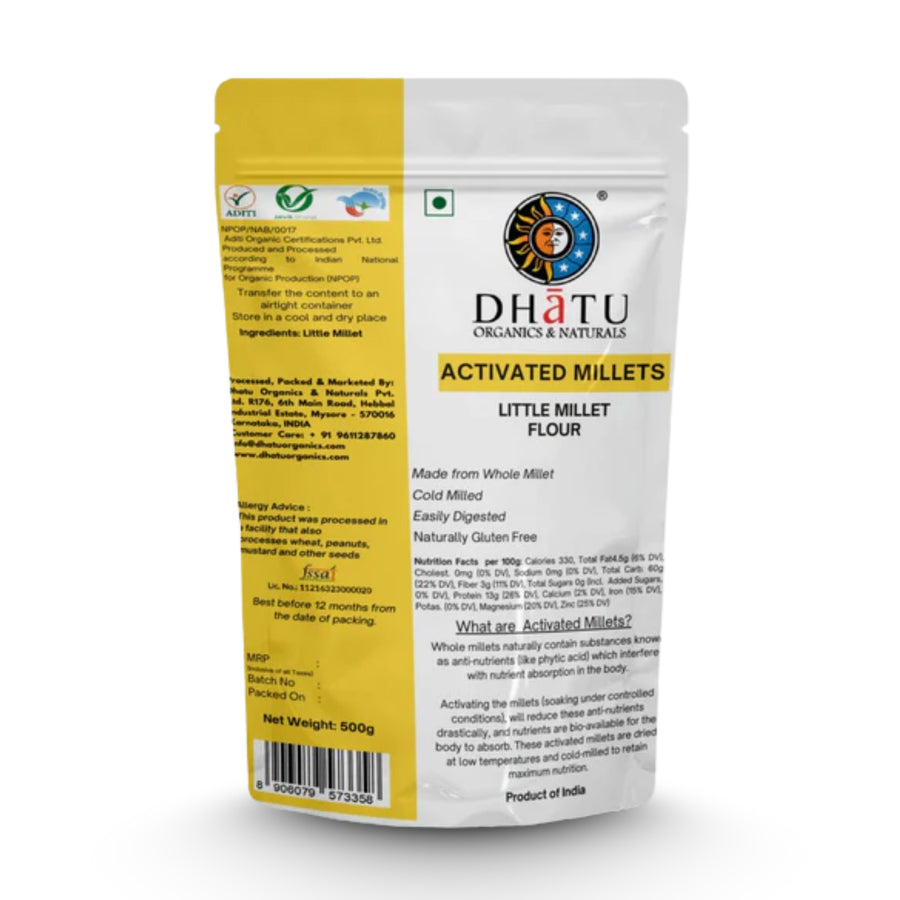
Activated Little Millet Flour 500g
₹ 220.00
Dhatu Organics Activated Little Millet Flour is made from little millet (Panicum sumatrense), known as saame in Kannada, samai in Tamil, kutki in Hindi and chama in Malayalam. T... Read more ↓
100% Organic
No Additives
Free Delivery ₹749+
100% Organic Activated Little Millet (Samai / Same / Kutki / Saamai / Chama). Vegan. Naturally gluten-free. No preservatives, no additives, no artificial flavours or colours.
Nutrition FactsServing: 30g (3 tbsp)
| Nutrient | Per serving | Per 100g | % RDA* |
|---|---|---|---|
| Energy | 99 kcal | 329 kcal | 4.9% |
| Protein | 2.9g | 9.7g | 5.8% |
| Carbohydrates | 19.7g | 65.6g | 6.6% |
| Of which Sugars | 0.24g | 0.8g | 0.5% |
| Total Fat | 1.4g | 4.7g | 2.2% |
| Of which Saturated Fat | 0.27g | 0.9g | <1% |
| Dietary Fibre | 2.3g | 7.6g | 9.1% |
| Sodium | 1.5mg | 5mg | <1% |
| Iron | 2.8mg | 9.3mg | 16.4% |
| Calcium | 5.1mg | 17mg | <1% |
| Magnesium | 27.6mg | 92mg | 6.9% |
| Zinc | 0.63mg | 2.1mg | 5.3% |
* % RDA based on a 2000 kcal reference diet (FSSAI). Values are approximate and may vary by batch.
We deliver across India within 3–5 business days via trusted logistics partners.
- Free delivery on orders above ₹749.
- Orders dispatched within 1 business day of payment confirmation.
- Perishable goods cannot be returned once dispatched. Non-perishable items may be returned within 7 days in original, unopened condition.
- For damaged or incorrect items, contact info@dhatuorganics.com within 48 hours of delivery.
Choose Your Pack
Dhatu Organics Activated Little Millet Flour is made from little millet (Panicum sumatrense), known as saame in Kannada, samai in Tamil, kutki in Hindi and chama in Malayalam. The grain is soaked overnight ("activated"), dried and stone cold-milled into a light, mild flour. Soaking is a traditional step that reduces phytic acid.
Why this flour?
- Light and mild: the easiest millet flour to start with.
- Naturally gluten-free.
- Contains iron and fibre (about 9.3mg iron per 100g).
How to use
- Rotis: use alone with hot water, or mix 60:40 with wheat flour for softer rotis.
- Dosa: mix with rice flour and urad dal batter.
- Porridge and upma: cooks quickly into a smooth porridge.
- Laddoos and pancakes: roast lightly and mix with jaggery and nuts.
If you plan to give millet porridge to a baby, please ask your paediatrician when and how to introduce it.
Storage
Keep airtight in a cool, dry place and refrigerate in hot, humid weather.
More in our activated millet flours.
Frequently Asked Questions
Activated little millet flour (Samai / Same / Kutki) is produced by soaking organic little millet grains overnight to trigger bioactivation — a natural process that deactivates phytic acid and activates digestive enzymes. The grain is then sun-dried and stone cold-milled into a fine, light flour. Little millet is known for its delicate flavour and high iron content (9.3mg per 100g).
Little millet is rich in iron, dietary fibre, magnesium, and B vitamins. The activated version removes phytic acid so these minerals are fully absorbed. Regular consumption supports energy levels, healthy haemoglobin, gut health, and blood sugar regulation. Its low glycaemic index makes it particularly beneficial for people with diabetes or insulin resistance.
Little millet (Samai) is one of the smallest and most delicate millets. Compared to foxtail millet, it has a softer texture and slightly lighter flavour, making it very versatile in the kitchen. It has a lower calorie content (329 kcal per 100g) than foxtail (351 kcal) and is particularly valued for its high iron content and digestibility.
Yes, activated little millet flour is one of the best flours for introducing to babies from 6 months onwards. The activation process makes it highly digestible and improves iron absorption — critical for infant brain development. It can be made into a smooth porridge with breast milk, formula, or water. Always consult your paediatrician before introducing any new food.
Little millet flour can be used for rotis, idlis, dosas, porridge, pancakes, muffins, and cookies. Its light texture makes it one of the easiest millet flours to work with. For soft rotis, mix with a little wheat flour or ragi flour. For baby food, simply boil with water, add salt or jaggery, and a drop of ghee.
Yes. Little millet is naturally 100% gluten-free. Dhatu Organics processes it in a dedicated facility free from wheat, barley, and rye. It is safe for coeliac disease, wheat allergies, and anyone on a gluten-free diet.