

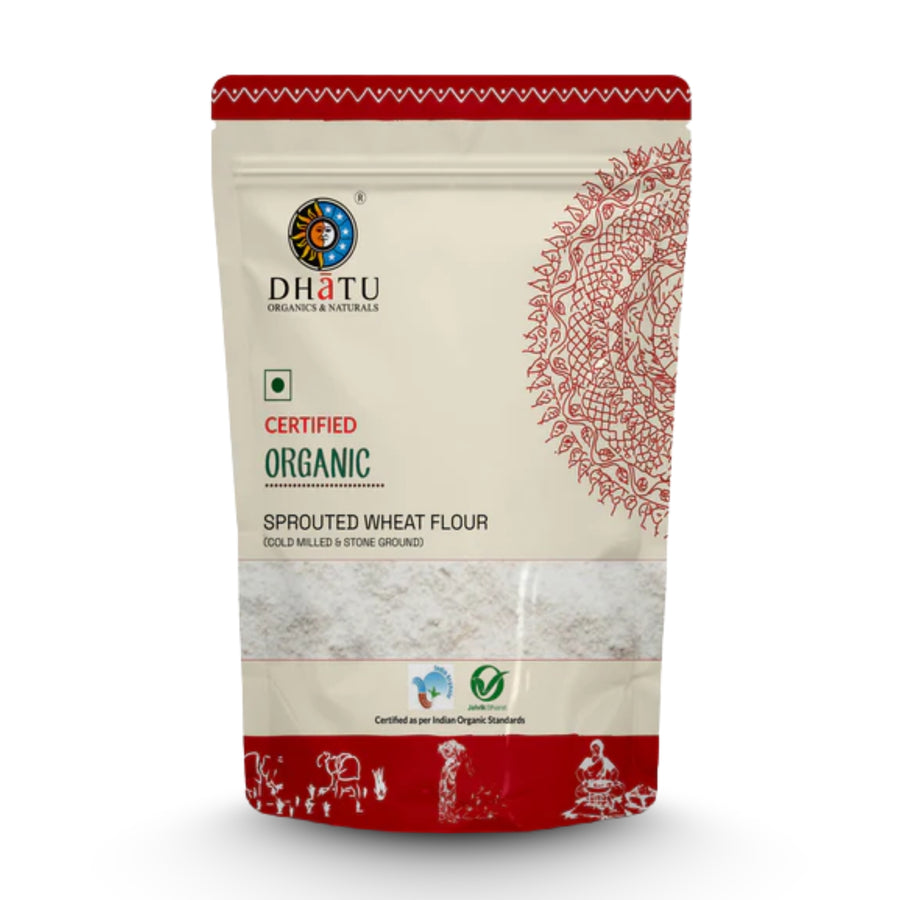
Organic Sprouted Wheat Flour 500g | Improved Digestion
₹ 160.00
Wheat doesn't have to be the enemy of digestion. Sprouting changes the gluten structure, breaks down phytic acid, and pre-digests starch — making this whole wheat flour dramat... Read more ↓
100% Organic
No Additives
Free Delivery ₹499+
100% Organic Sprouted Whole Wheat (Triticum aestivum) — Stone Ground
Nutrition FactsServing: 30g
| Nutrient | Per serving | Per 100g | % RDA* |
|---|---|---|---|
| Energy | 99 kcal | 330 kcal | 5% |
| Protein | 4.2 g | 14 g | 8.4% |
| Carbohydrates | 20.4 g | 68 g | 6.8% |
| of which Sugars | 0.9 g | 3 g | 1.8% |
| Dietary Fibre | 3.3 g | 11 g | 13.2% |
| Fat | 0.75 g | 2.5 g | 1.2% |
| of which Saturated Fat | 0.12 g | 0.4 g | <1% |
| Iron | 1.2 mg | 4 mg | 7.1% |
| Calcium | 10.2 mg | 34 mg | 1% |
| Potassium | 120 mg | 400 mg | 3% |
| Magnesium | 41.4 mg | 138 mg | 10.4% |
| Zinc | 0.9 mg | 3 mg | 7.5% |
| Folate (B9) | 11.4 mcg | 38 mcg | 5.7% |
| Vitamin B1 (Thiamine) | 0.15 mg | 0.5 mg | 10.7% |
| Phosphorus | 107 mg | 357 mg | 10.7% |
* % RDA based on a 2000 kcal reference diet (FSSAI). Values are approximate and may vary by batch.
We deliver across India within 3–5 business days via trusted logistics partners.
- Free delivery on orders above ₹499.
- Orders dispatched within 1 business day of payment confirmation.
- Perishable goods cannot be returned once dispatched. Non-perishable items may be returned within 7 days in original, unopened condition.
- For damaged or incorrect items, contact info@dhatuorganics.com within 48 hours of delivery.
Choose Your Pack
Wheat doesn't have to be the enemy of digestion. Sprouting changes the gluten structure, breaks down phytic acid, and pre-digests starch — making this whole wheat flour dramatically easier on the gut than conventional atta.
What Sprouting Does to Wheat
When wheat germinates, three important things happen. First, phytic acid — which blocks the absorption of iron, zinc, and magnesium — is broken down by up to 40%. Second, amylase enzymes begin pre-digesting starches, reducing the glycaemic load. Third, and most significantly, gluten proteins (specifically gliadin) are partially broken down into smaller peptides by the sprouting process — the structure that most people find difficult to digest is simplified, making sprouted wheat far gentler on the digestive system than conventional flour. This does not make it gluten-free, but it makes it meaningfully easier to digest for non-coeliac gluten-sensitive individuals.
Key Benefits
- Modified gluten structure — easier to digest than conventional whole wheat for most people
- 14g protein per 100g — higher than most commercial attas
- 11g dietary fibre — complete whole grain, nothing removed
- Reduced phytic acid — better absorption of iron (4mg), zinc (3mg), and magnesium (138mg)
- Lower effective glycaemic load — starch pre-digestion by enzymes slows glucose release
- Certified organic — no synthetic pesticides, herbicides, or chemical fertilisers
- 100% whole grain — bran, germ, and endosperm all intact
How to Use
- Use as a direct 1:1 replacement for regular atta in rotis and phulkas
- Use in parathas, naan, and stuffed breads
- Blend with other flours for bread, muffins, and pancakes
- Use in pasta dough for a whole wheat pasta
- Make seviyan, puri, and traditional Indian breads
Frequently Asked Questions
Is sprouted wheat flour gluten-free?
No. Sprouting modifies the gluten structure and makes wheat easier to digest for many people, but it does not eliminate gluten. People with coeliac disease must avoid this product. For gluten-sensitive individuals (non-coeliac), sprouted wheat is often much better tolerated than conventional wheat — but individual responses vary.
Does it make softer rotis than regular atta?
Many people find that sprouted wheat rotis are softer and stay softer for longer. The modified starch structure (partially pre-digested by enzymes) holds moisture differently from conventional flour. Knead with slightly more water than usual and allow to rest for 20 minutes before rolling.
Is it whole grain?
Yes — 100% whole grain. The bran, germ, and endosperm are all retained. Nothing is removed or refined. The fibre content (11g per 100g) confirms this.
Why does it taste different from regular atta?
Sprouted wheat flour has a slightly sweeter, nuttier flavour compared to conventional atta. This comes from the enzyme activity during sprouting that converts some starch into natural sugars and develops more complex flavour compounds. Most people find it more flavourful, not less.
Does it have a shorter shelf life?
Sprouted flour can be more prone to oxidation than conventional flour due to the activated germ and higher fat content. Store in an airtight container in a cool, dry place and use within 3 months of opening. Refrigeration extends freshness during hot months.
Phytic Acid Reduction: How Processing Methods Compare
Not all methods of preparing grain are equally effective at reducing phytic acid. The chart below compares how much phytic acid each method removes, based on peer-reviewed research. Ranges reflect variation across grain types, duration, and study conditions.
0%
25%
50%
75%
100%
🔥 Roasting (dry heat)
0 – 10%
Heat deactivates phytase before it can act. Phytic acid itself is thermostable — near-zero reduction.
💧 Soaking / Activation
10 – 30%
Leaches some phytate into soak water. Does not trigger the enzyme cascade that germination activates. More effective in legumes than cereals.
🌿 Sprouting / Germination ► this product
20 – 60%
▮ Solid gold band = wheat-specific range (30–50%). ▮ Black marker = 40%, the figure cited above. ▮ Faint band = full cereal range (20–60%).
🦠 Fermentation (sourdough / lacto)
50 – 90%
Most effective method. Lactic acid bacteria lower pH, maximising phytase activity and producing organic acids that further chelate phytate. Sourdough wheat can lose 60–90%.
Additional Notes on Range & Context
- Why a range, not a single number: Phytic acid reduction in wheat depends on sprouting duration (3–7 days), temperature, moisture, and variety. Shorter sprouts (2–3 days) yield 20–35%; well-developed sprouts (5–7 days) can reach 50–60%.
- Is 40% accurate? Yes — it sits in the middle of the wheat-specific literature range (30–50%) and reflects median findings across wheat germination studies. It is neither a floor nor an inflated ceiling.
- Roasting does not reduce phytate: Phytase is denatured at temperatures above ~70°C before it can act on its substrate. Phytic acid itself survives roasting temperatures intact.
- Fermentation outperforms sprouting because lactic acid bacteria both activate phytase and lower dough pH, creating ideal conditions for phytate breakdown. Sourdough achieves 60–90% reduction.
- The practical ceiling: Complete elimination of phytic acid through food processing alone is not achievable. A 30–50% reduction via sprouting meaningfully improves mineral bioavailability without supplementation.
Scientific References
- Liang, J., Han, B.Z., Nout, M.J.R. & Hamer, R.J. (2008). Effects of soaking, germination and fermentation on phytic acid, total and in vitro soluble zinc in brown rice. Food Chemistry, 110(4), 821–828. doi:10.1016/j.foodchem.2008.02.069
- Greiner, R. & Konietzny, U. (2006). Phytase for food application. Food Technology and Biotechnology, 44(2), 125–140. hrcak.srce.hr/7175
- Kumar, V., Sinha, A.K., Makkar, H.P.S. & Becker, K. (2010). Dietary roles of phytate and phytase in human nutrition: A review. Food Chemistry, 120(4), 945–959. doi:10.1016/j.foodchem.2009.11.052
- Hurrell, R.F., Juillerat, M.A., Reddy, M.B., Lynch, S.R., Dassenko, S.A. & Cook, J.D. (1992). Soy protein, phytate, and iron absorption in humans. American Journal of Clinical Nutrition, 56(3), 573–578. doi:10.1093/ajcn/56.3.573
- Frontela, C., Ros, G. & Martínez, C. (2011). Phytic acid content and "in vitro" iron, calcium and zinc bioavailability in flours and biscuits. Journal of Cereal Science, 54(1), 122–128. doi:10.1016/j.jcs.2011.04.007
- Lopez, H.W., Leenhardt, F., Coudray, C. & Remesy, C. (2002). Minerals and phytic acid interactions: Is it a real problem for human nutrition? International Journal of Food Science & Technology, 37(7), 727–739. doi:10.1046/j.1365-2621.2002.00557.x
- Katina, K., Laitila, A., Juvonen, R., Liukkonen, K.H., Kariluoto, S., Piironen, V. & Poutanen, K. (2007). Bran fermentation as a means to enhance technological performance and bioactive compounds of rye. Food Microbiology, 24(2), 175–188. doi:10.1016/j.fm.2006.04.009